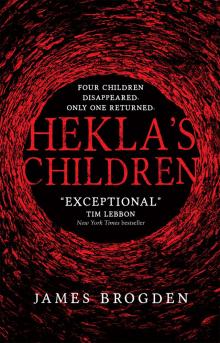
Heklas children, p.1
Hekla's Children, page 1


Contents
Cover
Praise
Also available from James Brogden and Titan Books
Title Page
Copyright
Dedication
Epigraph
Prologue
1. Before
2. Rowton Man
3. Call Me Tinkerbell
4. The Cosmic Wind-Up
5. The Flood
6. Sue
7. Dissections
8. Intrusions
9. Abduction
10. Bedside Manner
11. Coffee and Confessions
12. Liv in Un
13. Home Visit
14. Scraps
15. Different Cells
16. The Thrice-Dead King
17. Moonbridge
18. The Sweat
19. New Flames For Old
20. Heartlands
21. Awake
22. Bran in Un
23. The Oendir
24. Sir Boss
25. Pathless
26. Kinless
27. Shal
28. The Far Pastures
29. Scattie in Un
30. The White Wall
31. Tuonen the Boatman
32. Hywelan’s Forge
33. The Afaugh in Un
34. The Erinyes
35. Black Country Boy
36. Sympathetic Magic
37. The Lost Country
38. The Sea Henge
Epilogue
Acknowledgements
About the Author
‘Hekla’s Children is a brilliant novel full of great twists, beautifully drawn characters, exceptional writing, and some really startling ideas. It will leave you questioning the truths of myth and history, and that fine knife-edge between personal perception and reality.’
Tim Lebbon, New York Times bestselling author
‘Hekla’s Children marks the emergence on to a vibrant horror scene of an exciting new talent. James Brogden offers us a compulsive and unpredictable page-turner in which the ancient and modern world clash with devastating effect. Engaging characters, mind-bending concepts and enthralling set pieces propel the reader through a story in which the stakes are high and nothing can be taken for granted. Terrific stuff!’
Mark Morris, British Fantasy Award winner
‘Brogdan’s words have a way of getting under your skin. From the brilliantly creepy first line to the haunting last Hekla’s Children had me in its thrall. There’s some dark, sinister magic going on in these pages. Brogdan’s strength is that he knows there is beauty in that darkness, and that makes him one of the most compelling new voices out there.’
Steven Savile, bestselling author of Silver
‘Hekla’s Children is at once a very modern dark fantasy, which also harks back to the classics of the genre. Like an irresistible mix of Masterton, Simmons and Gaiman, this novel marks Brogden out as a new rising star. This one’s definitely a winner!’
Paul Kane, bestselling author of Hooded Man
‘Places James Brogden in the company of Neil Gaiman, Tim Lebbon and Joe Hill… for me there was also a strong and pleasing likeness to the magical dream-states of Robert Holdstock. Brogden has a penchant for the darker side of ancient myth and his knowledge of folklore woven into the fabric of Hekla’s
Children makes for a riveting read.’
Jan Edwards, British Fantasy Award winner
‘I thoroughly enjoyed it. It’s deliciously dark and twisty and filled with toothy menace. A real pleasure to read.’
Ren Waron, author of Escapology
Also available from James Brogden and Titan Books
The Hollow Tree (March 2018)
Hekla’s Children
Print edition ISBN: 9781785654381
E-book edition ISBN: 9781785654398
Published by Titan Books
A division of Titan Publishing Group Ltd
144 Southwark Street, London SE1 0UP
First edition: March 2017
1 2 3 4 5 6 7 8 9 10
This is a work of fiction. Names, characters, places, and incidents either are the product of the author’s imagination or are used fictitiously, and any resemblance to actual persons, living or dead, business establishments, events, or locales is entirely coincidental. The publisher does not have any control over and does not assume any responsibility for author or third-party websites or their content.
Copyright © 2017 by James Brogden. All rights reserved.
No part of this publication may be reproduced, stored in a retrieval system, or transmitted, in any form or by any means without the prior written permission of the publisher, nor be otherwise circulated in any form of binding or cover other than that in which it is published and without a similar condition being imposed on the subsequent purchaser.
A CIP catalogue record for this title is available from the British Library.
FOR STUART, SALLY,
SAM AND LILY
‘THE TEPID TWILIGHT OF A
PRESENT WITHOUT A PAST.’
JOAN LINDSAY,
The Secret of Hanging Rock
PROLOGUE
IT WAS A SOUND WITH WHICH THE VILLAGERS WERE ALL TOO familiar: the screaming of a mother for her stolen baby.
Across the hill fort they awoke. The women reached for their children in the dark and held them close, thankful that this time it wasn’t them, while the men found their bronze-bladed hunting spears and lurched out into the night, drunk with sleep. The embers of cooking fires were blown up to kindle torches, and the men met at the centre of the village in a huddle of wide eyes and whitened knuckles.
Drizzle sifted through the flames, and the light scored the lines of ribcages with shadow; these men were starving. Their families were starving. They had all been starving since their own childhoods when, on an island of rock and ice so far across the northern ocean that it existed only as a rumour on the edge of traders’ tales, a mountain of fire exploded, and its anger darkened the skies. Exactly what their forefathers had done to anger the goddess so profoundly was a mystery, but black rain had flooded the land and forest had become fen, driving the animals far away in search of light and warmth. Those who had chosen not to follow – who remained in the Four Valleys hoping for better times amongst the burial mounds of their ancestors – had found nothing but gnawing famine in their absence.
Muttering darkly amongst themselves, the men split into groups of three to search the village and its surroundings, already knowing what they would find.
The afaugh.
There were many empty roundhouses to be searched. Once proud homes, the thatch and timber of their steep conical roofs had long since been taken to repair the meagre dwellings of those who remained, leaving only the circular walls open to the elements, pooled with stagnant water and rotting from the inside. Torches and spears held in nervous hands swept from one to another, finding nothing.
And all the while the mother’s keening echoed across the hilltop.
They found the afaugh outside what remained of the palisade wall, halfway down the slope of the hill, as if it hadn’t felt the need to escape, or couldn’t wait to enjoy its prize.
It was a man called Nima, once a farmer, whose farmstead had been one of the last to be swallowed up by the encroaching fen. His family had long since perished and he had taken to sheltering in the broken ruins of the old houses, living on vermin and stealing scraps from his neighbours. They knew, and pitied him, seeing in themselves a gaunt shadow of their own futures. What the spearmen saw now, however, was an abomination. The infant hung from his blood-slicked hands, its viscera looped and slithering between his fingers. His face was red and his jaws still chewing when the light found him.
‘The afaugh,’ whispered the men to each other. ‘The afaugh has him.’
Some said it was the bloodlust of neighbour for neighbour in these dark times that had drawn it out of Un, the spirit world, down through the rivers and streams and into the black peat bogs that saturated the plains. Some said it was a curse upon them by the goddess herself, like the black sky. Regardless, the afaugh was a nightmare of terrible appetites, which inhabited the bodies of those too famished to resist, and through them took what little the people had left, including the lives of their children. They would have fled it long ago, had there been anywhere to flee that was not already guarded by jealous spears.
It leered at them from behind the man’s face, and licked its tongue across sharpened, cannibal teeth.
They beat it out of Nima with the hafts of their spears. It was a pale thing, thin-necked and swollen-bellied with pitiless hunger, and it fled screeching from their shining metal blades back into the forests of Un where they could not follow.
Enough, they told each other. Enough.
* * *
A TRUCE WAS CALLED, AND YOUNG WARRIORS CAME FROM all over the Four Valleys in the depths of that bitter, decades-long winter to compete for the honour of becoming the One From Many who would guard and watch over them. For three days and three nights they fought in a great circle of the lime-whitened poles that the spirit-dancers had built, until the ground was churned with mud and blood. In honour of their ancestors who had escaped the First Ice they fought not with bronze but with spearheads of razor-sharp flint, whilst three times the sun rose and fell, and each time fewer warriors remained until one stood victorious and the howl of his triumph echoed across the land. The spirit-dancers robed their new hero in boar skin and led him to the pools of black water which were called the Mother’ s Tears, followed by a joyful crowd who sang and played music on bone flutes and skin drums.
The afaugh heard their celebrations, and knew fear for the first time.
They took their hero to that place where the skin between the world and Un was thin, and there they bound him tightly with many cords and strangled him so that the strength of his spirit would not escape with his breath but remain in his body. He was a mighty man, and though he had fought hard for this honour his spirit would not be tamed, and it took many of them to hold him. This was his first death. Then they pierced his breast with the bronze blade of a mighty spear that had been forged for him, and this was his second death. At last, they slipped him into the icy black water along with a host of treasures for him to take into Un as gifts for the ancestors and weapons to use against the afaugh, and this was the third of his threefold deaths.
Later, when the spirits of land and water had shown their favour by making his skin as black as pitch and as hard as leather, he was buried in a high place above the Four Valleys, to watch over his people, and defend them from the afaugh for eternity.
And it worked. The afaugh was banished from the world. It found its return blocked by the One From Many, and fled from his spear deep into the wild places of Un. But it was content to wait, for it knew that there were always men whose weakness and hunger would give it a way back.
1
BEFORE
IT IS HAPPENING NOW, AS IT WILL GO ON HAPPENING UNTIL the end of time.
In Sutton Park’s main Town Gate car park the coach is surrounded by a milling chaos of students, hauling rucksacks out of its luggage bay and squabbling over them like hyenas disembowelling a wildebeest. The teachers stand at a safe distance, watching, and Nathan takes advantage of the noise and confusion to sidle up to Sue. She’s been deliberately avoiding him since they got on the coach, even though he is the only other person who knows why she’s been ‘off sick’ for the past two days, and it worries him that she doesn’t seem to want to talk about it.
‘I don’t want to talk about it,’ she says, before he can open his mouth. She looks pale and tired.
‘I do,’ he says. ‘I’ll walk with you up to your checkpoint.’
‘No you bloody won’t!’ she hisses, still without looking at him. ‘The last thing I need is one of those gossipmongers seeing us together.’
‘Which ones – the staff or the kids?’
That produces a wan smile, which he takes as an encouraging sign, even though she turns from him without response and walks away to help two girls disentangle their bags.
The students are sorted out and given the obligatory safety briefing on what not to do to the local wildlife and how not to get killed by strangers, and as they split up with their respective leaders Nathan surveys his own particular party of brave adventurers. He’s been given the latecomers and the remnants of other groups that have imploded due to the shifting allegiances of adolescent peer politics. There are four of them shuffling and grumbling under the weight of their packs. Team Leftover.
‘Morning, chaps and chapesses!’ he grins. ‘Right then. Have you got your map and compass?’
‘Here, Mr Brookes!’ bellows Ryan, snatching both from Catharine ‘Scattie’ Powell.
‘Knob-end!’ she yells, and grabs for it but he easily keeps it out of reach and squints at it. Ryan Edwards isn’t the shining star of the school football team, but he is definitely part of that constellation, and has clearly decided that he’s in charge. He signed up to the hiking and camp-craft programme late, after someone suggested that it might help his application to the army, and he’s turned up in fatigues, with a highly illegal lock-knife in a pouch on his belt. Nathan should probably confiscate it, but he really can’t face an argument with a teenage jock today, on top of everything with Sue.
‘How’s the ankle, Ryan?’ Nathan asks.
‘Fine, sir,’ he says, flexing his left foot. ‘The pins came out last week.’
‘Good to know. Anything twinges or drops off, you let me know, okay?’
Obviously, Ryan’s parents have waited until this morning to inform him that their son had surgery on an old football injury days before the expedition; Ryan shouldn’t really be here, but if he’s sent home it means the other three can’t do the hike either because the minimum group size is four and all the other groups are full, which is another reason not to report him for the knife. Obviously, the parents will threaten to sue if Ryan’s ankle is injured in any way today. Obviously, Ryan and his parents are selfish pricks, but at least in his defence he’s a fifteen-year-old boy – it’s his job to be a selfish prick.
‘Sir,’ he says, ‘it says here that there’s a swimming pool in the park.’
‘Yes, well sorry to disappoint you but it’s not there any more. The lido burnt down ages ago. That’s an old map.’
‘How could someone burn down a pool, sir? It’s full of water!’ His voice is loud enough to carry to his mates in the other groups, who laugh at this. He is, after all, a noted wit and raconteur of the class. Nathan ignores it.
‘Basically, Ryan, if you find yourself standing in anything that’s blue and wobbly and around your knees, you’re lost. Plus, that pool is in the opposite direction to the way you’re going. You’re facing the wrong way.’
‘Knob-end,’ mutters Scattie, and finally succeeds in snatching the map back. She is wearing a neon-pink headscarf covered in black skull-and-crossbones. She’ll be good, Nathan thinks; she can handle a compass and will probably take over completely when Ryan gets bored or distracted by something shiny.
Scattie’s first mate is Olivia Crawford, a bird-like girl with fine, angular features, no hips and about as much body fat as a piece of Lego, which is not a good thing given that this hike is supposed to be training for a four-day expedition in the Brecon Beacons. The borrowed rucksack she’s wearing is the smallest in the school’s store, but even though the waist strap has been tightened as far as it will go, it still hangs loose on her. Still, trying to tell girls these days that putting on a bit of weight might be good for them is treated in much the same way as suggesting that they cut off a limb.
The final member of Team Leftover is Brandon. He is kitted out in a checked walking shirt that Nathan’s own grandfather might have thought a bit old-fashioned, trousers tucked into red socks, a leather hip-flask (full of lemonade; Nathan has checked), and a walking stick. Not one of those ergonomically designed, collapsible aluminium trekking poles, but an honest-to-goodness hazel walking stick with carved bone handle. And they’re only planning to be out for, at most, six hours. Brandon Whitehead is a legend in the school. He is so far off the scale intellectually that the teachers are happy for him not to hand in his homework because it is intimidatingly good, and he is so entirely without arrogance about it that the other kids, amazingly, don’t bully him for it. They actually seem quite protective of him, almost as if he’s some kind of school mascot. He is calmly updating his travel journal while he waits for the others to sort themselves out.
‘No piña coladas by the pool, then, sir?’ Ryan continues, pleased with his own wit.
‘Ryan, I will make a deal with you. All of you, in fact. Make it around the park and back here by three, with all of the checkpoints correct, and without getting lost, shouted at by a member of the public, or arrested for molesting any ponies, and I will buy everybody an ice cream. That’s the best I can offer. Will that do you?’
He may as well have fired a starting pistol.
He accompanies them for a hundred metres or so, watching Ryan hurtle off ahead without so much as a glance back, Scattie with her head in the map, and Brandon and Olivia bringing up the rear, chatting quietly.
He falls in beside Scattie. ‘So,’ he says, indicating the map. ‘You want to show me where we are?’
‘Right here, obviously,’ she replies, pointing. Their route takes them west along the park’s southern boundary, downhill all the way to the car park at Banner’s Gate in the extreme south-western corner. Then they turn right, skirting a small lake called Longmoor Pool, and head north for almost a kilometre, up the shallow Longmoor Valley and its brook, which feeds the lake. Turning more easterly, they cross the brook close to a feature called Rowton’s Well, then climb the slope of Rowton Bank to their first checkpoint at a monument called the Jamboree Stone. This is just a leg-stretch to warm them up. After that it’s all compass work and micro-navigation in amongst the labyrinth of trails that criss-cross the heathland, woods and marshes of the park’s two thousand or so acres. Satisfied that they know where they’re going, he drops back to Brandon.