

Dark luminosity, p.1
Dark Luminosity, page 1
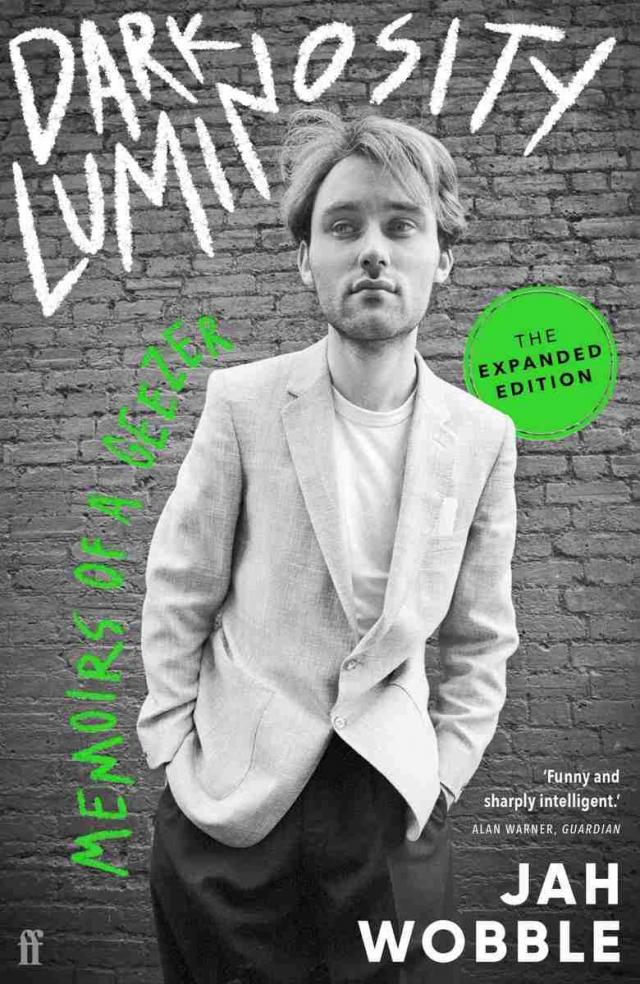


DARK LUMINOSITY
• MEMOIRS OF A GEEZER •
JAH WOBBLE
THE
EXPANDED
EDITION
I dedicate this book to Zi-Lan and my sons, John and Charlie, and our lovely Staffie Tyson (sadly passed). The four of you were my redemption.
Contents
Title Page
Dedication
Foreword by Jon Savage
Acknowledgements
1 Childhood
2 Teenage Years
3 Punk
4 PiL
5 The Metal Box
6 America
7 Going Solo
8 Nil by Mouth
9 New Start
10 Solo Success
11 Changing Times
12 New Departures
13 Renaissance Man
14 Farewell to All That
Epilogue Stockport, Chelsea, Tottenham, The Bus Routes of South London, Ancoats, London Borough of Merton, Recording
Picture Credits
Index
About the Author
Copyright
Foreword by Jon Savage
This is the story of a man who has transformed and transcended. The distance from where John Wardle began to where he is now is considerable: perhaps think of this book as a modern morality tale where the protagonist, like John Bunyan’s pilgrim, travels through the travails of the world – and indeed the Slough of Despond – before he finds deliverance: in love, music, hope and spirituality. The fact that this happened to a working-class boy from the inner East End is even more extraordinary.
John’s stage name is Jah Wobble, given to him in the mid-seventies by Sid Vicious, who, along with other key punk protagonists, makes a cameo appearance here. He was one of a loose group of friends who met at Kingsway College of Further Education: John Lydon, John Beverley, John Gray and John Wardle. Apart from Gray, who would remain Lydon’s éminence grise, all gained fame and attention – if not notoriety – during the height of British punk rock and its aftermath.
As one of the four Johns, Wobble saw the development of punk from its very beginnings, when his friend John Lydon joined the Sex Pistols in autumn 1975. As he writes: ‘Once they had been going for a few weeks John invited me, along with John Gray, to see them rehearse at their premises in Tin Pan Alley. I don’t think he realised how excited I was. I had never been in a rehearsal room before. Steve Jones really was a very powerful guitarist.’
Wobble recognised himself and the group as part of what he calls the ‘end of the line generation; the last lot to grow up in a society still relatively untarnished by free-market economics and monetarism. We had our adolescence at a particularly turbulent time, politically speaking, in this nation’s post-war history. The ruling classes were very concerned by the growing power of the unions. They also feared and suspected many in the Labour Party.’
‘All the people I knew had a lot in common. They had all grown up in poky council flats, were brighter than average, and had a certain je ne sais quoi. There was a sense with all of us that we somehow wanted to escape the rather sedate destiny that had already been mapped out for us by square society. We were also far too sussed and bright to believe anything that trendy Hampstead intellectuals or hippies had to say. There was a “quotient x” present among us all that was among other things wilful, angry, narcissistic, courageous and bold.’
Punk was a misfits’ charter, that pulled in disaffected and underprivileged teens from all over the country. The young John Wardle was a classic example of an adolescent who deserved better: his relationship with his parents wasn’t good – his father was damaged by his service in the Second World War – and his schooling failed to engage his restless intelligence. He was, in retrospect, perfectly situated to accept the punk challenge to get active; do it yourself – an exhortation that pulled in a generation of working-class autodidacts.
He writes well about the music of his early teenage years: Tamla Motown, the Sound of Philly, The Who, Stevie Wonder, Manu Dibango and one Beatles song, ‘Strawberry Fields Forever’. Unsatisfied with mainstream culture, he started listening to short-wave radio oscillations which put him into a trance. At the same time, he read Hemingway, Steinbeck, Camus, Greene, D. H. Lawrence, Zola, Ballard and Orwell, the late Sanskrit texts the Upanishads. ‘Even at that age’, he remembers, ‘I had a strong spiritual bent.’
This began to come out in a more focused way. Sitting in a Southwark squat for long periods in 1977, he began focusing on the bass guitar: ‘the desire to get a bass wasn’t contingent or dependent on anything other than I wanted to play the bass. The initial attraction was a sonic one; primarily I was fascinated and captivated by low frequencies. Heavy bass had an effect on me that was essentially visceral; I felt and perceived it at gut level. It took the emphasis away from my head and “thinking”. ’
‘Even today as I sit here, my heart skips a beat at the thought of “BASS”. I now realise that when you truly accept bass as (essentially) an emanation of God (at gut level), as the “ground” of existence, let alone music, you make a friend of impermanence, everything vibrates, moves, is in a state of flux, therefore the fear of losing what you have, or of not getting what (you think) you want, diminishes. You will truly ride the rhythm. You will reside in the resonance of Om. To you the open E string becomes spiritually vehicular. You can ride the sonic boom to heaven.’
That sonic boom is the first thing you hear on the first single by Public Image Limited, ‘Public Image’. As a core member of John Lydon’s post-Sex Pistols group, Wobble was initially given as much freedom as he wanted and, indeed, his fundamental bass lines anchored Keith Levene’s psychedelic guitar and John Lydon’s muezzin wails. PiL set him free: it promised much – a promise completely fulfilled on 1979’s extraordinary Metal Box – but he became disillusioned with the hard drug use, poor business ethics and narcissistic attitudes of his fellow members.
Public Image Limited thrust Wobble into the spotlight, but, as the book makes clear, he has rarely stopped making music – right up to the present day, forty-five years after he joined the group. There are so many variations: the solo years, the Human Condition, Invaders of the Heart, Psychic Life, the Chinese Dub Orchestra. He has collaborated with musicians as diverse as Pharoah Sanders, Bill Laswell, the Edge, Evan Parker, Andrew Weatherall, Primal Scream, Jaki Liebezeit, Holger Czukay, Baaba Maal, Chaka Demus and Sinead O’Connor.
In the middle of this was a descent into hell. Apart from the vicissitudes and vicious class politics of the music industry – sabbaticals from full-time music included periods as a warehouse keeper, a ticket collector and a train driver – Wobble was afflicted by severe alcoholism, which harmed his first marriage and fuelled a tendency to violence. As he writes, ‘the scene in the latter stages of GoodFellas where Ray Liotta’s coke-addled character Henry is trying to keep it all together in the middle of domestic life really reminds me of my life in the mid-eighties’.
Wobble became sober on 23 October 1986. Thanks to Alcoholics Anonymous he began to address the issues underlying his drinking, which meant changing his outlook on life: ‘I think that most psychiatrists working in the field would agree that gross emotional immaturity is one of the most noticeable aspects of alcoholics. I realise now that I had gone backwards in regard to emotional development at that time. In many respects I was more sensible at eighteen than I was at twenty-five.’
Perhaps his most famous song, ‘Visions of You’, describes the process of getting clear and psychologically healthy: ‘I was really feeling the benefits of that process, spiritually, mentally and physically. I tended towards a feeling of well-being for much of the time. I felt incredibly vital and alive. Consequently my lyrics refer to no longer being “numbed out”. It felt at that time as though my feelings were thawing. I also talked of no longer being “drenched in shame”. ’
He writes about a ‘possible outcome avoided’, the fate of his close friend Ronnie Britton, with whom he’d walk the night-time city in the mid-seventies. Meeting him again after several years, he found Britton homeless and poorly: ‘he spoke in a fractured way that didn’t make complete sense. He was telling me that he regularly talked to the Queen and John Major … I realised that this was more than just crazy drug talk; Ron had some other issues going on … Sadly Ronnie passed away just before Christmas 2008. His liver and kidneys packed up.’
After becoming sober, Wobble began filling in the gaps of a turbulent adolescence: seeing a therapist, going into higher education (a BA in humanities at Birkbeck College), remarrying and raising a second family, writing reviews for the Independent on Sunday and publishing this book in 2009. By that time he had released over twenty-five albums, solo and in collaboration, including Snake Charmer (1983), Rising Above Bedlam (1991), The Inspiration of William Blake (1996), Deep Space (1999), Radioaxiom (2001) and Chinese Dub (2009).
In the fourteen years since publication, there have been a dozen more albums, including Psychic Life (with Lonelady, 2011), Maghrebi Jazz (2018) and Metal Box in Dub (2021). John continues his spiritual practice and his AA involvement, while still continuing to musically develop and innovate: his current shows mix up forty-five years of musical experience, ranging from dub, jazz, Far Eastern, trance – all pulled together by a genial, comedic and uplifting presence.
This is a frank and unsentimental memoir. John does not spare many of those he has encountered over the years in the music and media industries, but he spares himself even less: his accounts of his alcoholism and violence are
2024
Acknowledgements
Thanks to everyone featured in this book, especially ‘my enemies’. Without you lot, it would have been anodyne and meaningless, so thank you very much for giving me something to push against (and then see the calm field, within which the drama unfolds). In any case, none of you could ever have been a worse enemy than I have been to myself. Credit goes to Ian Preece, my editor, and Dan Papps and Kate Ward at Faber. I am very grateful to Amanda Russell for helping source the fantastic photos in this updated book. Thanks to all the friends who gave me their unconditional and enthusiastic support. And also for helping me to verify stuff. In particular, thanks to Jon Savage, Pete Holdsworth, Pat Macardle, John Freeman (now sadly deceased), Dave Maltby, Neville Murray (also sadly deceased) and Dickie Daws.
1 Childhood
The Bell (Seconds Out, Round 1)
A bell rang loudly. My mum Kathleen was as alarmed as the bell. As if giving birth isn’t scary enough, she was now fearful that the bell signified that I was a ‘blue baby’. In fact it merely indicated that I was a ‘witnessed birth’. In those days every twelfth birth had to be witnessed by the student midwives and trainee doctors. The bell was summoning all to witness my birth. So even then I had an audience. As was the practice then, the midwife held me upside down and smacked my bum, causing me to issue forth a loud and furious wail. She laughed and said, ‘This one got a temper!’ Well, she wasn’t wrong there. My entrance into the world was made at the East End Maternity Home on Commercial Road, Stepney, London, E1. The date was 11 August 1958. I was christened John Joseph Wardle.
My family were living in Locksley Street, E14. When I was still a baby we moved to Smithy Street, E1. The house had been home to a woman who was a spiritualist. She had held regular meetings there. The house had a very dark and weird vibe. My mum found that she was afraid there, especially when she was alone with me and my sister Catherine during the day. She was very unnerved. I now realise that what many would term poltergeist activity was occurring. My mum’s resolve finally broke when my sister, who was about six at the time, told her about the conversations she was having with the ‘old man at the piano’ (the place came with an old out-of-tune pub piano). That was it … my mum freaked out and got my dad’s brother Terry, who was a Roman Catholic priest, to come and bless every room in the house. He didn’t do a ‘full-on’ pukka exorcism (I think at that time the Catholic Church in the UK sort of unofficially left full-on exorcisms to a group of monks based in Highgate).
I recollect him going from room to room, splashing holy water about while mumbling prayers in Latin. I think the feeling, for my mum, was akin to having sorted out an insurance policy; a few evil spirits cannot argue with the cover provided by the Holy Ghost. My most vivid memory of that house is of falling ill with a very high temperature (something that I was prone to throughout childhood). I started to hallucinate, seeing gaudily coloured snakes on both animate and inanimate surfaces. I was screaming, ‘’Nakes!’, ’nakes!’, but could not be consoled, because those snakes were everywhere, even on the bodies and faces of my mum and dad.
They fetched the Jewish doctor from across the street where his practice was situated. When summoned, Dr Abrahams said, ‘If I didn’t know better, I would swear that this boy had the DTs.’ Well, funnily enough, years later I did indeed suffer from the DTs, but I never saw anything quite as powerful as that childhood hallucination. Decades later, when I looked at Van Gogh’s late-period paintings, his vibrant swirls of colour reminded me of that vision.
Blokes like me start out in life in similar fashion to how they finish: lying back on the settee à la Homer Simpson
Another memory of Smithy Street is of the rather shadowy tenant that came with the house. In those days having to share accommodation with others was by no means an unusual situation in the East End. The bloke in question was a Canadian, who went by the name of Constantine. He lived up in the attic. He kept pile upon pile of old newspapers. My mum felt that was a fire risk. No one saw much of him. He was often away. Years later my family found out that he had amassed a fortune on the Stock Market. Mysterious marginal characters like that were typical of the East End. My mum to this day suspects that he used to wee down the sink in his room rather than use the outside privy (a wise choice: it was three storeys down to a cold yard, and I know I’d rather have used the sink). At this time nearly all my extended family lived within a ten-minute walk of each other. There were always lots of cousins to play and fight with. I had many violent clashes with a cousin of mine who was also called John. He was a few months younger than me, so he was called ‘Little John’ and I was called ‘Big John’. I recall getting into big trouble for hitting him with a brick on one occasion; I really whacked him. Then again I’m sure that he whacked me a few times. My mum had three sisters, Nora, Mary and Edie, and two brothers, John and Joey. Joey was severely handicapped. I take my middle name from Joey. He died in a ‘home’ when he was in his twenties; I believe that he choked to death. My dad, Harry, had a sister, Agnes, and two brothers, Terry and John. I am named after John. John fell in the river by Limehouse Cut when he was eight. He was fished out but died a few days later in the old Poplar Hospital from ‘complications’ (pneumonia, I would imagine). My dad’s family still feels bitter about the circumstances surrounding John’s death. They believe that the treatment he received, from the doctor at the hospital, was appalling. This was in the era prior to the formation of the NHS. You didn’t want to be poor and poorly. (It looks to me like those days are coming back.)
Family History
The maternal side of my family (the Fitzgibbons and Haggertys) had been coming over from Ireland in dribs and drabs since the time of the potato famine. This culminated in my mum’s mum and her mum coming to Britain a few years into the twentieth century. My maternal great-grandfather, who was an alcoholic, came with them. However, he soon ended up living rough on the streets. Most of the family settled in Wapping, where their boats docked. A regular steam packet ran from Cork to Wapping; consequently most of the Irish in east London at that time hailed from the vicinity of Cork. Indeed, both sides of my mum’s family came from West Cork. Her mum’s clan came from a coastal village called Durrus. Funnily enough, I still work at a music studio that is situated right on the site they settled at, in Pennington Street, Wapping.
My dad’s first name is Harry, his second is Eugene; his mum’s side of the family had made their way over from Schull in West Cork, as a result of the potato famine. Their family names were Leahy and Connolly. I was told, as a kid, that the exception to this Irish lineage was a bloke called Wardle, my great-grandfather, who was a Scouse Protestant. Well, I found out that this wasn’t true. Brexit kickstarted me into getting an Irish passport and citizenship sorted. There was a ton of stuff, especially birth, marriage and death certificates, to get together. I asked a genealogist friend of mine called Emma Jolly to do a lot of that for me. I also asked her to do a bit of digging re. my father’s side of the family. His dad, Jack, my grandfather, was English. My great-grandfather, Fredrick John Wardle (Freddie), was based, as all the Wardle’s family were back then, in Wapping and Shadwell. They were, to a man, lightermen on the Thames, and had been since before the time of Dickens. It turned out that Freddie had a drunken brawl with his father-in-law, a docker, who died during the fight. In court Freddie was acquitted, amongst angry scenes, of all charges. Freddie subsequently died from typhoid in the London Hospital aged thirty. His own father, John Wardle, had died young when he fell in the Thames and drowned; a sadly common occurrence in regard to Thames lightermen. Can you imagine walking around the barges, via the narrow gunnels, in icy treacherous weather? It would be so easy to slip and fall into the water. As I said before, there was another near drowning in 1925 when my uncle John fell into the water at Limehouse Cut. A brave man, a decorated ex-soldier, dived in and brought him to the surface. Sadly John died in Poplar Hospital shortly afterwards – this was in the pre-NHS days. Some of the family felt that John did not get the care he needed. I can see where the link with Liverpool came in: the dependents of those lightermen Wardles came from the town of Wardle, near Rochdale – not that far from where I live now. There is a Y-chromosome haplogroup passed down the patrilineal line, which is clustered around the north-west of England, and is commonly associated with western and central Asia, North Africa and northern Iran. One theory has it that this is possibly down to Roman mercenaries from the Middle East being based predominantly in the north-west of England. Other theories link its predominance to gypsies migrating across Europe from the Caucasus and the Balkans.









