

Charming, p.1
Charming, page 1


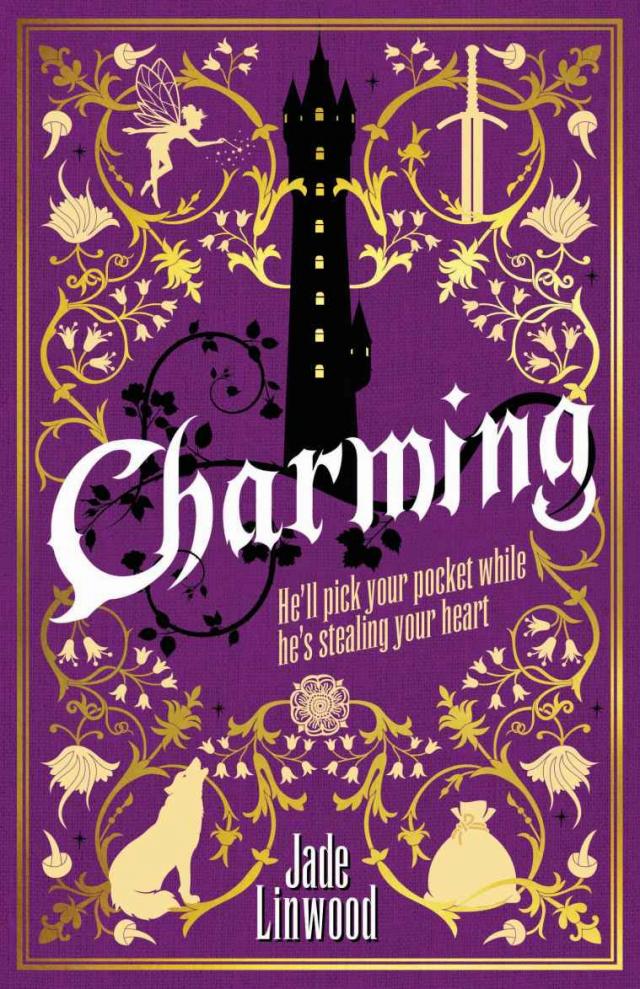
First published 2023 by Solaris
an imprint of Rebellion Publishing Ltd,
Riverside House, Osney Mead,
Oxford, OX2 0ES, UK
www.solarisbooks.com
ISBN: 978-1-78618-847-2
Copyright © 2023 Rebellion Publishing Ltd.
The right of the proprietor to be identified as the author of this work has been asserted in accordance with the Copyright, Designs and Patents Act 1988.
All rights reserved. No part of this publication may be reproduced, stored in a retrieval system, or transmitted, in any form or by any means, electronic, mechanical, photocopying, recording or otherwise, without the prior permission of the copyright owners.
This book is a work of fiction. Names, characters, places and incidents are products of the author’s imagination or are used fictitiously.
A CIP catalogue record for this book is available from the British Library.
eBook production
by Oxford eBooks Ltd.
www.oxford-ebooks.com
To all those princesses
who realised
that they could rescue themselves
The Palace of Sleep
Once upon a time, in a land far away…
There is a palace. It is as much fort as palace, though splendid, in a square, frowning sort of way, its towers muscular and business-like. The formal grounds are perfectly groomed, although, strangely, not one gardener can be seen.
The lake, in its marble bed, lies utterly still, a perfect mirror of a clear blue sky dotted with white clouds. The actual sky is dove grey, raining in a soft and constant drizzle, of which no single drop mars the lake’s surface, nor bends a blade of the perfectly scythed grass.
Not one bird sings, not one bee buzzes, not one insect darts through the unmoving air. And even in the open, the scents of leaf and grass and water are strangely muted, like things smelled in a dream.
All around the edges of the grounds is a huge hedge of briars, as tall as a clocktower, set thick and close and twisted. Its trunks are gnarled and furrowed and as wide as a man’s thigh, its stems gleaming red and writhing like the veins of a giant. Its thorns are mahogany daggers, and its leaves bristle with grey, jabbing spines. This hedge of briars never flowers, nor fruits; and that is just as well, for its berries, however large and juicy and gleaming, would surely be poisonous.
A little way outside the briar hedge, near a clearing, two fellows crouch in some bushes. One of them does not need to put much effort into it: being short and oddly shaped, he is what you might call ‘pre-crouched.’ This is Roland, something between a valet and an accomplice.
The other is so tall that, despite his best efforts, his slightly damp golden locks are visible above the top of the foliage, like the nest of a particularly fussy and well-groomed bird.
This is Jean-Marc Charming Arundel, more generally known as Prince Charming.
He has all the expected attributes. Well, many of them, at any rate.
He is certainly very handsome.
“Why the ever-loving Goose are there ogres?” the Prince muttered, glowering through the bushes. He did a good glower. Like most expressions, it only made him more handsome. If the man ever caught a cold, he would blow his nose appealingly.
Roland blowing his nose, on the other hand, was something to inspire nausea in people fifty feet away. He snorted (imagine, if you will, the sound of a frog drowning in yoghurt).
“They probably thought the palace was empty,” Roland said. “That’s their thing. They’re like them little crabs, whatsit, hermit jobbies. Ogres can’t build, they don’t have the brains or the patience, but they find an abandoned palace, fort—even a mill, in a pinch—and they’re in like rats down a sewer. Big, hairy, tusky, stinky rats. Saw the palace, but couldn’t get past the briars.”
“Stinky is right.” Charming wrinkled his nose.
“I know. Nothing else ’round here smells hardly at all, ’snot natural. But them? They pong, all right.”
“Look who’s talking.” Charming sighed, then turned back to his study. “I can see two adults and two youngsters, sitting around what I sincerely hope is the corpse of a pig, and not some local tragedy.”
Roland sniffed. “Yep. Pig. This time.”
“I’m amazed even you can smell anything other than ogre.”
“The important thing is they don’t smell us.”
The ogres, were, indeed, pungent; a bloody, dank, cheesy reek. They had long tusks, and long, sharp, extremely dirty nails on both hands and feet. They also looked as though their skin was somewhat too big for them, sagging around their middles and joints. Even the young ones were twice Charming’s height—the adults were as tall as oak trees. Each had by their side a crude club, little more than a tree branch with most of the bark knocked off by use, stained here and there with old blood. They were not above striking each other with them as they fought over the meal.
Charming stared up through the drizzle at the towers of the ducal palace, just visible over the briar hedge. “I hope it’s worth it.”
“So do I,” Roland said. “It’s a bit risky, this. I mean, apart from ogres, which we didn’t know about, there’s the what you might call ‘interested bystanders.’ Which, I might remind you, we did. Know about. ’Cause I told you. And you listened about as much as you normally do.”
“Judging by the state of the place, the interested bystanders have lost interest,” Charming said.
“It’s possible,” Roland admitted. “They do that. And then they remember things. And one day they turn up on your doorstep reminding you about some bargain great-grandpa made of a summer evening, which you’re now responsible for, ta very much.”
“I’ll cross that particular troll-guarded bridge should it appear in front of me. Hold on, they’re getting up, they must have finished. Shall we get on?”
“Don’t say I didn’t warn you,” Roland muttered.
“You didn’t warn me about the ogres,” the Prince said with a grin, and slipped from the bushes with his usual lithe grace to sneak up on the big male. Grumbling, Roland followed.
Charming hacked through the big male’s hamstrings and, as the roaring ogre toppled forward, leapt up his back like a startled deer and sprang over his head, taking out the big female on his way past with a well-timed stroke to the throat. The ogres’ two offspring stood side by side, gaping, as they struggled to catch up with events.
Roland, who was finishing off the big male with an efficient dagger into his ear, was promptly drenched with the female’s blood—which, like everything else about them, stank. It was the aroma of a butcher’s stall which had crashed into a cheesemonger, then been abandoned in the hot sun for at least a week.
“Oh, very nice,” Roland shouted. “Thank you so much.”
“Oh, stop complaining,” the Prince replied, as he jauntily dodged the descending club of one of the younger ogres. “I’m doing all the hard work.” He nipped around and poked the ogre in the bum, causing him to turn clumsily but at high speed and whack his nearby brother across the head with his club, felling him like a tree. “Timbeeerrrr!”
Roland dodged the falling ogre, just. “Showy,” he said. “Always so bloody showy.”
It takes more than a single blow from a club to knock out an ogre, but once he was on all fours, blearily shaking his head, it was easy enough for Roland to put his dagger through his eye, nipping out of the way as the giant collapsed. “See,” he said to the corpse. “No need for all that palaver, is there?”
The corpse, unsurprisingly, failed to respond. Charming was dodging about in front of the remaining ogre, which kept whacking his club at where the Prince had just been.
“Finish the blasted thing off, will you?” Roland snarled. “I want to get this stink off me.”
“Do you really... oops! ...think... oho, will you, eh? ...anyone will notice? I mean, you’re not the... wahey! ...most fragrant of creatures, Roland.”
“That’s my stink,” Roland said. “I worked on that. It’s my whatsit, signature perfume. Some people find it very appealing.”
“How extremely odd of them. Oh, all right, I suppose we should get on.” Charming looked around, leapt up a nearby tree like a leopard, and holding on with his left hand stabbed the ogre through the flabby chest.
It took a moment for the beast to realise he was dead, looking down at the sword, frowning. Then he pitched backwards, taking Charming’s sword with him.
“Bother. Stuck on a rib.” Charming dropped out of the tree—right onto the last ogre, which neither of them had noticed, fast asleep in the bushes below.
His entire family being slaughtered had not wakened him from his stuffed slumber, but a pair of scratched and battered leather boots and six feet of muscular Prince landing on his privates did the job.
He bolted upright, roaring, projecting the Prince through the air, to land on his back, inches from the briar hedge. And a long way from Roland, or his sword.
Charming had had the breath knocked right out of him, and for a moment could only stare at the approaching ogre. Roland was scurrying towards him, but the beast was closer, and there was nowhere to go. The briars were an impenetrable wall. The ogre raised his club.
Charming managed to turn himself over and scoot out of the way with inches to spare. Slam! Down came the club, where his legs had been seconds before, as Charming’s feet shot up in the air and slapped down into the mud, hauling him upright. Slam! The club shattered a rock, sending fragments whistling around Charming, one of them ripping through his sleeve. Cha
The ogre held his club aloft, scowling, looking for the annoying creature that had been just there a moment ago.
Charming held on with all his might, trying not to breathe in, his boots dangling just above the ogre’s shoulder. His foot brushed the ogre’s ear, and the creature shook his head.
Charming closed his eyes for a moment, then opened them and let go, springing off the ogre’s shoulder and landing in a nearby tree.
The ogre worked out where he was just as Roland sliced through his ankle tendon. He flailed towards the Prince, hampered by his newly-crippled leg. Roland threw the Prince his sword, and he caught it, and, dispensing with the flourish, got the ogre through the throat.
This time Charming was the one who got drenched.
He sat back in the crook of the tree, and looked down at himself, trying not to gag. “That’s never going to come out, is it?” he said. “Now, normally I might say, showing up bearing the evidence of a hard-won fight always goes down well. But I think the stench is likely to make things come up, not go down. I suppose there’s the river?”
“If I might point out to Your Highness,” Roland said, “that river comes out of the city. You en’t going to get any cleaner bathing in that. There’s a spring, just the other side of the briars.”
“Oh, for a proper hot bath, and lithe and willing maidens with warm towels,” the Prince said, descending from the tree.
Roland collected his pack beast. It was a bony, ugly creature with capacious saddlebags and a permanently disgruntled expression, and was generally referred to, should anyone ask, as ‘mostly donkey.’
“No lithe maidens for you in there,” Roland said. “Or just the one.”
“True,” said Charming. “But I’m sure I’ll cope.”
Our heroes, or our hero-and-a-bit, started towards the hedge of briars.
Roland pulled a small double-headed axe from his pack. Charming eyed it suspiciously, and looked at the massive, tangled wall of spines and trunks. “Are you sure that’s going to get through?”
Roland shrugged. “That wizard’s usually reliable. For a wizard. I mean, you could try with that pretty sword of yours, but I don’t fancy your chances.”
“It just looks so small.”
“Size isn’t everything,” Roland smirked, and swung. The blade gleamed flatly as a snake’s eye. When the edge hit them, the briar stems parted with somehow unsettling ease, as though they were hardly there at all, though they gave off a thick, bitter smell, like the taste of woodsmoke. There was a low rushing sound, though there was no wind. Green dust sprayed from the cut.
Roland swung again.
“Can you make it any higher?” Charming complained, scrambling along in a back-wrenching stoop and trying not to impale himself on thorns.
“My arms are only so long. You want to try? This isn’t as easy as it looks.”
“The axe won’t work for me, will it? That’s what the wizard said. Needs your ‘special qualities,’ Roland.”
Roland muttered something obscene, but kept swinging. A single rowan tree, slender and flower-crowned, appeared as the briars thinned; Roland glared at it and gave it a wide berth. “What is it with you and rowans?” Charming said. Roland did not answer.
By the time they emerged by the spring-fed pool in the palace grounds, there was little left of Charming’s shirt. He whisked off the remnants along with the rest of his clothes, placed the scuffed boots carefully close to hand on the bank, and plunged into the cold water with a gasp. “Soap?” he prompted.
Roland threw him a bar of soap and clambered in more slowly, retaining his under-things, which consisted of baggy drawers and a pair of extremely thick socks whose original colour could only be guessed at, and only by the brave.
Charming scrubbed soap through his blood-drenched hair. “Oh, this is going to ruin the condition. I wonder if there’s any almond oil in that palace. I suppose an avocado might be too much to ask for.”
“Given the palace’s been bespelled since before they started importing them, probably, yes.”
“I shall just have to make do.” Charming emerged from the pool, looking rather too much like a piece of classical statuary for anybody’s good. His hair, despite the soap, was quickly drying to a leonine mane, if a little fluffier than usual. Roland produced clean clothes from his saddlebags, and they made their way towards the palace.
Now its entire frontage was visible, it was obvious that, despite its manicured grounds, the palace had been built for withstanding armies. It stood on a hill commanding a sweeping view down into the valley. The city of Caraggia, some way upriver, was a picturesque tumble of warm red domes, austerely imposing civic architecture and crowded streets, through which the river curved, gleaming in the sun. A wide carriageway swept down from the gates of the palace towards the city, until the briars blocked it. The air at least did not smell of ogre, though it did lack the scents that a damp summer day should have. Instead of the sweet green of wet growing things, it smelled like an old, empty barn, where hay had been stored long ago; it smelled of dust and the long-gone ghosts of a thousand tiny meadow flowers.
“Well, will you look at that,” Charming said. “The grass looks as though it was just scythed yesterday.”
“Stasis,” Roland said.
“Whosis?”
“Stasis. Everything within the bounds of the briars has been in stasis—as in, not growing, or dying, or changing. Interesting spell. Nasty in the wrong hands. Or just the stupid hands. It’s all in the wording. I knew a wizard, once, tried to use it to make himself immortal.”
“Didn’t it work?”
“Oh, it worked, all right,” Roland said, with a deeply unpleasant grin. “He’s probably still there, in that box.”
Charming gave him a sideways look.
“You remember what I told you?” Roland said, as they neared the great iron gates. Two guards stood grasping their spears.
“Of course I remember. You are sure? It’s a long way to the next one.”
“Told you. It’s all in the wording.”
The guards remained staring straight ahead.
Roland put his hand to the gates, which swung aside with a deep groan.
They walked through the inner courtyard, observed only by statues, most of them high-nosed men in heavy robes; one, presumably the Duke, depicted in armour, on a rearing horse, his sword aloft. Roland tied up the beast, and they approached the inner doors. “Ready?” Roland asked.
The inner doors opened with a groan so dramatic it could have been scored for a dozen shrieking violins.
Picture the scene. The main reception hall of the ducal palace. Without, a fortress. Within, a floor of red and white tiles laid in intricate geometric patterns, high windows spilling a tranquil silver light across the room. It smells of the memories of perfume: musk, amber, civet.
Every wall is rich with frescoes, depicting military triumphs and various interactions (only the friendly ones, of course) with the Good Folk, in the stiff but colourful style of a bygone age.
And these unmoving crowds, frozen in time, are reflected in the room itself. A young man bows over a lady’s hand, one toe pointed before him; he wears a long, full robe in deep blue embroidered with gold, its sleeves brushing the floor. The lady wears a voluminous green gown, the wide sleeves trimmed with dark fur. She looks down on the man’s bent head with an expression of faint distaste, from beneath an elaborately plaited hairstyle topped with a jewelled net. A young dog is caught in mid-pounce at a cat, which, judging by its puffed fur and snarl, had no desire to make friends, and has not mellowed over the years. A servant bears a jug of wine, and is in the act of surreptitiously wiping his mouth on his sleeve. The whole room is like some giant, complex game of chess. Even Charming, known for his poise, stands for a moment, dumbstruck.
As for those frozen in the hall—did they once have lives, hopes, loved ones? Homes of their own now rotted to dust, gardens all overgrown, families left waiting beyond the Palace walls, for whom great-great-grandma is little more than a rumour?
But they are almost all, even the best-dressed of them, servants. Most of the rest left before the fateful birthday, knowing what was about to befall those who stayed. And who cares about servants’ stories? Apart from the Good Folk. They sometimes show an interest in servants; and if you’re very clever and extremely lucky, you might even survive it.









