

Magic, p.1
Magic, page 1


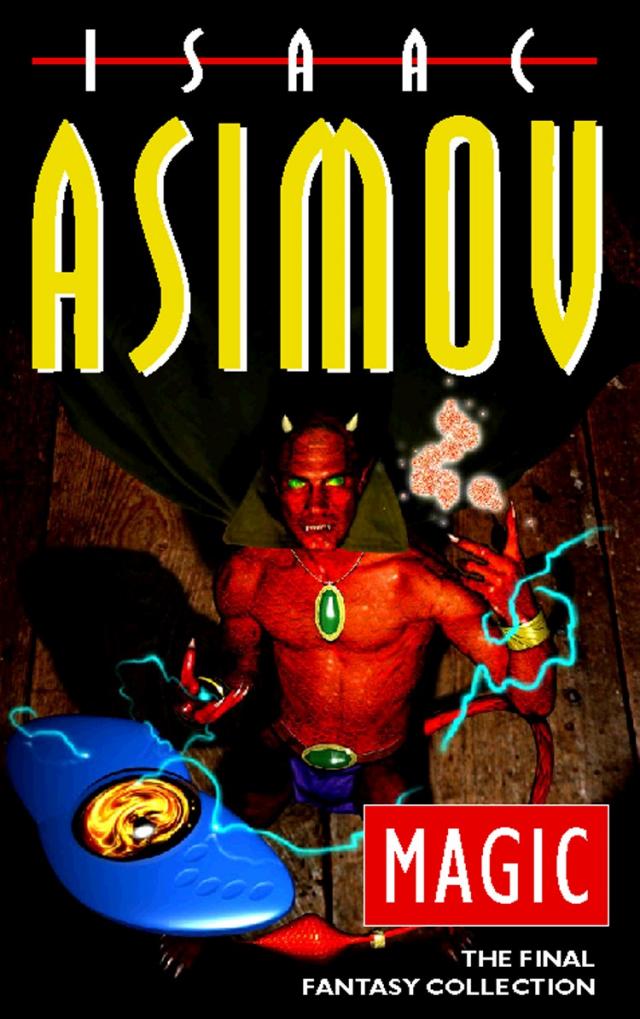
MAGIC
The Final Fantasy Collection
Isaac Asimov
Copyright
HarperVoyager
An imprint of HarperCollinsPublishers Ltd
1 London Bridge Street
London SE1 9GF
www.harpercollins.co.uk
This eBook edition 2023
First published in Great Britain by
HarperVoyager 1996
Copyright © Asimov Holdings, LLC 1996
Cover illustration by Fred Gambino
Isaac Asimov asserts the moral right to be identified as the author of this work.
A catalogue copy of this book is available from the British Library.
This novel is entirely a work of fiction. The names, characters and incidents portrayed in it are the work of the author’s imagination. Any resemblance to actual persons, living or dead, events or localities is entirely coincidental.
All rights reserved under International and Pan-American Copyright Conventions. By payment of the required fees, you have been granted the non-exclusive, non-transferable right to access and read the text of this e-book on screen. No part of this text may be reproduced, transmitted, down-loaded, decompiled, reverse engineered, or stored in or introduced into any information storage and retrieval system, in any form or by any means, whether electronic or mechanical, now known or hereinafter invented, without the express written permission of HarperCollins.
Source ISBN: 9780006482031
eBook Edition © November 2023 ISBN: 9780007397518
Version: 2023-10-09
CONTENTS
Cover
Title Page
Copyright
Introduction
PART ONE
The Final Fantasy Stories
To Your Health
The Critic on the Hearth
It’s a Job
Baby, It’s Cold Outside
The Time Traveller
Wine Is a Mocker
The Mad Scientist
The Fable of the Three Princes
March Against the Foe
Northwestward
Prince Delightful and the Flameless Dragon
PART TWO
On Fantasy
Magic
Sword and Sorcery
Concerning Tolkien
In Days of Old
Giants In the Earth
When Fantasy Became Fantasy
The Reluctant Critic
The Unicorn
Unknown
Extraordinary Voyages
Fairy Tales
Dear Judy-Lynn
Fantasy
PART THREE
Beyond Fantasy
Reading and Writing
The Right Answer
Ignorance in America
Knock Plastic!
Lost in Non-Translation
Look Long Upon a Monkey
Thinking About Thinking
Copyright Notices
Footnotes
About the Author
By the Same Author
About the Publisher
INTRODUCTION
ASIMOV … FANTASY? As almost everyone on our planet knows, Isaac Asimov was the most prodigiously talented, productive, and renowned science fiction writer who ever lived. As everyone perhaps doesn’t know, he also delighted himself and his readers by writing fantasy stories throughout his fifty-year career.
Like the great Victorians, whom he so admired and so resembled in both seriousness and industry, Isaac Asimov wrote to entertain as well as to instruct: to puzzle, to divert, and sometimes simply to charm or to dazzle. Asimov’s fantasies were as often written to justify a pun as to illustrate a point. But they invariably honored his deepest tendencies toward rationalism and logic. Even his wizards were logicians; even his dragons obeyed the Laws of Thermodynamics.
And like the great Victorians, Asimov worked at his writing desk until the day he died. We have thought it a fitting memorial, therefore, to complete the monumental task at which he labored all his life, and to assemble in one volume for the last time, all the uncollected fantasy stories he wrote during his enormously productive career. Many are whimsical, others are elevating, but all are entertaining and all reveal another fascinating side to the protean figure that was Asimov.
Also included, on a more serious (but hardly somber) note, are the critical essays he wrote on the subject of fantasy. Toward the end of his days, Isaac Asimov was concerned with the prospects and condition of his beloved field of science fiction, well aware that it had become inseparably linked with fantasy both in the marketplace and in the public’s imagination. Indeed, it was only shortly after his death that the Science Fiction Writers of America, the organization he helped found and nurture, officially became the Science Fiction and Fantasy Writers of America. In the essays collected here for the first time, Asimov expresses his hopes and fears for this marriage, which was one of convenience as well as love; and explores as only he can, the shifting, permeable but very real border between the two realms.
Finally, and most appropriately, we have included Isaac Asimov’s previously uncollected articles that range beyond the formal field of fantasy to touch on such “unscientific” subjects as luck and immortality, Biblical astronomy, the Universe’s ultimate fate … and America’s prospects for survival. A fantasy? The good doctor hoped not.
It is our hope that this farewell collection of Asimov’s best-loved fantasies and writings on fantasy will take its place on the shelf as a companion to Gold, Asimov’s final science fiction collection. Together, they form an integral and essential part of his legacy.
In one of his essays, Asimov quotes his friend Arthur C. Clarke’s famous dictum that “science, sufficiently advanced, is indistinguishable from magic.” The same might be said of the good doctor’s own delightful tales—that occasional fantasy, gracefully presented by a masterful writer who happens to be a scientist, is … well, Magic.
THE PUBLISHERS
PART ONE
THE FINAL FANTASY STORIES
TO YOUR HEALTH
I SNEEZED.
George drew himself away and said, austerely, “Another cold?”
I blew my nose without doing myself much good and said (my voice rather muffled by the tissue), “Not a cold. Sinusitis.”
I stared at the remains of my coffee as though it were its fault that it had had no taste. I said, “This is the fourth flare-up of my sinusitis in the course of a year and each time I lose my sense of smell and taste for a shorter or longer length of time. Right now I can’t taste a thing and the dinner we’ve just eaten might as well have been composed of cardboard.”
“Will it help,” said George, “if I assure you that everything was superb?”
“Not in the least,” I said, grumpily.
“I myself don’t have these afflictions,” he said. “I attribute it entirely to clean living and a clear conscience.”
“Thank you,” I said, “for your sympathy, and I prefer to think that you avoid these disasters simply because no self-respecting microorganism would consent to live on your foul tissues.”
“I don’t take offense at that unkind remark, old fellow,” said George, bridling more than a bit, “because I understand that these afflictions sour the disposition and cause you to say things that, in your right mind (assuming you have ever been in it), you would not say. It reminds me very much of my good friend Manfred Dunkel, when he was competing with his good friend, Absalom Gelb, for the charms of the fair Euterpe Weiss.”
I said, morosely, “Curse and blast your good friend, Manfred Dunkel, his good friend Absalom Gelb, and their mutual prey, Euterpe Weiss.”
“That is your sinusitis speaking, old man,” said George, “not you.”
Manfred Dunkel and Absalom Gelb [said George] had both attended the New York Institute of Opticianry and a fast friendship had formed between the two young men. It is, of course, impossible for two young men to immerse themselves in the mystery of lenses and refraction, to tackle the serious conditions of myopia, presbyopia, and hypermetropia, to sit at the grinding table together, without coming to feel like brothers.
They studied eye charts together, designed new ones for those who were most familiar with the Cyrillic or Greek alphabets, chose ideograms for Orientals, and discussed as only two specialists could the intricacies of balancing the advantages versus the disadvantages of using the various accents, grave, acute, circumflex, and cedillas, for French patients; umlauts for German ones; tildes for Hispanics, and so on. As Absalom told me once, very emotionally, the absence of these accents was pure racism and resulted in imperfect corrections of the eyes of those who were not of pure Anglo-Saxon ancestry.
In fact, a Homeric struggle on the subject filled the letter columns of the American Journal of Optical Casuistry some years back. Perhaps you remember an article written jointly by our two friends denouncing the old charts. It was entitled “Eye! Tear that tattered ensign down.” Manfred and Absalom stood back to back against the united conservatism of the profession and although they did not succeed in imprinting their point of view upon the field, it drew them closer together than ever.
Upon graduating they opened the firm of Dunkel and Gelb, having tossed a coin to see which name was to go first. They prospered exceedingly. Dunkel, perhaps, was a trifle better at grinding surfaces to perfection, while Gelb was an acknowledged master at designing spectacles in art-deco modes. In everything, they saw, as they were fond of saying, eye to eye.
It was not surprising, then, that when they fell in love, it was with the same woman. Euterpe Weiss came in for new contact lenses and as the two men eyed her (one cannot say ogled in connection with the truly professional manner in which they studied her lovely optics), they realized they had encountered perfection.
I cannot say, as a nonoptician, that I quite appreciated what that perfection consisted of, but each of the two waxed lyrical to me—separately, of course—and talked fluently of optical axes and diopters.
Because I had known the two lads since they were young teenagers wearing their first spectacles (Manfred was slightly nearsighted while Absalom was slightly far-sighted, and both were moderately astigmatic), I feared the result.
Alas, I thought to myself, surely a sacred boyhood friendship would founder, as the two, grown into strong men, would compete for Euterpe who, as Manfred said, with his hands clasped over his heart, was “a sight for sore eyes,” or, as Absalom said, with his hands raised to heaven, “where Euterpe is concerned, the eyes have it.”
But I was wrong. Even in connection with the divine Euterpe, the two opticians, closer to each other than even the closest-set eyes, behaved in perfect amity.
It was understood between them that on Tuesdays and Fridays, Manfred would be free to date Euterpe, if such dates could be arranged, while on Mondays and Thursdays, Absalom would have his chance. Weekends, the two worked together, taking the damsel to museums, operas, poetry readings, and chaste meals at some convenient diner. Life was a giddy round of pleasure.
What about Wednesday, you ask? That showed the young men’s enlightened attitude at their highest and most refined. On Wednesdays, Euterpe was free to date others if she cared to.
The passion of Manfred was pure, as was that of Absalom. They wanted Euterpe to make her own choice even if it meant that some lout who was not an optician might be gazing into her eyes—breathing sighs—telling lies—
What do you mean, you wonder who’s kissing her now? Why do you introduce non sequiturs when I am trying to give you a coherent account of events?
All went well for quite a while. No week passed in which Manfred didn’t play a snappy game of casino with the young lady on one evening, while on another Absalom would blow a stirring tune on a comb covered with tissue paper. It was a halcyon time.
Or, at least, I thought it was.
And then Manfred came to see me. One look at his haggard face, and it seemed to me I knew all. “My poor young man,” I said, “don’t tell me that Euterpe has decided that, on the whole, she prefers Absalom?” (I was neutral in this matter, old fellow, and was prepared to mourn if either young man got it in the eye, so to speak.)
“No,” said Manfred, “I won’t tell you that. Not yet. But it can’t last long, Uncle George. I am under a handicap. My eyes are red and swollen and Euterpe can scarcely respect an optician with eyes that fall short of normality.”
“You have been weeping, have you?”
“Not at all,” said Manfred, proudly. “Opticians are strong men who do not weep. I merely have a case of the sniffles. A cold, you understand.”
“Do you have them often?” I asked, with sympathy.
“Lately, yes.”
“And Absalom, does he have colds?”
“Yes,” said Manfred, “but not as often as I do. He throws his back out occasionally, and I never do, but what of that? A man with a bad back has eyes that are clear and pellucid. The occasional groan, the periodic inability to stand up, are unimportant. But as Euterpe stares at my streaming eyes, at the redness of the sclerotic blood vessels, at the flush of the conjunctiva, surely a feeling of repulsion must sweep over her.”
“Ah, but does it, Manfred? By all accounts she is a sweet damsel with a melting, sympathetic eye.”
Manfred said grimly, “I dare not chance it. I absent myself when I have a cold and lately, this has meant that Absalom has seen her far more often than I have. He is a tall and lissome young man and no maiden can listen to the stirring music of his comb and tissue paper without being moved. I’m afraid I don’t have a chance.” And he buried his head in his hands, being careful to avoid harmful pressure on his eyes.
I was moved myself, as though ten combs with ten tissue papers had struck up “The Stars and Stripes Forever.”
I said, “I might be able to arrange to make you immune to colds forever, my boy.”
He looked up in wild hope. “You have a cure? A method of prevention? But no—” The momentary flame in his reddened eyes died away, leaving them just as reddened, however. “Medical science is helpless before the common cold.”
“Not necessarily. I might not only cure you, my boy, but I might see to it that Absalom was afflicted with constant colds.”
I said that only to test him, for you know my rigid sense of ethics, old fellow, and I am proud to say that Manfred passed as only an optician could.
“Never,” he said, ringingly. “I ask that I be freed of this incubus, yes, but only that I might fight fair and meet my adversary on equal grounds. I would scorn to place him under a disadvantage of his own. I would sooner lose the celestial Euterpe than do that.”
“It shall be as you say,” I said, wringing his hand and clapping him on his back.
Azazel—I may have told you of my two-centimeter extraterrestrial, the one whom I can call from the vasty deep of space and who will come when I do call for him. Oh, I have, have I? —And what do you mean I should tell truth and shame the devil. I am telling the truth, blast you.
In any case, Azazel tramped up and down the edge of the table, his wiry tail twitching and his little nubbins of horns flushing a faint blue with the effort of thought.
“You are asking for health,” said Azazel. “You are asking for normality. You are asking for a situation of balance.”
“I know what I’m asking for, O Divine and Universal Omnipotence,” I said, trying to mask my impatience. “I am asking to have my friend avoid having colds. I’ve had you meet him. You studied him.”
“And that’s all you want? To avoid his having these nasty, rheumy, messy, phlegmy colds that you sub-bestial inhabitants of a worm-eaten planet are subject to? You think that it is possible to light one corner of a room without lighting the whole room? I’ll have you know that the balance of the four humors in the specimen you showed me is badly, viciously askew.”
“The balance of the four humors? Sanctified One, humors went out with Herodotus.”
Azazel gave me a sharp look. “What do you think humors are?”
“The four fluids thought to control the body: blood, phlegm, bile, and black bile.”
Azazel said, “What a disgusting idea. I hope that this Herodotus is very properly held in universal execration by your people. The four humors are, of course, four mindsets, which, when balanced very carefully, cannot help but bring permanent normality and good health to the useless bodies of even such insignificant vermin as yourselves.”
“Well, then, can you balance the humors very carefully in my verminous friend?”
“I think I can, but it’s not easy. I don’t want to touch him.”
“You won’t. He’s not even here.”
“I mean make contact astrally. It would require a ritual of purification that would take the better part of a week and be quite painful in spots.”
“I am sure, O Essence of Perfection, that avoiding the astral touch would be to you a trifling matter.”
As usual, Azazel brightened under flattery and his horns stiffened. “I dare say I can,” he said, and he could.
The next day I saw Manfred. He was visibly glowing with health and he said to me, “Uncle George, those deep-breathing exercises you told me about did the trick. The cold was cured between one breath and the next. My eyes cleared up, whitened, cooled, and I can now look the whole world in the face. In fact,” he continued, “I don’t know what it is, but I feel healthy all over. I feel like a well-oiled machine. My eyes are the headlights of a marvelous locomotive that is racing across the countryside.
“I even,” he went on, “have this marvelous impulse to dance to some seductive Spanish rhythm. I will do this and dazzle the heavenly and ethereal Euterpe.”
He left the room, dancing, his feet spurning the floor with delicate steps while he cried out: “Eye, eye, eye-eye.”
I could not help but smile. Manfred was not quite as tall as Absalom, not quite as lissome, and although all opticians are classically handsome, Manfred was not quite as classical in his handsomeness. He looked better than the Apollo Belvedere but not quite as much better as Absalom did.






