Erased faces, p.1
Erased faces, page 1


erased faces
erased faces
A Novel
By
Graciela Limón
This volume is made possible through grants from the City of Houston through the Houston Arts Alliance.
Recovering the past, creating the future
University of Houston
Arte Público Press
452 Cullen Performance Hall
Houston, Texas 77204-2004
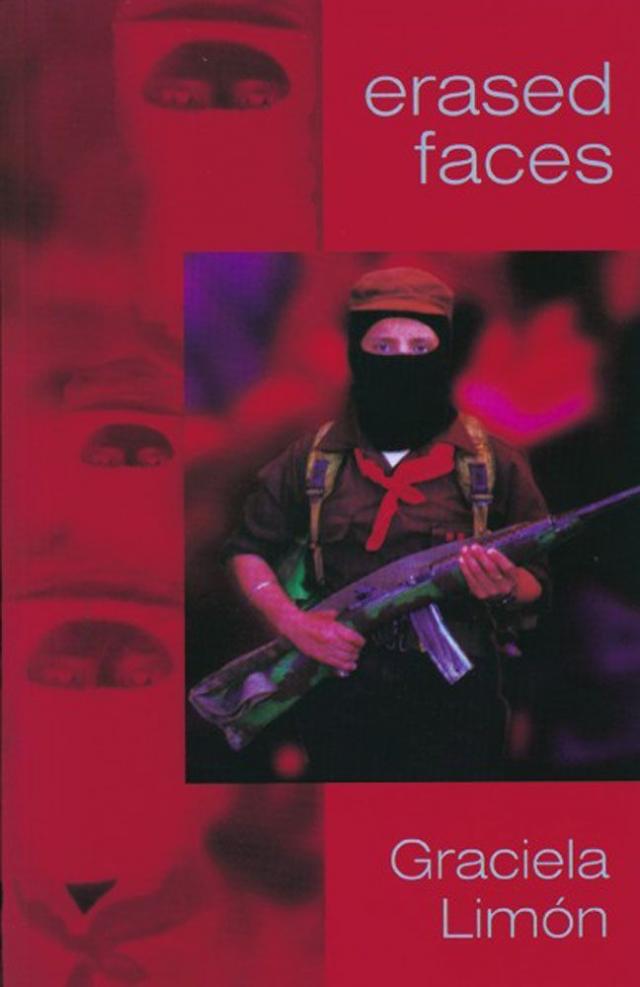
Cover design by James Brisson
Photo courtesy of Eduardo Vera, “Mayor insurgente Maribel,
EZLN, October 1994”
http://evera.home.ige.org
Limón, Graciela.
Erased Faces / by Graciela Limón.
p. cm.
ISBN 978-1-55885-342-3
1. Women photographers—Fiction. 2. Women revolutionaries—Fiction. 3. Americans—Mexico—Fiction. 4. Indian women—Fiction. 5. Mexico—Fiction. I. Title.
PS3562.I464 E7 2001
813?.54—dc21
2001035543
CIP
The paper used in this publication meets the requirements of the American National Standard for Information Sciences—Permanence of Paper for Printed Library Materials, ANSI Z39.48-1984.
© 2001 by Graciela Limón
Printed in the United States of America
10 11 12 13 14 15 10 9 8 7 6 5 4 3
In memory of those who perished in the
massacre of Acteal, Chiapas
22 December 1997
Although set against a background of conflict in Chiapas, this work is a novel. Places and people portrayed have been fictionalized.
G. L.
She meets with her face erased, and her name hidden. With her come thousands of women. More and more arrive. Dozens, hundreds, thousands, millions of women who remember all over the world that there is much to be done and remember that there is still much to fight for.
EZLN communiqué:
Twelve Women in the Twelfth Year
Subcomandante Insurgente Marcos
1996
Contents
Acknowledgments
Chapter 1 She didn’t look like me.
Chapter 2 Adriana decided never to speak again.
Chapter 3 We repeat ourselves.
Chapter 4 She wondered if white things felt pain and sadness.
Chapter 5 The mountain spoke to us.
Chapter 6 You have already been among us.
Chapter 7 Our people built that church.
Chapter 8 The soil was gray; it had no color.
Chapter 9 She felt that floating would turn to flying.
Chapter 10 The gods made men and women of maize.
Chapter 11 Why don’t you come and see?
Chapter 12 In the end, los patrones are severe and unforgiving.
Chapter 13 He even owns a mule.
Chapter 14 Kap jol, the anger of the people.
Chapter 15 I’ll see that he’s taken care of.
Chapter 16 There was only emptiness.
Chapter 17 The night in Tlatelolco had shaken him.
Chapter 18 We call him Tatic, Little Father.
Chapter 19 They crush us but we also crush ourselves.
Chapter 20 There cannot be equality in a false peace!
Chapter 21 He wondered if he would ever see her again.
Chapter 22 It was quick. It was merciful.
Chapter 23 In these parts the only thing that matters is a signature.
Chapter 24 They were innocent!
Chapter 25 Why is the day moving in reverse?
Chapter 26 What about me?
Chapter 27 Emboldened, Juana mingled with the crowd.
Chapter 28 You are my blessing.
Chapter 29 The leash snapped!
Chapter 30 In lak’ech. You are my other self.
Chapter 31 The anguish, too, was the same.
Chapter 32 She asked me to be the lips through which their silenced voices will speak.
Books by Graciela Limón
About the Author
Acknowledgments
I’m sincerely grateful to Letitia Soto, my dearest cousin, as well as to Andy Soto, who accompanied me to Chiapas during the month of June 1999. Circumstances were intimidating to travelers at the time, especially since we had to travel through the mountains between Palenque and San Cristóbal de las Casas, a region filled with armed military checkpoints. I know that I would not have had the courage to do it on my own. Letitia and Andy’s company, their courage, their chistes and cariño of what we saw and experienced, made that journey unforgettable and rich in information. Roberto Flores, valued colleague, shared remarkable photographs and documentation on the Zapatista War, and for that I’m indebted to him. I thank him most especially. I’m very grateful to Mary Wilbur, one of the first readers of Erased Faces. Her input, suggestions and research enhanced the work beyond my initial concept of it. Also, much gratitude to Toni Zepeda for her numerous readings of the manuscript and for her helpful input. Finally, but not least of all, is Acción Zapatista which has been so helpful to me in gathering information.
G. L.
Chapter 1
She didn’t look like me.
The Lacandona Jungle, Chiapas, Mexico, 1993.
Her ankle-length dress caught in the thick undergrowth. Her legs and bare feet were bleeding from cuts inflicted by roots and branches matting the muddy ground. She ran, plunging headlong into a snare of decaying plants, oblivious to the pain that shot up her ankles, through the calves of her legs, lodging deep in her thighs. She ran because she knew the dogs were gaining on her; she could hear their baying, and in seconds she began to sense their clumsy paws pounding the darkened jungle floor. Terrified, she ran, lunging forward, panting, her body covered with sweat and her face smeared with tears of dread.
She could not be sure, but she thought that there were others running alongside her. In the thick gloom of the forest, she caught sight of women running, desperately clinging to babies, tugging at children trying not to lose their way in the darkness. Long cotton dresses pulled at them as they plunged through the growth; straight, tangled hair stuck to their shoulders. She saw that those women were also afraid that the snarling dogs would catch them and tear them to pieces. Men were running, and they, too, were terrified—their brown, sinewy bodies pressed through the dense foliage, their loincloths snagged and ripped by gigantic ferns that reached out with deadly tentacles.
The Lacandón women and men ran because they understood that soon they would be overcome and devoured by the ravenous pursuers. She ran with them, but suddenly she stopped; her feet dug deep into the jungle slime as she halted abruptly. She began to turn in circles, arms rigidly outstretched, but she could see nothing; she was blinded by fear, and she darted in different directions. She had lost something, but she could not remember what it was that had slipped through her fingers. She dropped to her knees, groveling in the mud, digging, trying to find what it was that she had lost. Her fingers began to bleed when her nails ripped from her flesh, and her desperation grew, looming larger than even her pain, greater even than the terror of being overcome by the dogs.
She was on her knees when she felt her long straight hair wrap itself around her neck. It got tighter and tighter. It began to strangle her. Frantically, her fingers dug into the taut coils that were cutting off her breath. Nearly drained of air, she felt that her lungs were about to collapse. With each second, the hungry dogs got closer, but she was paralyzed because the pain of having lost something that was precious to her nailed itself into her heart.
Adriana Mora awoke startled, panting and covered with perspiration. She sat up choking, out of breath and in the grip of an asthma attack. In the darkness she fumbled, trying to reach the inhaler that she had placed on the rickety crate next to her cot, but her groping hand got tangled in the mosquito net. She struggled with the mesh, knocking her dark glasses to the ground, almost spilling a cup half-filled with water. When she finally reached the device, she pressed it into her mouth and plunged once, twice, relieved to feel air clearing her throat and reaching her lungs.
When Adriana’s heart returned to its normal rhythm and her lungs readjusted, she sat with her back to the wall, still shaken and breathing heavily. Making out the palm ceiling as well as the earthen floor, she looked around the tiny hut, a palapa. Through the ridges between the cane stilts, moonlight seeped casting elongated shadows on the dirt. Trying to gain a hold on herself, she stared at the small table where she had propped her equipment: cameras, tripod, note pad, canvas jacket with its pockets stuffed with lenses she used to capture the faces and bodies of Lacandón women.
Adriana drew her legs up until her knees pressed against her breasts. Wrapping her arms around the calves of her legs, she leaned her head against her knees; she stayed that way, thinking of the nightmare from which she had awakened. She was listening to the jungle sounds that filled the night: the jumble of insect chirping that scraped against the heavy breathing of iguanas and other reptiles. Howling monkeys barked, chattering angrily as they swung from branch to branch. Screeching parrots complained because of the hooting of owls and other nocturnal birds. Adriana tried to decipher each sound. She wanted to identify what animal, which insect had made what noise, but it was impossible because it all melted into an indistinguishable cacophony of murmur, hissing, and howling. The night vibrations of the jungle fused with the sad groaning of the muddy waters of the river that coiled around the tiny village of Pichucalco.
She thought of the dream, trying to discern it s meaning. She had experienced it before, but never had it been as vivid, as terrifying. The other times, the woman had been remote, someone else. This time, however, she had no doubt: It had been she who was being hunted, she who was running in the forest along with other natives. It had been she who had lost something precious, something loved and so riveted onto her heart that reliving the dream made her feel pain beneath the nipple of her left breast. With outstretched fingers, she rubbed the palm of her hand over her chest; she was thinking, concentrating, trying to recognize what she had lost. But it was useless, because she could not remember anything that had ever meant so much to her, not even the distant memory of her mother and father.
Unable to find the answer, Adriana straightened her head and cocked it to one side, this time listening to her dream. She stayed that way for a while until she realized that she heard only the sound of menacing dogs. Her searching mind then focused on the woman in the dream.
“She didn’t look like me!”
Mumbling out loud, Adriana flung aside the net and slid off the cot. She went to the stand where she kept a basin and water jug that she used to wash her face and hands; above it, she had nailed a small mirror. She unhooked it and made her way past the gunny sack that covered the entrance of the palapa. Once outside, Adriana found herself in moonlight that was bright enough to see her reflection.
“It couldn’t have been me.”
She studied her face: brown angular features, high cheekbones. Adriana concentrated, turning her gaze on her mouth and head: thick lips; short, curled hair. Then she went back into the hut, stretched out on the cot and stared at the palm-frond ceiling. She reflected on her nightmare, the baying of dogs still echoed in her memory as did the sensation of pain. She brought her hands close to her eyes, turning them palms up, then down. There were no cuts, no bruises.
She touched her forearms, searching, but her fingertips found only the scar tissue inflicted on her left forearm by scalding water when she was a child; she had been seven years old when that happened. Adriana’s mind halted for a few seconds, remembering that day. Then she returned her attention to the dream, to any traces it might have left on her. She went on feeling her body, pausing, searching for signs of pain, or even a slight indication of having been hurt, but she discovered nothing.
A nagging sense of loss forced Adriana to shut her eyes because she felt the sting of tears burning behind her eyeballs. She flung her arm across her face and remembered her life, how ever since she could remember, she had felt lost, separated, alone, always filled with fear. She was twenty-four years old, but sometimes she still felt as she had when she was a child; nothing in her life seemed to change—not inside of her. She was now a woman, on her own, making a living as a photographer. Wanting to be accomplished in her profession, to publish her work, she had chosen to come to the jungle to create a photo history of the women of the Lacandona.
Adriana stared at the thatched ceiling, her eyes wide open and vacant. She was remembering that when she had finished college in Los Angeles, she had drifted to New Mexico, where she stayed a short while. After that she decided to go south to Chiapas, so she made her way to the border, and from that point down to Mexico City, and from there she traveled to Mérida, Yucatán, where she stayed only a few days. Then she pushed on to Palenque, attracted by the prospect of capturing on film what was left of Mayan civilization, but once there, she realized that it was for living faces that she searched. So she put her things on a dilapidated bus that had Pueblos Indígenas painted in large letters on its windshield. When she got off the vehicle, she was in Pichucalco, on the edge of the Lacandona Jungle.
Her thoughts drifted back to her childhood, probing incidents in her life, trying to explain why she had always felt such deep isolation. Then she relaxed her body, allowing her memory to return to the past.
Chapter 2
Adriana decided never to speak again.
Adriana was barely four years old the night she was awakened by loud voices. She sat up, hugging her raggedy stuffed rabbit, listening, turning her head toward the door, trying to make out who was screaming. Her eyes were beginning to adjust to the darkness of the room when a blast silenced the voices. The girl was struggling to make out the noise, when a second detonation shook the walls. Time passed but nothing happened. Then a smoky stench seeped into her room from beneath the closed door. There was no more yelling, no more explosions, so she slipped back onto her pillow.
Everything was quiet again; she could not hear or see anything, not even when she peeked out from under the covers. The girl listened for her mother’s voice, or the sound of her father’s heavy footsteps, but all she heard were cars driving by their apartment. She wanted her mother to come and wrap her arms around her, but there was only silence. Adriana drifted back to sleep.
She opened her eyes again, but this time it was the sun that had awakened her. With the frayed rabbit still in her arms and her legs cramped from being rolled in against her body, she stretched and looked around the room. In one corner were her toys and on the other side was the small closet. She could see her dresses hanging neatly, one next to the other.
“Mamá?”
Adriana called her mother just as she did every morning. She waited, hugging her toy to her chest, but nothing happened. Her mother did not open the door and peek around it to smile at her. Trying to see the sky, she looked out the window. There was nothing there except the bare branches of a tree.
“Mamá?”
This time Adriana’s voice was edged with tears because she was remembering the noises she had heard the night before. She began to shiver, thinking that her mother and father had gone away, leaving her alone. She had never before heard the house that quiet. She decided to go out to the kitchen to find them.
Adriana, with her rabbit dangling from one hand, shuffled down the hallway to the bathroom, where she struggled onto the toilet. After that she went to the kitchen. When she walked in, she felt happy all of a sudden because she saw her father taking a nap at the table. She looked carefully, taking in how he was sitting in his favorite chair, leaning his head in his cradled arms. She was relieved to see him, although she had never seen him sleep that way.
She tiptoed across the kitchen to the stove, where she expected to find her breakfast. At that moment, she wondered why her mother was not there. She looked first in the service porch, thinking her mother might be putting laundry into the washer. When she did not find her there, Adriana searched the small front room, where she found the television set turned on. That was all. From there she made her way to her parent’s bedroom.
“Mamá? Mamá?”
She found her mother lying on the bed; she was taking a nap, too. Adriana decided not to go near her; she might awaken her. Still clinging to the dingy stuffed rabbit, Adriana returned to the kitchen because she was hungry. Trying not to make noise, she opened the cupboard and looked for her favorite cookies, but when she saw that the package was on a shelf too high for her to reach, she put down the toy and struggled to edge a chair into position. She was able to do this quietly up until the last pull, when one of the legs stuck in a crack in the linoleum. She yanked, then flinched at the loud, grinding noise that filled the kitchen. She shut her eyes and hunched her shoulders, expecting her father to wake up and scold her, but nothing happened. When she opened her eyes to look at him, she saw that he was still asleep. Relieved, she climbed up and lowered the box. Then she went to the refrigerator, where she found a small carton of milk. Again she could not reach a glass, so she took the cookies and the container to the front room, where she munched as she watched cartoons until late into the afternoon.
When she needed to go to the bathroom again, she decided to awaken her mother. As she neared the bed, Adriana saw that the sheets and bedspread were stained red, and that her mother held her father’s gun in one hand. She saw also that there was a big bump on one side of her mother’s forehead, and that, too, was dripping with a red mess.
Adriana was so frightened that she felt pee dripping between her legs; she could not help it, and she did not know what to do. She reached out and grabbed one of her mother’s shoulders and shook her, trying to awaken her, but she felt that her mother was stiff and cold. Crying, she ran to where her father was still sleeping, and she tugged at his shirt, hoping that he would wake up to help with her mother. Instead, her pulling pried loose one of his arms; it fell inertly and dangled from his shoulder.