In the warsaw ghetto, p.1
In the Warsaw Ghetto, page 1


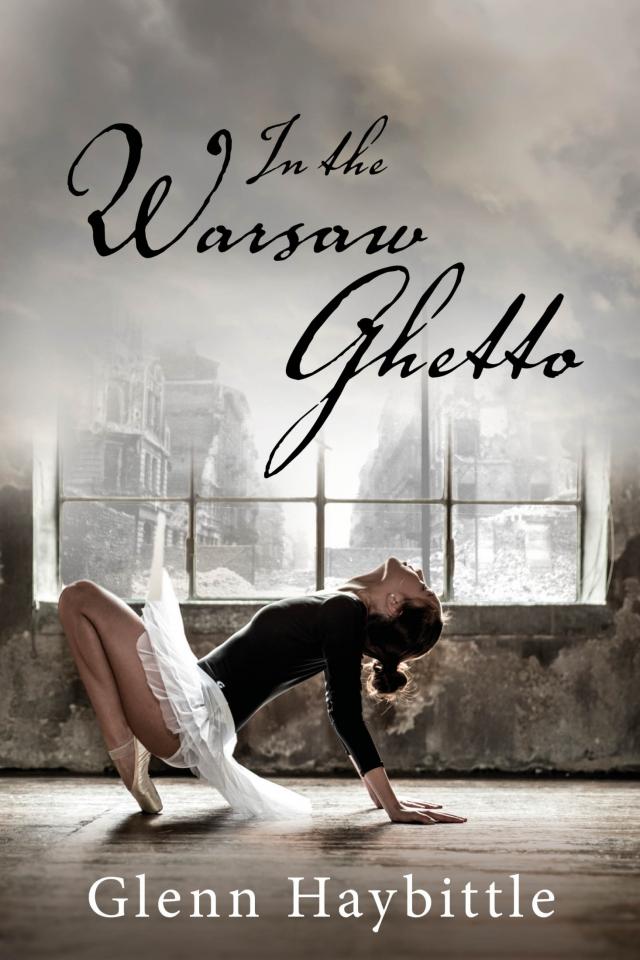
IN THE
WARSAW
GHETTO
Glenn Haybittle
Published by Cheyne Walk 2019
Copyright © Glenn Haybittle 2018
This book is a work of fiction and, except in the case of historical fact, any resemblance to actual persons, living or dead, is purely coincidental.
All right reserved. Without limiting the rights under copyright reserved above, no part of this publication may be reproduced, stored in or introduced into a retreival system, or transmitted, in any form or by any means (electronic, mechanical, photocopying, recording or otherwise), without the prior written permission of both the copyright owner and the publisher of the book.
The moral right of the author has been asserted.
Published by Cheyne Walk
www.cheynewalk.co
ISBN- 978-1-9999682-0-5 (paperback)
978-1-9999682-1-2 (ebook)
‘Every man’s death is a standing in for every other. And since death comes to all there is no way to abate the fear of it except to love that man who stands for us. We are not waiting for his history to be written. He passed here long ago. That man who is all men and who stands in the dock for us until our own time comes and we must stand for him. Do you love him, that man? Will you honour the path he has taken? Will you listen to his tale?’
― Cormac McCarthy, Cities of the Plain
Contents
Book One
1
2
3
4
5
6
7
8
9
10
11
12
13
14
15
16
17
18
19
20
21
22
23
24
25
26
27
28
29
30
31
32
33
34
Book Two 1942
1
2
3
4
5
6
7
8
9
10
11
12
13
14
15
16
17
18
19
20
21
22
23
24
25
26
27
28
29
30
31
32
33
34
35
36
37
38
39
40
41
42
43
44
Book Three 1943
1
2
3
4
5
6
7
8
9
10
11
12
13
14
15
16
17
18
19
20
21
22
23
Postscript
Book One
1
The world seems strange and quiet. On the far side of the river, just above eye level, a red kite writhes a moment on its string and then flails. Ala, shielding her eyes from the reflected sun glitter, feels a current of empathy with the kite’s struggle to unfurl and soar. Her uncle, sitting beside her, is also mesmerised by the kite. Perhaps he too feels an intimate connection with its failure to catch the wind.
Ala digs her bare toes into the warm sand. Eager for the ripple of sensual life to make play in her body again. Tonight, she thinks, sand will fall from my clothes when I undress, sand will crunch beneath my bare feet when I walk over to my bed.
“Why did you never marry?” she asks her uncle.
“Are you really interested or just being polite?”
“Mother says I don’t know how to be polite.”
“She’s hard on you, isn’t she?”
“She’s jealous. That’s all. She’d like to be eighteen again.”
“I can’t imagine my brother ever makes her feel she’s eighteen,” he says.
“Dad is set in his ways.”
“Family trait, I’m afraid.”
“So why didn’t you marry?”
“You think I’d be a good catch?”
“Stop fishing for compliments and answer my question.”
“Relationships might bring out the best in one, but they also bring out the worst. I’m not sure I want to subject anyone to the worst in me. Neither do I want to experience it myself. My insufficiencies, my immaturities, my insecurities. Alone, I avoid the worst of myself.”
“And perhaps the best of yourself.”
“Yes, that’s the monotonous reproach I hear in the dark. But despite all my perceived failings, I still feel special. I sometimes wonder if there is anyone who doesn’t secretly feel special. I hope you feel special. Because you are. Very special.”
Ala smiles and digs her toes into the warm sand again.
“I suspect,” her uncle continues after lighting a cigarette, “nothing has more power to alienate one from the wellsprings of all one’s creative vitality than being trapped in a loveless marriage. Probably they are the people who no longer feel special, the unhappily married.”
“Like my mother and father.”
“I wouldn’t say that. Your mother and father allow each other certain necessary freedoms. They’ve become good at turning a blind eye.”
Ala, her long black hair fastened into a bun, intermittently performs stretching exercises. She is aware, a little, of showing off. She wants to impress her uncle. Always has done for as long as she can remember. His opinion of her is important. She demands of him an unfailing keen observance. “The formality which exists between my mum and dad never ceases to baffle me,” she says, doing centre splits with her toes pointed. “They behave together like awkward acquaintances who haven’t yet found anything they have in common.”
“Your father resists any emotion with momentum in it. He’s like a parked car. He was like that as a young boy too. Sometimes I think he’s still waiting for his true life to arrive. That said, he doesn’t like change. He doesn’t like its violence.”
“We dancers are trained to be wary of change,” says Ala. She always feels a wobble of vulnerability when she refers to herself as a dancer, as if she is passing across a forged document. A dancer is what she hopes to become, not yet what she is. “We have to censor our appetites every day. We’re highly sensitive to every single thing we take into our body, how it affects our balance. We have to ensure we can awaken every muscle at a moment’s notice. And to achieve this we have to repeat the exact same regimes every day. Every deviation is dangerous. I’ve been trained to be an ethereal being. Or an ethereal being with muscles. Ethereal beings don’t eat sausages or drink alcohol.” Neither do they have pubic hair or menstruate, she thinks, but these are intimacies she cannot share with her uncle. She hasn’t even told her mother that she misses periods regularly or that she was instructed to shave her pubic hair the first week she joined the corps of the Ballet Polonaise.
“Sacrifice is perhaps the hardest discipline of all to learn in life,” says Max. “It’s often to belittle yourself to the agency of something greater. You have to believe in that something greater. I’m not sure I do. You’re lucky.”
“I feel lucky, even though I don’t like the competiveness of dance. Often what you gain is at someone else’s expense.”
“All life is like that.”
“I suppose it is. You’re right about the sacrifice. There’s no room in my life to do anything but dance, recover from the aches and stresses of dancing and prepare my body for more dancing. I feel closeted, like a child. You know how we hate our world to be invaded by anything foreign as children? Always suspicious of unknown tastes, unknown people, unknown clothes even.”
“I rather liked everything foreign when I was a child. It was the familiar I was less keen on. Except when it came to clothes. I remember this pair of itchy trousers I had to wear every time we visited my grandparents. How I loathed those trousers. And I loathed my father for making me wear them.”
“Is that why you no longer speak to your father, because he made you wear itchy trousers?”
“I think you’ve come up with the perfect explanation,” he says scratching the back of his head, one of his characteristic gestures. “My father was just like that itchy pair of trousers.”
“You see that tree over there, the one all alone and bent out of shape by the wind? That’s you.”
Max laughs. “I think you’re right. I seem to have made it my mission in life to repel all human intimacy. Divine intimacy too, come to think of it.”
“Why did you convert to Catholicism then?”
“To annoy my father, to get rid of those itchy trousers? Maybe I just was fed up with being disliked for something that had no bearing on who I am.”
“Do you believe that? That being Jewish has no bearing on who you are?”
Max watches a flight of birds, returning to nests.
“Wasn’t there ever someone you wanted to marry?”
“I imagine being married must increase the number of secrets you keep a hundredfold. All the discords and falsities and petty guilty irritations you feel but cannot voice without performing a cruelty which will damage the self-esteem of both parties. I don’t want to experience those petty irritations let alone pass them on.”
“No one can live without being the cause of pain,” she says, stretching out her long legs and flexing her toes. “But stop evading the question.”
“Okay,” he says, running the flat of his hand back and forth over his thick black hair, “there was a girl. Sabina Milajkowski. I spent a lot of time with her, when I was at university, but she always seemed to be behind glass. Physically elusive. No matter how much intimacy we created with talk she remained as if behind glass. She said she found me physically unattractive. I was quite vain about my looks in those days. I thought it was a defect in her makeup that she couldn’t see me as I saw myself. One day, when we were sitting by the river, not far from here, she told me she didn’t find me physically attractive. I stripped off in front of her and threw myself in the river in mock protest. I pretended I was drowning. She just laughed. You’re not coming in to save me? I said. No, she said. Her smile always made it easy to forgive anything she did or said. I’ve never known someone so apparently self-possessed and entitled and yet so short of confidence as her. In the end I reasoned it was this lack of confidence that prevented her from seeing things as they were.”
“That she was really in love with you?”
“Exactly,” he says, allowing a handful of sand to spill through his fingers. “I’ve since learned she probably had a kind of second sight. I wasn’t made for marriage. She saw that before I myself did. Probably I gave her no choice but to turn me down. Perhaps that was even what I wanted deep down where I didn’t know myself.”
“Tell me something else about her.”
“She’s hard on you, isn’t she?”
Ala watches the concertina reflections of trees in the water. Then a bird that swoops down and wets its breast in the lake and the glistening drops that fall from its feathers as it soars back into the higher air. “She’s jealous,” she says. “That’s all. She’d like to be eighteen again.”
“I’ve never in my life seen anyone look so beautiful in green. She sometimes wore these green socks.”
“You were in love with her socks?”
“It always felt like she was showing something very intimate about herself when she wore those socks. Her legs would be tanned and she’d be wearing a thin printed dress. And it was such a stunning shade of green. Sort of lime green.”
“It all sounds a bit superficial to me,” says Ala with a teasing smile. “Anyone can wear green socks.”
“But sometimes someone will wear something that allows you a glimpse of their secret self. The essence becomes distinct for a moment.”
Ala wonders if there’s anything in her wardrobe that makes her essence distinct. She wonders what her essence is. Perhaps, she thinks, it’s something only other people can detect.
“Anyway, Sabina Milajkowski married someone else. A successful businessman and a Catholic to boot. I only met him once. He was one of those men who pantomimes himself as relentlessly busy as if his time is a gift he’s offering you.”
“Do you ever see her?”
“I haven’t seen her for years. She moved to Lublin.”
“Do you think she still thinks about you?”
He allows a tiny spider to crawl up onto the back of his hand and watches it as if it were threading out a message there. “It’s very important to me I believe that,” he says.
“You’re not like other adults.”
He laughs. “That’s a kind way of saying I haven’t grown up much.”
“Well, I like that. It makes you easier to talk to. Most men your age have a formula they run through. It’s like they’re blotting a letter already written. They get embarrassed if you say anything they think is indiscreet. I like the way you share yourself. It’s like you always have an innocence of purpose. Was my father more like you before he married? Before he began cowering under the tyranny of my mother? When I think of Dad I see someone who wants to be somewhere else. He’s always the first to want to leave anywhere we go, whether it’s the theatre, a restaurant or a visit to relatives. He always wants to go home and yet I never feel he’s happy at home.”
Max lets the spider return to the earth. “My brother was always very secretive. When we were boys he often invented ailments so as to return to his hiding places. My father had a boat, a simple flat-bottomed boat like a punt. And he liked to take it down the river after dinner. Your father always had an excuse ready so it was me who accompanied our father on the boat. He never stopped talking. Your grandfather, I mean. He’d tell me what he expected me to achieve in life. He wanted me to become a historian of the Jews. Because that’s what he wanted to be. He left your father in peace for some reason. It was me who he sought to fashion into a likeness of himself.”
“I remember you used to carry me on your shoulders. Dad never did.”
“It was the first thing you demanded every time I saw you. And the faster I ran the more you enjoyed it.”
“Do you know what mother once said about you?”
“I’m not sure I want to know. I know I promised not to talk about Hitler or Stalin, but between them they’ve greatly reduced my sense of my living space. A barb from your mother might leave me without a leg to stand on.”
“She said there’s one fact that tells you everything you need to know about your character.”
“And what might that fact be?”
“That you love Italian art, but that you’ve never found the initiative to go to Italy.”
“She’s got a point. At least though I still have Italy to look forward to. Sometimes I think that’s all happiness is, having something to look forward to.”
“There are so many things to look forward to in life. There must be other things you look forward to besides visiting Italy.”
“But there’s nothing I look forward to so much. Except, of course, seeing you dance again. Any chance of that happening soon?”
Ala springs to her feet and performs an arabesque followed by a grande jeté.
“Bravo,” he says. He then makes a fluid sequence of movements with his hands.
“What was that you did?”
“Sign language. The man I work for is deaf. I learned fingerspelling so everything I said wouldn’t be written down on paper which was how we initially communicated.”
“It’s like you’re making your hands dance. I love it. Will you teach me?”
“What would you like to say?”
Ala picks a blade of grass. “How about, make the blood speak through the muscle. It’s one of Madame’s catchphrases.”
He signs out the sentence for her. She copies it. He corrects her errors.
“Madame would love this. She’s always looking for new expressive gestures. She’s tired of the boundaries of classical ballet. She makes us do all kinds of strange things. The other day we had to choose a partner and sit back to back with him and communicate silently with our shoulders. I’ll show you.”
Ala sits down with her back pressed against her uncle’s back. “Sit up straighter,” she commands him. She rocks her shoulder blades against his back.
“Can you guess what I’m saying?”
“I haven’t a clue. Are you flirting with me?”
Ala laughs. Then jumps to her feet.
The presence of the planes is first sensed as a vibration that makes itself felt at the back of the neck. Soon black specks form a sinister grid over the horizon.
“Are they ours?”
“I don’t know. Let’s hope so.”
2
Max looks down at the white oleanders on the balcony beneath his apartment in Nowolipki Street. To his eyes the pollen-heavy flowers have acquired an otherworldly brilliance in this new apocalyptic world. He takes a deep breath, hoping to catch some whisper of their scent, but he only smells the acrid smoke rising from the blackened shells of buildings further down the street.
Indecision has been his constant companion since the war began. The Biblical exodus on the streets horrified him. He wanted no part of it. Entire families, constrained to make a fateful choice over dining room tables, fleeing the city in cars, carts and on foot with their prized belongings. The sight of people herding together for security only accentuated his longstanding sense of himself as an outcast. He has blamed this sense of alienation on his Jewishness in the past. Converting to Catholicism changed nothing down in the depths of his being.