

The difficult summer, p.1
The Difficult Summer, page 1


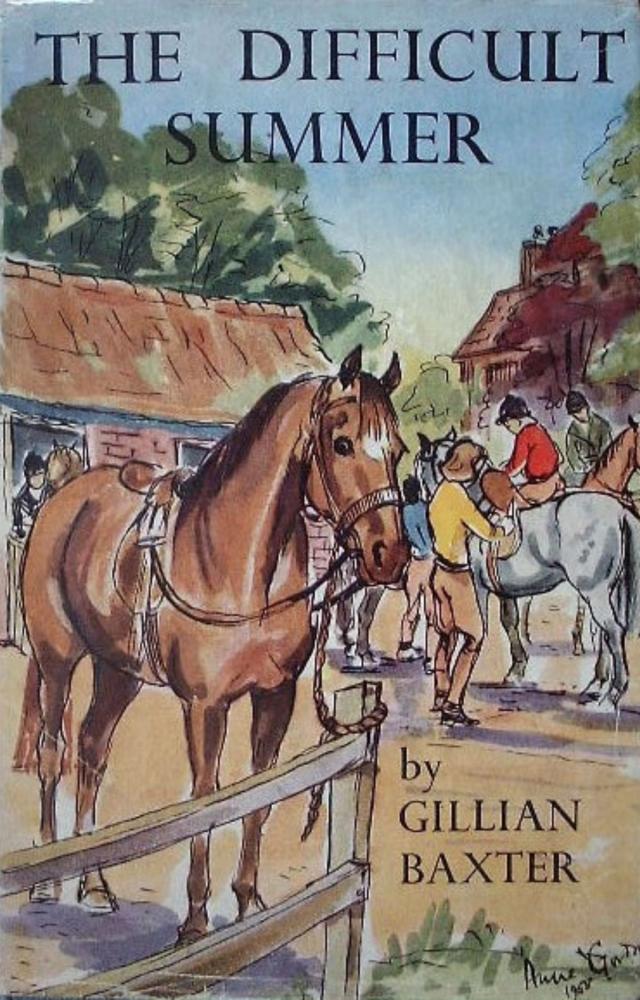
The Difficult Summer
Gillian Baxter
Contents
Introduction by Gillian Baxter
Chapter 1
Chapter 2
Chapter 3
Chapter 4
Chapter 5
Chapter 6
Chapter 7
Chapter 8
Chapter 9
Chapter 10
Historical note
Publishing history
The Bracken Stables series
Introduction by Gillian Baxter
I was born at Dartford in Kent just before the war and my earliest memories are of the army convoys of trucks and tanks driving past my house on the main road to Dover and the docks. A little later the memories include flying bombs coming over on their way to London. They did not always get that far and after a near miss by one my mother took me to stay with my grandmother in the safer area of Burton-on-Trent.
When I was twelve, we moved to London. My mother and father had both been teachers, though my mother had stopped work when I was small. My father was an economist and mathematician, and he joined the board of Marks and Spencer in London as an adviser on store management.
Until then I had gone to a convent school where I was fairly happy, but I hated the high powered Camden School for Girls. I went as little as possible and ended by being registered as home taught. I always felt a drive to write: I used to write about my pets, guinea pigs and mice, and when I started riding and became obsessed with horses writing about them was another way to enjoy them.
It was in London that I began to ride at the De Vere riding school in Kensington. It was owned by Anthony Pratt, one of the nicest people I was ever to meet. The horses were stabled on the first floor of De Vere mews with old coach houses on the ground floor and flats above the horses. The stables were reached by a cobbled ramp and the balcony outside them had a high wooden fence. I was soon spending all my spare time there helping with the horses in return for rides and I met my lifetime best friend there. Now both in our eighties Kay and I are still best friends, each of us now widows with daughters who also ride and compete.
It was Kay who inspired Jump to the Stars (1957), my second published book—the first was Horses and Heather (1956), for which I received a one-off payment from Warnes. Kay was sent to a rather exclusive boarding school and managed to turn permission for riding lessons into riding horses belonging to a dealer and jumping them in shows. It seemed a great plot for a book and so Bobby, Guy and Shelta came into being.
The 1950s was a good time to be writing pony books. Riding schools were opening, pony ownership was becoming more accessible and show jumping was on TV, its stars such as Pat Smythe, Marion Mould and David Broome collecting many fans. Even princesses were interested in show jumping and it was great to see Princess Anne photographed getting off a train with Jump to the Stars under her arm.
My third published book was Tan and Tarmac (1958), about horses and riding in London, and I used many of my experiences at the De Vere stables in that. It was after Tan and Tarmac that I set out seriously to write my next book as a sequel to Jump to the Stars and The Difficult Summer (1959) was the result.
I was by then working as an invoice typist at Country Life magazine but I never gave up writing: it has always been an essential part of my life. As well as over twenty books, I wrote weekly scripts for D.C. Thompson’s series of girls papers, Bunty, Judy and the like, which I continued to do for twenty five years.
I was even lucky enough to get my own pony, the first of many through the years. He was Tommy, a brown cob bought from a farm in Marlow where one of the girls who worked for Tony Pratt had connections. I was to own him for over twenty years. He was a very kind pony, quite plain with a hogged mane, lazy but excellent for learning on. As I got more experienced I rode many more horses but Tommy was always there, kind and good for most things from hacking down Rotten Row to galloping across country behind hounds, which he liked best. Many years later he was the first horse my daughter sat on when he was grey and elderly but still going. He was finally put down when he was thirty after increasingly bad bouts of colic.
In 1963 I got married to Peter Hirst, who was a teacher, and we had two daughters, Christina and Victoria, who are now keen riders themselves. Peter died quite suddenly from a heart attack and life in Surrey seemed to be a dead end. Chris was now with her future husband and Vicky was engaged when an advertisement in Horse and Hound gave Chris and me the idea for a new life with horses. This led us and Chris’s Paul to my present home in West Wales where we ran pony trekking and a riding school. Chris got a new event horse, and we were later joined in Wales by Vicky too. Much of this was the basis for my new Patsy series of books which started with With Vacant Possession? (2018).
As I started to think about new plots and characters I began to wonder what might have happened to Bobby, Guy, and their horses. I decided to find out. I had written many other books but always had a soft spot for Guy, bringing him back from his crippling injuries in The Difficult Summer and in The Perfect Horse. Now giving my characters a real romantic interest was very appealing, and that led to Love and Horses at Bracken (2019). This picks up where The Perfect Horse ends, with Guy proposing to Bobby. There are now six further Bracken stories, as well as three more books in the Patsy series.
I can no longer ride due to severe arthritis in my spine but as long as I can tap away on my iPad I hope to keep writing.
1
THE shadows were lengthening across the show ground, and the sunlight slanted in golden shafts across the quiet Surrey meadows. In the ring the jumps lay piled beside the ropes, leaving a clear run for the gymkhana ponies, and the audience was starting to thin, as people made their way towards the gates and joined the long queues at the bus stops. The show jumpers, hacks, show ponies and hunters were being loaded into their cattle trucks, trailers, and horse boxes, heavy lorries crawled carefully across the rough ground to the gate, bouncing over the cart ruts, and revving their engines frantically to get them up the steep, slippery slope to the road.
Roberta Morton put her tack into the passenger compartment of the big Bedford four-horse box belonging to the Bracken Hills Riding School, pushed her short, wavy brown hair back from her small, vivacious face, and gave her famous chestnut mare, Shelta, a last pat before jumping down and slamming the door on the two horses inside. Red-haired Heath Graham, who, like Bobby, worked for the Bracken stables, was fixing the three rosettes that they had won in the cab window, Shelta’s two blue firsts, and June Evening’s second from the novice class.
“They’re a wonderful advertisement,” remarked Bobby, climbing into the cab. “Not that we really need one at the moment.”
“We certainly don’t,” agreed Heath, remembering the teeming pupils and the endless lessons which went on all day, and sometimes, it seemed, half the night in the indoor school and the paddock at Bracken.
Heath finished fixing the rosettes where they could be seen by people outside and settled into the driving seat, switching on the ignition. A few minutes later they were driving slowly out into the road, people standing aside to let them pass, and Heath turned the box towards home, along the quiet, shadowy lanes.
As they rattled steadily along, with the shadows falling longer across their path as the sun sank towards the wooded hills of Surrey, Bobby happily remembered each glorious moment of Shelta’s two jumping classes, as she always could remember the details of her beloved mare’s performances. Shelta was jumping better than ever now, she decided, after her winter’s rest. It was her first show of any size since their tremendous success at Harringay last October, when they had won the B.S.J.A. spurs for the highest number of points gained by any one rider on one horse in the competitions held under B.S.J.A. rules during the days of the show.
“She really was going well today,” remarked Heath, signalling to an impatient, snarling sports car that she was ready to be overtaken.
“Yes. Two jump offs, and not a fence down all afternoon,” agreed Bobby, remembering Shelta floating effortlessly over the big triple to beat internationally famous Keith Rhodes by a clear round to his horse’s four faults.
“I meant June,” said Heath mildly. “I thought she was wonderful to come second with all that competition.”
“Oh yes, she was. Sorry. I was thinking about Shelta,” Bobby smiled. “You know, the only thing wrong with working for Guy is that it makes me professional, which means I can’t jump her in the British Team,” she said. “I’m sure she’d be good enough.”
“So am I,” agreed Heath. “But short of leaving Guy and getting a job in an office or something, I don’t see that there’s much you can do about it.”
Bobby agreed, knowing that she would never consider the idea. She was far too happy at Bracken, working for Guy Mathews, the young man who owned the riding school, and jumping some of his horses as well as her own Shelta in the shows.
High above them the sky was turning a darker blue as the sun sank towards the horizon, and the evening star appeared, pale against the darkening sky above the wooded slopes and the large suburban houses, the open stretches of common land, the golf links, patchy farmlands, and arterial roads of which Surrey is formed. They were just turning off the main road into one of the quiet lanes which led towards Bracken Hills when above the throb of their engine and the sound of traffic on the main coast road they heard the deep, stuttering roar of a heavy ’plane with engine trouble. Bobby peered out of the cab at the quiet, pale sky, and the ’plane came in to view, a little to their right, still quite high, but diving steeply, with a dark banner of smoke trailing from one of its engines.
“Heath, he’s going to crash,” she exclaimed.
“He might reach Gatwick,” replied Heath, watching the smoke thicken behind the machine. “It isn’t so far away.”
But Bobby doubted it. The ’plane’s dive seemed to become even steeper, and it was hidden from sight by the tree-covered slopes of the North Downs.
“I hope he manages to get down somewhere safely, anyway,” she said as the box gathered speed again along the quiet road.
As she finished speaking they were both startled by the dull roll of a distant explosion. Bobby gave an exclamation of horror, and the box swung slightly as Heath instinctively glanced in the direction in which the ’plane had vanished. There was an indignant blast on the horn of a following car, and Bobby said, “Heath, there’s smoke over there, towards Bracken.”
“It can’t possibly be the village,” said Heath firmly. “Not with all those hills round it. He must have hit the downs above the valley. I only hope they all managed to get out first.”
Bobby agreed, still gazing at the smoke, hating the thought of anyone crashing in flames like that. Heath drove on through the quiet lanes towards Bracken, and the thick black cloud was hidden from sight as they drove through Fern Dene, the next village to Bracken Hills, and took the quiet, tree-shadowed road towards Bracken. It was dark beneath the interlacing branches, and Heath switched on the headlights as they momentarily left the woods and passed Bracken Hills Station, with the pink stationmaster’s cottage behind it. From here another dark, deserted lane led to the village itself. Both girls were silent, remembering the roar of the explosion and the heavy cloud of oily smoke drifting above the downs. They rounded a bend faster than Heath normally drove with horses behind her, and Heath’s feet went down suddenly on brake and clutch at the sight of a riderless horse trotting in a nervous, hesitant manner up the centre of the road. She had the cab door open and was down on the road in a moment, with Bobby close behind her.
“Steady, girl. Steady, Froth.” Heath was holding out her hand. Pink Froth, fourteen two, strawberry roan, and one of the best gymkhana ponies in Surrey, stopped dead, staring at them with head flung up and eyes wild. In the light from the box headlamps she looked crazy and terrified, white glinting round her big dark eyes, nostrils red rimmed, and sweat creaming on her neck and flanks. But she allowed Heath to catch her, and without speaking Bobby fetched a halter from the box and slipped it over the pony’s tense ears. Then she lowered the ramp, the pony was hustled inside before she could think of jibbing, and the two girls scrambled back into the cab, not daring to put into words the thing that they both feared. Heath put the box into gear, surprised to find that her hands were shaking, and sent it leaping forward, ignoring the bangs of balancing horses behind her.
“She could have dodged out somehow,” said Bobby hopefully as Heath changed rapidly into top gear and trod on the accelerator.
“She could,” agreed Heath, swinging the box round a bend behind the swinging path of its headlights. One more bend and Bracken Hills was in sight. Both girls caught their breath at the sight ahead of them. The village itself seemed deserted, cottage doors stood open, a dog barked at a closed gate, and over everything, blotting out the evening star, hung a heavy pall of smoke. Somewhere ahead a flickering glow was reflected on the trees, and above the sound of the box they heard the clang of bells. Heath took the last long bend rather wildly, missing the kerb by a miracle, and pulling up sharply behind a police car. For a moment both girls just stared in stunned silence, unable to realise that they were not dreaming. For instead of the short, dark drive, and beyond it the softly lighted square of loose boxes, barns, and tack room, they saw the lurid flicker of flames, licking along rows of ruined loose boxes, the glowing, twisted parts of the crashed ’plane, the drifting cloud of evil smelling smoke, scarlet fire engines standing side by side in the road, while firemen, dark silhouettes against the heavy glow of the fire, played powerful jets of water on the flames. Two ambulances stood parked nearby, their white paint looking pink in the weird light. Several wild-eyed, sweating, panic-stricken horses milled among the crowd, while a few helpful onlookers attempted to catch them, and more people stood massed at the end of the drive, staring at the fire.
Feeling that she must wake at any moment Bobby climbed slowly down from the box, and followed by Heath pushed her way through the crowd towards the drive. Several people tried to stop her, or speak to her, but Bobby only wanted to hear, sensibly and truthfully, what had happened to everyone, to Guy, to the resident pupils, and to the horses. The entrance to the stable yard was blocked by the main fuselage of the ’plane, a mass of blazing fabric and struts, broken in two, seats hanging out of the shattered body, with the flames sweeping over them. There did not appear to be anyone inside, for which Bobby was thankful. The pilot had probably been making for the open fields beyond the stables, Bobby realised, and he had just failed to reach them. He seemed to have swept the tops off the boxes on the right of the yard as he came in, and had crashed just in front of them, the nose and forepart breaking away to bounce on to the boxes on the left. The firemen were playing thousands of gallons of water over the fiercely burning wreckage, somewhere a horse was kicking and screaming, and Bobby grabbed the arm of a nearby policeman, who was helping to keep the crowd back.
“Have you seen Mr. Mathews, the owner?” she asked desperately.
“Yes, he’s all right Miss, he wasn’t hurt,” the policeman assured her. “You’ll very likely find him with his horses, in the road.”
Bobby was staring into the smoke and flames, towards the sound of kicking.
“Is there a horse trapped somewhere?” she asked, finding herself forced to shout in order to make herself heard above the roar of the flames, the hiss of water, and the shouts of men.
“Well, I’m afraid there were several we couldn’t get out,” explained the policeman. “Had to stop Mr. Mathews from trying, he’d have got himself killed. Now, you go and help him look after the horses, Miss. You can’t do any good here.”
Bobby hardly heard the last part of the sentence. There was another way into the yard. She turned, forcing her way through the crowd across the bottom of the drive, and heading for the gate into the jumping paddock behind the stables. Then she was running over the rough grass behind the blazing boxes, heading for the other gate into the yard. There were two more fire engines parked there, the hoses leading in through the gateway. Bobby went straight in. The boxes, barn, and tack room across the top of the yard seemed undamaged, the box doors stood open, and the horses were gone. But the rest of the yard seemed an impossible inferno. But from somewhere behind that thick barrier of smoke, and the masses of wreckage and rubble, came the sound of kicking.
Bobby was past the firemen before anyone saw her, and was plunging into the smoke. The heat from the burning ’plane hit her like a solid wall, but she gasped and ran on. A roof shifted and fell inwards, sending up a shower of sparks, and there was the sudden roar of a new fire. The horse was not far away now, screaming on a high pitched note of terror that made Bobby feel sick. It was then that she saw Guy. He was struggling to shift a jammed door, his brown hair falling over his eyes, the lurid glow of the flames throwing weird shadows over him. There was a crash from inside the box, and Bobby hurried to help. It was unbelievably hot; the box was one of three that had somehow escaped the first blaze, and were so far only smouldering. One of them was Shelta’s, Bobby realised, and then remembered with a rush of relief that her horse was safe in the box outside.
The noise came from the centre one, and Bobby joined Guy in tugging at the broken, swollen top door. They were hidden from the fire fighters by the wreckage and the smoke. Both were weak with coughing, and Bobby could hardly see from her stinging, watering eyes.






