The long reckoning, p.1
The Long Reckoning, page 1


ALSO BY GEORGE BLACK
On the Ganges: Encounters with Saints and Sinners Along India’s Mythic River
Empire of Shadows: The Epic Story of Yellowstone
Casting a Spell: The Bamboo Fly Rod and the American Pursuit of Perfection
The Trout Pool Paradox: The American Lives of Three Rivers
Genocide in Iraq: The Anfal Campaign Against the Kurds
Black Hands of Beijing: Lives of Defiance in China’s Democracy Movement (with Robin Munro)
The Good Neighbor: How the United States Wrote the History of Central America and the Caribbean
THIS IS A BORZOI BOOK
PUBLISHED BY ALFRED A. KNOPF
Copyright © 2023 by George Black
All rights reserved. Published in the United States by Alfred A. Knopf, a division of Penguin Random House LLC, New York, and distributed in Canada by Penguin Random House Canada Limited, Toronto.
www.aaknopf.com
Knopf, Borzoi Books, and the colophon are registered trademarks of Penguin Random House LLC.
Library of Congress Cataloging-in-Publication Data
Names: Black, George, [date] author.
Title: The long reckoning: a story of war, peace, and redemption in Vietnam / George Black.
Description: First edition. | New York: Alfred A. Knopf, 2023. | “This is a Borzoi book.” | Includes bibliographical references and index.
Identifiers: LCCN 2022023618 (print) | LCCN 2022023619 (ebook) | ISBN 9780593534106 (hardcover) | ISBN 9780593534113 (ebook)
Subjects: LCSH: Agent Orange—Health aspects—Vietnam. | Agent Orange—Environmental aspects—Vietnam. | Vietnam War, 1961–1975—Health aspects—Vietnam. | Vietnam War, 1961–1975—Environmental aspects—Vietnam. | War victims—Services for—Vietnam. | Unexploded ordnance—Vietnam. | Land mines—Vietnam. | United States—Foreign relations—Vietnam. | Vietnam—Foreign relations—United States.
Classification: LCC DS559.8.C5 B53 2023 (print) | LCC DS559.8.C5 (ebook) | DDC 959.704/31—dc23/eng/20220810
LC record available at https://lccn.loc.gov/2022023618
LC ebook record available at https://lccn.loc.gov/2022023619
Ebook ISBN 9780593534113
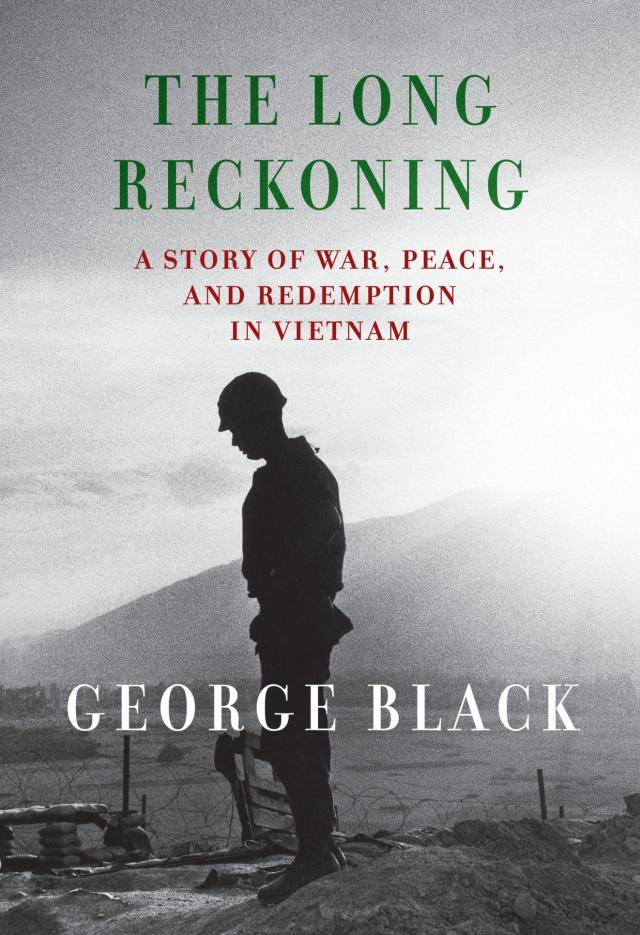
Cover photograph by Eddie Adams/AP/Shutterstock
Cover design by Chip Kidd
Maps by Joe LeMonnier
ep_prh_6.0_142879849_c0_r0
For Hien, Hong, Lai, Linh, Phu, Toan, and Trung,
who grew up under the long shadow of war
and have done so much to lighten it.
For Ngo Thien Khiet, in memoriam.
And for Yen Ly
The evils of war are great in their endurance, and have a long reckoning for ages to come.
—Thomas Jefferson,
letter to the Young Republicans of Pittsburg,
December 2, 1808
Contents
Maps
Prologue
PART I War
1 Going to B
2 Of Mountains and Machines
3 The Summer of Love
4 Socks on an Octopus
5 “Saddle Up, Cowboys!”
6 Grunt
7 Orphans of Creation
8 “This Is Not a Practice”
9 “Tonight You Die, Marine”
PART II Peace
10 Scavengers
11 The Smoky Landscape
12 Benefit of the Doubt
13 Untangling the Tangle
14 “Bring Our Daddy Home”
15 The Third Rail
16 The Things They Carried Back
17 A Vietnamese in Disguise
PART III Redemption
18 Policing the Brass
19 Milk That Glowed in the Dark
20 The End of Our Exploring
21 The Road to Damascus
22 Great Loss and Confusion
23 Angry Ghosts
24 The Worst Thing, the Best Thing
25 The Painter, the Sprinter, and the Monk
26 Unfinished Business
27 Turning the Ho Chi Minh Trail Brown
28 The Pocket of Fire
29 The End of the Trail
Epilogue: Hill 674
Illustrations
Acknowledgments
An Essay on Sources
Notes
Index
Illustration Credits
_142879849_
The Ho Chi Minh Trail ran almost all the way from Hanoi to Saigon, with a “Sea Trail” that carried supplies from the port of Haiphong. This map shows the main axis of the Trail in Laos and Cambodia and the principal infiltration routes into South Vietnam.
Prologue
Her name is Kieu. There are thousands like her.
She had seen many different kinds of airplanes in the year since the Americans arrived. There were tiny ones with only one man inside that circled almost soundlessly overhead like a hawk searching for some small field creature. There were fast, terrifying ones that swooped down from the sky like birds that had spotted their prey. Some of these had short, stubby wings, and some had wings that were swept back like the point of an arrow. Both kinds threw down a curtain of red fire and black smoke that consumed long lines of banana trees and bamboo thickets and stuck to people’s bodies and burned off all their flesh. Sometimes these airplanes fired rockets that made the houses explode and burst into flames.
She had also seen many different kinds of bombs. Some came in big containers that opened up before they hit the ground and shot out hundreds of little round bombs in all directions, small enough to fit into your hand. They reminded her of the ball she sometimes saw the Americans tossing around when they were off duty. Some of these little bombs thudded to the ground but did not explode, lying half-buried in the dirt. They seemed to be harmless, but Kieu’s mother warned her not to pick them up. Not every child in the village heeded that warning, and they paid dearly for it. There were also shells that were bigger than her baby brother, and her father told her that these came from the big guns on wheels that the Americans had placed on a hilltop west of the town. They made a whistling, roaring sound as they streaked overhead, and sometimes you could see the puff of smoke that rose when they struck their faraway targets. But the worst bombs of all fell from airplanes that flew so high no one could see them, and these shook the ground for many kilometers around and left rows of large deep holes in the rice fields that filled with water when the rains came.
There was also another kind of airplane that whirred like a dragonfly, and like a dragonfly, it could stop in midair and hover motionless. Mr. Tuan, who spoke the language of the Americans and helped them when they wanted to talk to local people, told Kieu that the soldiers gave these planes a special name: Huey. Once she had seen them firing their weapons at a patch of forest on the outskirts of her village, and then one of the fast planes came and set fire to all the trees. Then the dragonfly planes landed nearby, and all the men inside climbed out and hurried away, ducking their heads in the wind that gusted from the part on top that spun around in circles, flattening the grass.
Once Kieu was so close to one of the dragonfly planes that she could see the face of a soldier who sat in the open doorway holding a big gun. Somehow that made these hovering airplanes less frightening; you could look at him and hope he might look back and see that you were not his enemy. It was very different in this way from the silvery shapes in the sky that seemed to fly by themselves without human assistance.
Many of the soldiers lived at the base the Americans had built at the edge of the nearby town, on the road that led to the border between Vietnam and Laos. You would see them every day in the market, tossing coins to the women who squatted on the ground with their meager piles of fruit and vegetables for sale. Most of the men were friendly, although the ones from the government army who helped them could be rude and insulting. Some young women had come to live in the town when the Americans arrived, and they often waited at the gates of the camp and went for long walks with them and did not come back for a long time. Occasionally a soldier unwrapped a bar of sweet brown chocolate from its silvery paper and gave Kieu a square or two that she kept on her tongue until it melted.
After the soldiers went out to fight, she often saw them bringing back their dead on trucks or strapped to the back of a tank. Sometimes they were wrapped up in big green bags.
About a year later, when Kieu was twelve, a new kind of airplane came, very different from all the others. It was big and slow and ugly, with a fat engine slung under each wing and a high tail. Usually three of them flew so close together that their wings almost touched. They made a harsh, steady drone that grew louder as they approached and put her in mind of a big, lumbering water buffalo. Often a fast plane came ahead of them and dropped many of the little round bombs. These planes were called ma, the Phantom, Mr. Tuan said, and Kieu was always frightened when she saw one coming like an angry spirit.
The big airplanes came in the still of the early morning, from the direction of the East Sea, on days when there was no wind. They dipped low over the forest, barely high enough to clear the tallest trees, and a fine white mist streamed out behind them for some distance, then drifted to the ground like gentle summer rain.
The first time she saw these planes, they passed a few kilometers to the north of her village, where most of the fighting was, but later she saw them heading to the west, toward the Day Truong Son, the high mountains that ran along the border. Once they flew right over the fields next to her village, and people who were working there that morning got wet from the spray that came down on them. It made their eyes sting, and it smelled bad. After that the vegetables had a bad taste, and all the trees died.
The planes took off from the big air base in Danang, Mr. Tuan said. That was where the first American soldiers had come ashore from boats at the start of the war. He said that there had been a big celebration when they arrived. Schoolgirls had waited on the beach to greet them with garlands of flowers. Kieu had never been to the city herself; it was too far away. Mr. Tuan told her that even though the planes flew slowly, they could get here in less than an hour, which she found impossible to believe.
One day government soldiers came with guns and told everyone they had to walk into the town, which was four kilometers away. This was where they would live now, in small huts that they had to make from things that the Americans at the base had thrown away. They were surrounded by a fence made of curls of wire with sharp spikes. From the time the sun went down until it came up again the next morning, people were ordered not to leave their huts. A few days after they arrived, the soldiers burned Kieu’s village to the ground.
Despite the many hardships, Kieu made new friends in the town. Her parents got to know a family from a nearby village, whose eldest son, Thao, was sixteen years old. Her parents often said how much they liked the boy, how respectful he was, how devout his family were in worshipping their ancestors. At least once a week, Thao and his parents visited their graves, which were in one of the rice fields by the river that were still undisturbed. Kieu caught Thao glancing at her out of the corner of his eye; she had the impression that he liked her very much.
But then suddenly one morning he was gone. Kieu heard rumors that the Americans had come looking for him, and he had run away to the mountains with some of the other young men.
* * *
—
By the time peace came to her village, Kieu was a grown woman of twenty. She helped her parents and her two younger brothers rebuild their house and replant their fields. One day her father stepped on one of the little round bombs that had lain concealed for years in the mud of an irrigation ditch. It blew his left leg off below the knee and blinded him. After that, it was impossible for him to go on working.
About two years later, Kieu learned to her surprise and delight that Thao had returned to his ancestral village to visit his family. She went there to see him. He told her stories of the experiences he had had as a soldier. Many young men in his regiment had died, and he wondered if their bodies would ever be found and given a proper burial, or whether they would become wandering ghosts. He had seen the strange spray planes many times, he said, and twice, on the secret border trails, they had soaked him. Later he had watched the leaves on the nearby trees turn yellow and fall to the ground, and it was no longer safe to use those parts of the trail because now the bomber planes could see them from the air. But by that time the army from the North had big guns that were powerful enough to shoot down aircraft, and he watched several of them crash in flames, deep in the mountains.
Thao told Kieu that he had been living in the capital since the war ended. He now wore the uniform of the People’s Army, which made him look very handsome, and one day he asked his parents and Kieu’s if they would look well on his wish to join their families together.
After their marriage, Kieu and Thao moved to a small town near the ancient city of Hue, where Thao’s battalion was stationed. Their first child was born less than a year later. He was a strong, healthy boy, and they named him Hieu, choosing the name because it signified that he would be an honorable person and show respect to his parents.
A girl came next, and they called her Phuc, because she brought them happiness and good fortune. But this happiness did not last, because the child refused to nurse and was no more than skin and bone. She had only three fingers on one hand and dragged one very thin leg behind her when she learned to walk. Sometimes her whole body seemed to tremble, and she would fall to the ground.
Another brother followed, and his problems were of a different kind. He didn’t understand things well, and he never learned to speak properly. There was no question of sending him to school. Phuc sometimes went, but often she stayed home because she suffered from bad headaches, and her classmates made fun of her whenever she fell down.
A doctor from the city came to examine the two malformed children, but he had no explanation for these strange maladies. Kieu was not the only mother in the commune to have this experience. Several other families had two children who were sick in different ways, and one even had three. Kieu and her husband wondered if perhaps the villagers had done something to offend their ancestors and thereby aroused vengeful spirits. One morning when her younger son was ten, he did not wake up. Kieu was ashamed to admit it, but it came almost as a relief.
Many years passed. The government gave the family a little money because Thao was considered a hero of the war and Phuc was sick, but Kieu found it hard to look after their daughter alone. When Phuc reached the age at which a girl begins to think of marriage, Kieu knew that such a thing could never happen for her daughter. Though she herself had not even reached her forty-fifth birthday, she felt old before her time.
One day Mr. Tuan announced that some honored guests would be visiting the commune. He was the chairman of the people’s committee now, and it was only after the war that people learned that the whole time he had seemed to be working for the Americans, he had really been spying on them and passing along their secrets.
The guests were from America, Tuan said, which startled Kieu, because she had seen no Americans since the war ended. The villagers who had sick children, or who had been hurt by stepping on one of the little bombs, were invited to attend a special meeting with the visitors. Kieu went with Phuc. They sat next to their neighbor, Grandmother Huong, who came in her wheelchair, and Ong Khanh brought along his son, who had no arms.
Four Americans with graying hair, all a little older than Kieu, arrived in a small white van. She had forgotten how big Americans were. Mr. Tuan told the villagers that the men had fought here during the war, and two of them had even been in the big battle in Hue city, which had left so many people dead. The tallest of the guests, who seemed to be their leader, said that it had been very hard for them to come back, because their army had lost the war, even though it was so big and powerful. But they wanted to see the places where they had served their country, and to honor their fallen comrades.
Phuc grew restless as the man talked, and although Kieu told her to sit still and listen respectfully, she got up and began to walk around, dragging her misshapen leg behind her and making the strange little noises she made when her head hurt. The leader of the Americans stopped talking and watched Phuc with a sad expression on his face. He turned to Mr. Tuan and spoke softly to him. When he had finished, Mr. Tuan translated what he had said: “Is there anything we can do to help?”
PART I
WAR
Even the finest sword plunged into salt water will eventually rust.
—Sun Tzu, The Art of War
1
Going to B
Hanoi remembers the war, but mainly Hanoi forgets. There seems to be no end to the construction boom. In the city’s upscale neighborhoods, Vietnam’s nouveaux riches build themselves gaudy mansions with Roman balconies, Doric and Corinthian pillars, and classical fountains and statuary. Luxury high-rise apartment buildings spring up overnight. Many of these monuments to the new prosperity have English names—the Lancaster, the Gardenia, Goldmark City, the Skylake. Towering over a cloverleaf intersection by the rust-brown crawl of the Red River is the Sunshine Riverside, the name revolving in rainbow colors on a giant LED display at penthouse level. Other complexes, like the D’Le Roi Soleil, pay oblique homage to Vietnam’s French colonial heritage.