Flora macdonald, p.1
Flora Macdonald, page 1


Also by Flora Fraser
The Washingtons
Pauline Bonaparte
The Unruly Queen
Princesses
Beloved Emma
This Is a Borzoi Book
Published by Alfred A. Knopf
Copyright © 2022 by Flora Fraser
All rights reserved. Published in the United States by Alfred A. Knopf, a division of Penguin Random House LLC, New York, and distributed in Canada by Penguin Random House Canada Limited, Toronto. Originally published in hardcover in Great Britain by Bloomsbury Publishing Plc, London, in 2022.
www.aaknopf.com
Knopf, Borzoi Books, and the colophon are registered trademarks of Penguin Random House LLC.
Library of Congress Cataloging-in-Publication Data
Names: Fraser, Flora, author.
Title: Flora Macdonald : “pretty young rebel” : her life and story / Flora Fraser.
Description: First edition. | New York : Alfred A. Knopf, 2023. | “This is a Borzoi book published by Alfred A. Knopf.” | Includes bibliographical references and index.
Identifiers: LCCN 2022006215 (print) | LCCN 2022006216 (ebook) | ISBN 9780451494382 (hardcover) | ISBN 9780451494399 (ebook)
Subjects: LCSH: MacDonald, Flora, 1722–1790. | Charles Edward, Prince, grandson of James II, King of England, 1720–1788—Friends and associates. | Jacobites—Biography. | Women heroes—Scotland—Biography. | Scots—North Carolina—Biography. | Women American loyalists—North Carolina—Biography. | Scotland—History—18th century. | North Carolina—History—Revolution, 1775–1783.
Classification: LCC DA814.M14 F73 2023 (print) | LCC DA814.M14 (ebook) | DDC 941.107—dc23/eng/20220630
LC record available at https://lccn.loc.gov/2022006215
LC ebook record available at https://lccn.loc.gov/2022006216
Ebook ISBN 9780451494399
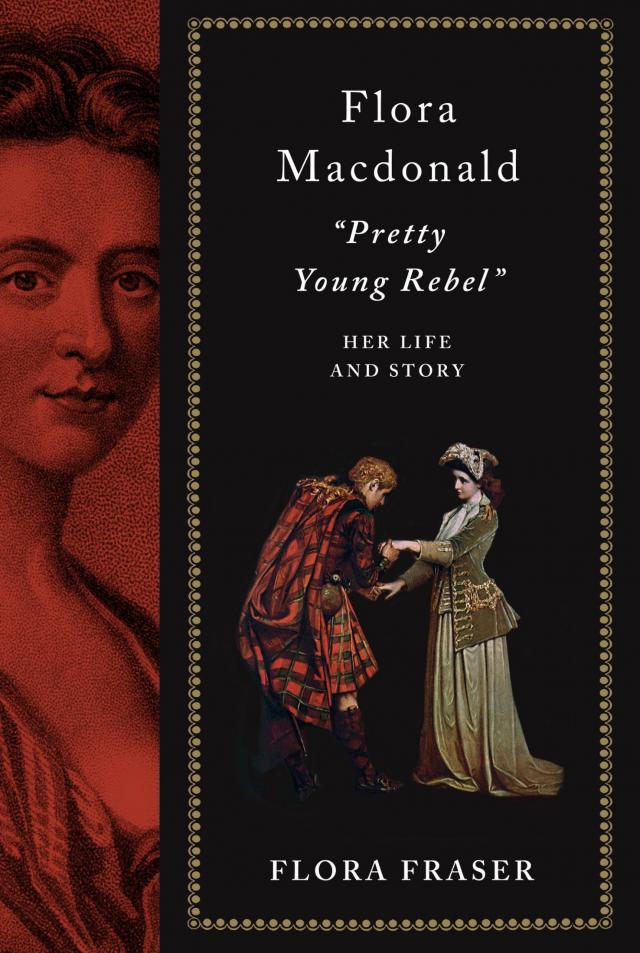
Cover images: (left) Flora Macdonald. Classic Image / Alamy; (right) Prince Charlie’s Farewell to Flora Macdonald. Pictures Now / Alamy
Cover design by Jenny Carrow
ep_prh_6.0_142226817_c0_r0
For Robert Gottlieb
dear friend and Avid Reader
Contents
Maps
Prologue: Flora Macdonald; Flora Fraser
1 A Fugitive Prince
1745–1746
2 Ill Met by Moonlight
June 1746
3 “Great Fears”
June 1746
4 “A Man in a Woman’s Dress”
June 1746
5 “Farewell to the Lad”
July 1746
6 Prisoner on the Furnace
July–August 1746
7 “The Famous Miss Flora Macdonald”
August–December 1746
8 High Treason
January–July 1747
9 A Jacobite Dowry
August 1747–April 1751
10 Married Life
April 1751–1770
11 “We Have Hardly What Will Pay Our Creditors”
1771–1774
12 Cheek’s Creek, North Carolina
1774–April 1775
13 “King and Country”
April–June 1775
14 “All Killed or Taken”
July 1775–February 1776
15 “Almost Starved with Cold to Death”
February 1776–December 1779
16 “All Possible Speed to the Highlands”
1780–1785
17 Royal Pensioner
1785–March 1790
18 “Speed, Bonnie Boat, like a Bird on the Wing”
The Story
Illustrations
Acknowledgments
A Note on Spelling and Punctuation
Notes
Select Bibliography
Index
_142226817_
Maps
Prologue
Flora Macdonald; Flora Fraser
I cannot remember a time when I did not know the story of Flora Macdonald. I was named after her and grew up at Eilean Aigas, a house on an island in Scotland with palace doors and wooden thrones carved by the Sobieski Stuarts. Occupants during the reign of Queen Victoria, these brothers claimed to be legitimate descendants of Bonnie Prince Charlie. Loaned this remote retreat on the river Beauly by the Lord Lovat of the day, the better to research their claim to the British throne, the Sobieski Stuarts dressed in full Highland regalia and were rowed in a royal barge to worship in the local Catholic church, which we attended in our turn.
Not only on the Island, as we termed our home, but everywhere around in my childhood and adolescence there were reminders of the ’Forty-five, the civil war that raged in Scotland in 1745–46 when the Stuart prince roused support for his bid to wrest the British throne from the House of Hanover. Stones on Culloden Moor, the other side of Inverness, marked the battle positions of Frasers and other local clansmen who fought under Charles Edward in a last and fatal reckoning in April 1746 with troops commanded by William, Duke of Cumberland. Disdain for the latter’s butchering ways in that engagement was later expressed by the naming of a weed seen in every hedgerow as Stinking Willy. Bonnie Prince Charlie, by contrast, appeared, in a portrait often reproduced in books, a pale and lovely Prince Charming. Flora Macdonald, who came to his aid at a time of great need, was a local heroine: her statue stood outside Inverness Castle, and her grave face and neat figure provided an image familiar to me from childhood on tartan boxes, on postcards, and in engravings.
At Beaufort Castle nearby loomed a Hogarth painting of the Old Fox, a Lovat forebear whose son was “out” in the ’Forty-five with the prince. Westward in Glen Strathfarrar, this clan chief lurked in the wake of Culloden, hoping, like the Stuart prince, to escape government detection. Lovat, apprehended, became the last peer to be executed on Tower Hill; Charles Edward, with the aid of Flora Macdonald and others, escaped to the Continent, where he was to die in 1788 without ever returning to Scotland.
I imbibed Robert Louis Stevenson’s Kidnapped and other books focusing on the prince or on his supporters skulking in the heather. Flora Macdonald’s bravery in voyaging with Charles Edward disguised as her Irish maid between the Western Isles and Skye attracted my attention. When I came to read, however, the works of John Prebble and others that dispelled romantic myths about the prince, I turned away from Jacobite history and shifted to other realms of the past. Had I not chanced upon her image when looking for illustrations for my book The Washingtons: George and Martha (2015), I might never have been drawn back to consider the life of Flora Macdonald. There, among a sheaf of American revolutionaries’ portraits, was an image of Flora Macdonald familiar to me as hanging in the Scottish National Portrait Gallery in Edinburgh. What had she, a Jacobite heroine of 1746, to do with these patriots across the Atlantic in the 1770s and later?
Dimly I remembered Dr. Johnson and Boswell visiting Flora on a journey they made to the Western Isles, and her telling them that they were lucky to catch her, as she was off to America. My curiosity aroused, I looked up the date and found that she acted as hostess to the pair on the Isle of Skye in September 1773, eighteen months before the outbreak of the Revolutionary War. A quick search revealed that Flora emigrated to North Carolina the following year and was subsequently also in New York and Halifax, Nova Scotia, during that conflict. Furthermore, while Flora had been imprisoned as a Jacobite rebel in the ’Forty-five, her husband and four of her sons fought as loyalist officers for George III.
I returned to my task of securing illustrations for The Washingtons, but my mind was made up. I would next write about my namesake. What I discovered and what I present here is almost stranger than the Jacobite fiction I read as a child. It has caused me to think deeply about Scottish and American nationalism and the nature of loyalism as a function of emigration. Most of all, while as a child, I hero-worshipped Bonnie Prince Charlie, now I admire Flora Macdonald unreservedly.
1
A Fugitive Prince
1745–1746
he Western Isles, or Outer Hebrides, are remote and wind-lashed maritime lands. A strand of rough diamonds, they lie off the west coast of mainland Scotland in the Atlantic Ocean and on the outer edge of Europe. The ground, at the mercy of the ebb and flow of the ocean and washed by driving rain much of the year, can appear more water than land. Lewis and Harris, North Uist, Benbecula and South Uist, Eriskay and Barra are some of these islands’ names. In the mid-eighteenth century, during the reign of George II, they were known locally and collectively as “the Long Island” and were the private fiefdoms of Macdonald, Macleod, and other clan chiefs.
White beaches and fertile shores dominate the low-lying western coastline of sprawling South Uist and of diminutive Benbecula, to the immediate north. On the farther side of a spine of hill, glen, and moor, the precipitous eastern coastline is rich in rocky inlets and coves, providing safe anchorage for vessels. In the mid-1740s a Macdonald chieftain generally known as “Old Clan” but properly Ranald Macdonald, XVII Captain of Clanranald, held feudal sway here and lived in peace with two powerful neighbors on the Isle of Skye, Sir Alexander Macdonald of Sleat and Norman Macleod of Macleod.
These last two chiefs were more of
Centuries before, Scottish kings had conferred lands in this Atlantic archipelago upon forebears of Old Clan, the Knight, and the Laird. In the clan system that had since evolved in the Highlands, “tacksmen,” or gentlemen farmers, from collateral branches of the main Clanranald line, held their land on long leases from their kinsman chief. In turn, they provided smallholders—known as “the common sort”—with exiguous acres in exchange for an amalgam of labor, rent, and produce. Bovine disease and drought, rather than the might of other clans or government troops, were now feared by these islanders, richer or poorer. In summer the tacksmen grazed their livestock inland, in the glens that abounded there and above a maze of freshwater lochs. In winter they pastured their cattle on low ground, close to their farms. The wealthier among them had stone houses and dined on roast meat and drank French wine and brandy, as did Old Clan and his wife and family at Nunton, his seat on Benbecula. Herdsmen occupying dwellings that were sometimes little more than huts made a diet of bread, oats, cheese, and barley more palatable by the addition of whisky.
In the summer of 1746, notwithstanding these decades of peace, the atmosphere on South Uist and Benbecula was febrile. Militia raised on behalf of the crown by the Knight and the Laird from their lands on Skye and on the Long Island guarded the fords in the shallows between South Uist and Benbecula. The Minch, a channel some thirty nautical miles wide between the Long Island and Skye, was “pestered with the English navy,” as a South Uist native later remembered with feeling. The vessels in question, he observed, had been “sent there a purpose to hinder the prince or any of his party to make their escape.”
The royal personage in question is known to history as Bonnie Prince Charlie. Then a fugitive with a price on his head, to his pursuers he was “the Young Pretender.” The limelight had shifted from his father, James Edward Stuart, a prince dubbed “the Pretender” at the time of his bid to seize the British throne thirty years earlier and now often referred to as “the Old Pretender.” In the wake of a failed attempt on the British throne, Prince Charles had since late April been “skulking”—moving about stealthily—in a variety of refuges on the Long Island, among them Corradale, a secluded glen in South Uist on Clanranald land. The chief of those territories and his brother, Alexander Macdonald of Boisdale, supplied bread and brandy, shirts and local information; and the latter took charge of plans to secure the prince’s escape to the Continent. Although the Knight was steadfast in his support for the government, his wife, Lady Margaret Macdonald, sent secretly to Charles Edward in his Corradale retreat copies of the London Gazette containing valuable domestic and foreign intelligence. Many others, including several militia officers on South Uist and Benbecula, came to know and keep secret his identity over the course of these weeks. When fifteen Royal Navy ships hovered off the coast in mid-June, however, and a party of regular (commissioned) officers, landing on South Uist with orders to hunt down the Young Pretender, took Boisdale prisoner, real danger threatened.
At this point, when all seemed lost, Hugh Macdonald of Armadale sent a private message to the loch, where the royal party was “lurking [concealed].” This Skye tacksman was an officer in one of the government militias raised the previous autumn by the Knight. “Armadale,” as he was known, declared himself, “though an enemy in appearance, yet…a sure friend in his heart” and made a novel and daring suggestion for the prince’s deliverance: “As it seemed now impossible for him to conceal himself any longer in the country,” the officer volunteered “to send his stepdaughter, Miss Florence [Flora] Macdonald,” then on South Uist, “to Sleat” in Skye, where he and her mother lived. If His Royal Highness would “dress in women’s clothes, that he might pass for her [Flora’s] servant maid” on the voyage, Armadale advised, the disguised prince was sure “to be protected by Lady Margaret Macdonald” on that island across the Minch. The Knight’s second wife had been bred to favor the exiled Stuarts by her mother, a Scottish countess. Finally, the Skye militia officer proposed that Neil MacEachen of Howbeg, a cousin of Flora’s then with Charles Edward, be appointed to take care of both mistress and “maid” on the journey. This scheme of Armadale’s “pleased the prince mightily,” and he was “very impatient to see it put into execution.” It was envisaged that, in place of Boisdale, secret adherents to the Stuart cause on Skye would further plan to land and conceal him on the mainland, until a passage to the Continent might be effected.
Charles Edward Louis Philip Casimir Stuart had come from the Continent the previous summer to threaten the Hanoverian dynasty, now established on the British throne some thirty years. Long before, in the “Glorious Revolution” of 1688, James II of England and Wales and VII of Scotland, Charles Edward’s grandfather, had been deposed and exiled to France, after he turned Catholic, with his second wife and infant son. Since then James II’s daughters and son-in-law—William and Mary, then Anne, all Protestant monarchs—had reigned, until 1714, when the last had died childless. The then Elector of Hanover, as the queen’s nearest Protestant relation, next succeeded to the British throne as George I, and his son, George II, now ruled in the United Kingdom.
These Hanoverian monarchs from Germany did not please all in Scotland, whether Protestant or Catholic. Other than during the Cromwellian years, Stuart monarchs had reigned there since 1371 and in England and Ireland since 1603. Although the exiled James II had died in 1701, periodic attempts were made after 1714, with the aid of France, to restore the “rightful” Stuart line to the British throne in the shape of his son, James Edward Stuart. All had failed. Most recently, a French invasion force sent across the English Channel in early 1744 had been driven back homeward by storms, and Louis XV thereafter declined to offer aid to his fellow Catholic prince. He continued, however, to recognize the Stuart exile as James VIII of Scotland and III of England. Pope Benedict XIV and the papal court in Rome, where James Edward had now long resided and brought up his sons, Charles Edward and Henry Benedict, followed suit.
Styled “the Chevalier” by his supporters and “the Pretender” by the Hanoverian government, the Stuart princes’ father was, in the 1740s, pious, sickly, and old before his time. Nevertheless, he and his adherents, termed Jacobites, “Jacobus” being the Latin for James, still dreamed of his restoration to the British throne and centered their hopes in James’s elder son as agent for that change. Charles Edward was an ambitious young man in vigorous health. Covert encouragement from the Scottish Highlands led him to leave his paternal home in Rome for Paris and there in the summer of 1745 plan a daring attempt on the Hanoverian throne. The outcome of this venture, which has come to be known as the ’Forty-five, was to visit upon Georgian Scotland and England civil war and government retribution that lasted into the following year. When the Stuart heir slipped out of France, however, and landed in July 1745 in Clanranald country on the west coast of Scotland, he had with him only seven companions, four of whom had no previous military experience.
The prince’s unheralded arrival in Scotland took both Highland chiefs and the Hanoverian government by surprise. The country people in Arisaig, where the prince came ashore, were thunderstruck by the royal apparition in their midst. A member of a nearby parish was questioned by her minister: “What number of people is with him?” “Six men and himself,” the woman answered, “but word is sent to all the Highland chiefs about.”