The far battleground, p.1
The Far Battleground, page 1


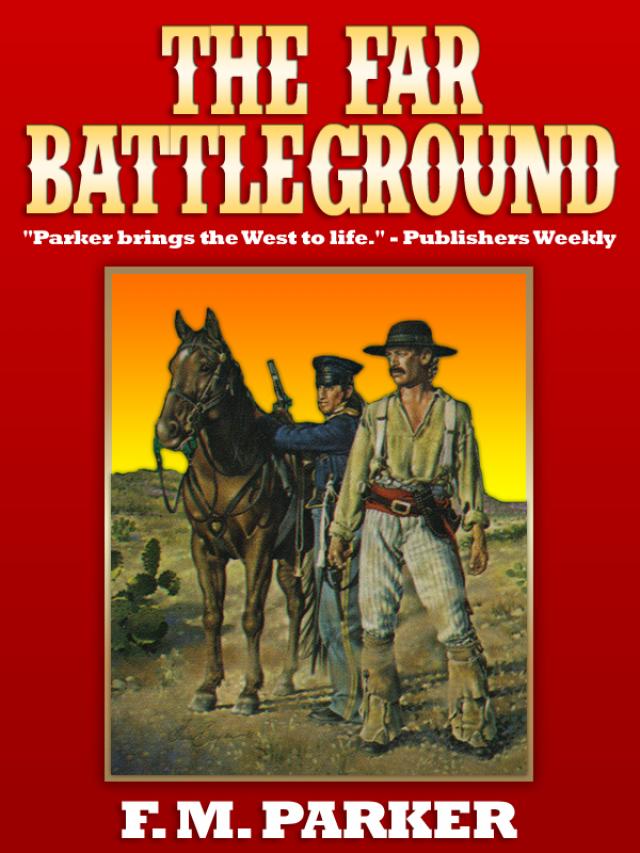
The Far Battleground
F. M. Parker
The Far Battleground is set in 1847 when the U.S. was at war with Mexico. It brings together two strong characters: Lieutenant Thomas Cavillin of the Texas Rangers and Lieutenant Matthew Chilton of the U. S. Calvary’s Dragoons. Fighting their way through hostile territory from Vera Cruz on the coast to capture Mexico City in the far mountains with General Winfield Scott’s small American Army, the two men are drawn together in warrior camaraderie. In the deadly battle to capture Mexico City, Cavillin leads his Rangers to punch a hole through a powerful force of Mexican Lancers to rescue seriously wounded Chilton and his Dragoons from slaughter.
Remembering the slaughter of Texans at The Alamo and Goliad, the Rangers are ruthless with the Mexican people. Robbing and killing them for little reason, the Rangers become a huge problem for General Scott trying to make a treaty with the government of the beaten people.
When Chilton recuperates from his wounds he is filled with vengeful bitterness, and feels responsible for many of his men being killed or crippled. Wanting to collect money for his crippled Dragoons and the families of those killed, he leads a renegade band of Dragoons on a marauding spree along the Camino Real robbing Mexican towns of their gold and silver.
Wade Ussing, thief and killer and whoremaster, brings his women from New Orleans to Vera Cruz and onward to Mexico City. There he sets up a brothel. Chilton falls in love with the beautiful Sylvia, Ussing’s woman. When Cavillin backs Chilton, Ussing and his thugs set out to kill both men.
Cavillin and his Rangers are ordered to catch the pillaging Dragoons. It is a difficult task for Cavillin who identifies his friend as the leader of the thieving Dragoons and must pursue him. The chase becomes a dilemma of conflicting emotions, divided loyalties and justice.
We are in a strange situation—a conquering army on a hill overlooking an enemy’s capital, which is perfectly at our mercy, yet not permitted to enter it, and compelled to submit to all manner of insults from its corrupt inhabitants.
From the diary of Ephraim Kirby Smith, Captain, U.S. Army, dated August 29, 1847, at Tacubaya, Mexico. Wounded in battle on September 8, Captain Smith died September 11, 1847.
Soon, too soon, come faithful warriors to their rest.
Author Unknown
About the Author
F. M. PARKER has worked as a sheepherder, lumberman, sailor, geologist, and as a manager of wild horses, buffalo, and livestock grazing. For several years he was the manager of five million acres of public domain land in eastern Oregon.
His highly acclaimed novels include Skinner, Coldiron, The Searcher, Shadow of the Wolf, The Shanghaiers, The Highbinders, The Far Battleground, The Shadow Man, and The Slavers.
“SUPERBLY WRITTEN AND DETAILED… PARKER BRINGS THE WEST TO LIFE.”
Publishers Weekly
“ABSORBING…SWIFTLY PACED, FILLED WITH ACTION!”
Library Journal
“PARKER ALWAYS PRESENTS A LIVELY, CLOSELY PLOTTED STORY.”
Bookmarks
“REFRESHING, COMBINES A GOOD STORY WITH FIRST-HAND KNOWLEDGE.”
University of Arizona Library
“RICH, REWARDING… DESERVES A WIDE GENERAL READERSHIP.”
Booklist
Also by F.M. Parker
Novels
The Highwayman
Wife Stealer
Winter Woman
The Assassins
Girl in Falling Snow
The Predators
The Far Battleground
Coldiron – Judge and Executioner
Coldiron - Shadow of the Wolf
Coldiron - The Shanghaiers
Coldiron - To Kill an Enemy
The Searcher
The Seeker
The Highbinders
The Shadow Man
The Slavers
Nighthawk
Skinner
Soldiers of Conquest
Screenplays
Women for Zion
Firefly Catcher
PROLOGUE
THE TWO continents were enormous plates of granitic rock seventy miles thick rafting upon the hot basalt core of the planet. For one hundred and sixty million years, the mighty continents had struggled to tear themselves apart. Tortured and stretched by tremendous rending forces, they reached nearly from pole to pole. Only a long, narrow neck of land still held the warring continents together.
A tall mountain range eighteen hundred miles long ran north-south upon the broad back of the northern continent. Many rivers poured from the mountain highlands in rock devouring violence down the steep escarpment, to plunge their endless floods into the salty brine of the waiting oceans.
Over the aeons, the powerful tension continued to build between the continents. In one section of the narrow neck, the strength of the rock was breached and a fault split the crustal plates, creating a rupture down to the hot bowels of the earth.
Along the zone of weakness, lava boiled upward thrusting apart the rock holding it entombed. The glowing, red-hot lava exploded onto the surface, spreading across the land, cooling and hardening. The molten mass erupted again and again from the deep cauldrons. Tall mountains grew, reaching three, four miles into the sky.
The violent explosion ceased. But the mountains only rested. Within their craters, poisonous sulfur fumes brewed endlessly. Upon the rocks, five hundred feet below the rim of one crater, a yellow rime of pure, elemental sulfur precipitated from the deadly vapors.
The volcanic mountains dammed the courses of several rivers. A bolson, a deep depression, some five thousand square miles in length, was formed, into which the rivers poured. The streams died there in five lakes and an immense area of swampland.
Far north of the bolson, a continental glacier came to life. It stole away thousands of cubic miles of water from the oceans. The ice accumulated to more than a mile thick and flowed south for many hundreds of miles. In the lower latitudes, ice fields were birthed on the tops of the tall mountains, filling all the high valleys.
The woolly mammoth, the saber-toothed tiger, the giant bison, and many other species of animals of the broad plains, fled before the irresistible advance of the ice monster. They migrated south, traveling just below the hanging walls of ice of the mountain glaciers.
A new animal, small compared to the woolly mammoth and the saber-toothed tiger, came upon the western border of the northern continent. The man, with his woman and sturdy children in tow, trekked south along the coast. With his flint-tipped spears and his courage, the man was a deadly hunter and a formidable opponent even to the largest of beasts.
In three hundred generations, nine thousand years, the man had ranged a very long distance and reached the deep bolson of the five lakes.
* * *
On the slopes of the smoking mountain above the bolson, the nine hunters of the clan of man halted in the edge of the coniferous forest beneath the hanging glacier. Quietly they squatted around a pile of dung dropped by a mammoth. Steam still rose in tiny gray tendrils from the brown pile. A rank odor was sour in the nostrils of the men. The leader gave a hand signal, and the men slipped, silent as spirits, along the spoor of the large animal.
The mammoth lifted his massive head, and the long trunk snaked out to suck at the cold, moist air. The scent of the alien creature that trailed him was stronger now. The shaggy beast shook his sharp ivory tusk. He trumpeted shrilly. His angry challenge bounced and echoed ferociously among the large boles of the pines.
At the cry of the mammoth, the band of men broke into a swift-footed run. They spread out when they came into sight of the animal. The leader drew back his arm and flung his stone-tipped spear.
The mammoth screamed at the sharp punch of the weapon. He whirled and lunged away. The men raced behind, howling wild, excited calls of encouragement to each other.
The beast hurled himself across a broad mass of rock and gravel washed out from the glacier, and onward down the mountainside to a jumble of fallen trees. There in the tangle of downed and rottening timber, the nimble-footed men overtook the mammoth. Thirty, a hundred times, the men stabbed the animal with their spears. And slew it.
Man had made his first kill on the mountain. The land would know his savage presence for the next ten millennia.
The mammoth, the saber-toothed tiger, and the giant bison would survive but two thousand years more. Over the passing ages, man would forget the big beasts had ever existed.
The man developed a grand civilization, a far-flung empire, and a powerful religion, with human sacrifices. All control of the vast domain was centered at a city of a quarter million citizens lying beside the five lakes in the wide bolson. It was a nation of proud people, rich with gold, silver, and jewels.
Until the white men came from the ocean and climbed the mountains. Twice the white men came—warring. Both times he conquered the brown men, killed them by the thousands, and stole their gold, silver, and jewels.
CHAPTER 1
September 7, 1847
THE MEXICAN Lancers left their place of concealment in the cypress woods on the flank of the hill, El Penor. Trotting their horses, the red-uniformed cavalrymen came down into the deeply worn and rutted El Camino Real, The King’s Highway, which connected Mexico City with Vera Cruz. The captain of the Lancers shouted a command, and his men formed into a single rank, stretching six hundred feet north from the base of the hill to an anchor point on the edge of a deep arroyo.
The captain reined his mount about and stared south along the ancient, centurie
These damnable Americans had invaded his land. They had won all five battles in the north on the Rio Grande, even Buena Vista, though General Santa Anna had declared that a victory for himself. But in what circumstances does a victorious army desert the battlefield secretly in the dark of a moonless night?
Flush with conquest, the Americans had come in an armada of ships and captured Vera Cruz. Brashly they marched inland, beating aside every attempt by the Mexicans to stop them at Cerro Gordo, Jalapa, Puebla, and many other battlefields. Now, two hundred and sixty miles deep in the heart of the country, they lay panting at the walls of Mexico City, the nation’s capitol. The captain had begun to think God was a Yankee.
* * *
Lieutenant Thomas Cavillin halted his troop of thirty Texas Rangers, and they sat their weary, sweat-streaked mounts under the huge yellow sun. The men pulled their neckerchiefs up over nose and mouth as the dust the horses had stomped into the air washed over them in a dense, gritty pall. It drifted away, and several of the Rangers hawked to clear their throats and spat on the ground.
“I count two officers and about a hundred Lancers,” said Cavillin, surveying the line of Mexican cavalrymen blocking the road three hundred yards ahead. He wiped at the sweat trickling down through the stubble of his red beard and flicked a droplet from the tip of his nose.
“That’s near my count, too, Lieutenant,” said Sergeant Granger, who sat his mount nearby.
Cavillin leaned his rawboned body toward his enemies as he speculated upon his next move. He lifted his head and sniffed at the slow wind flowing over him in hot, slippery waves, as if he could smell the intentions of the Mexicans on it.
The Rangers were part of a regiment of five hundred men sent by Texas to join the war against the Mexicans. They were hardened, staunch veterans, having fought in all the battles with General Zachary Taylor in the north on the Rio Grande. Then they had sailed from Brazos Santiago, south across the Gulf of Mexico, and helped General Scott capture Vera Cruz and fight inland to Mexico City.
Neither Cavillin nor his men owned uniforms. They were clad in a hodgepodge of leather boots, flannel shirts, cotton trousers, and caps or hats. All were armed with short-barreled carbines, bowie knives, and a pair of Paterson Colts, .36 caliber and holding five shots.
“Sergeant, those fellows seem intent on preventing us from reaching General Scott at Tacubaya,” Cavillin said and watching one of the Mexican officers in his tall, black, shako hat begin to ride along the rank of his men and talk to them, his arms gesturing for emphasis to his battle speech.
Cavillin pivoted his horse to scrutinize the terrain in all directions, searching for more enemy soldiers. There was nothing except the brushy hills, lying empty and smoldering in the heat.
Cavillin raised his voice and spoke to his men. “Our orders are to avoid a fight if we possibly can. General Scott wanted us to scout back along the road to Aytola and then return. But I see no way to get past these Mexicans, unless we take to the hills and try to outrun them.” His patrol had ridden hard for two days with only one six-hour camp made in the middle of the night. Fatigue showed in the strained faces of the men and the drooping heads of the jaded horses. Even Cavillin’s magnificent black mount stood without movement, taking advantage of the brief moment of rest.
“My cayuse is too wore out to run over that steep country,” said Sergeant Granger, sweeping a hand up at the rugged hills, covered with brush and trees.
“So is mine,” said a second Ranger. The other men called out a chorus of agreement.
Lieutenant Cavillin glanced again at the Mexican cavalrymen drawn up in battle formation. Their red uniforms were dazzlingly bright in the sunshine. Bright flashes of silver flared and died as rays of the sun caught the sharp points of their ten-foot lances. Cavillin had met the long lances in combat and knew them to be wicked weapons, once the guns were empty and only hand-to-hand fighting remained.
The enemy officers had ridden to a position slightly forward of their troopers. Their black hats with the waving plumes made them conspicuous among the white-hatted rank and file. The two men were foolish, Cavillin knew. They would be easily identified targets for the sharpshooting Texans.
Cavillin faced his Rangers. “I wouldn’t want to be chased like a coward into headquarters by a bunch of Mexicans, even if they did outnumber us more than three to one. We’ll kill a few of them and punch a hole through their line. Then see if they want further fight.
“We’ll spread out to match their entire length and move forward at a trot. No faster than that. We want time to use our guns before we get within reach of those lances.”
“Amen to that,” interjected Granger.
Cavillin continued. “At thirty yards, fire your rifles. Pull revolvers and veer in to close ranks and ride knee-to-knee with each other, and the sergeant and me. Kill the officers in the black hats first, if you can get a shot at them. Empty as many saddles in the center of the line as you can, and open a hole for us to ride through.”
“Lieutenant, they’re ready to move on us,” said Granger, looking past Cavillin at the enemy cavalrymen.
Cavillin called his last order. “Take positions at twenty foot intervals. Move out!”
The Rangers touched the flanks of their mounts with spurs and lunged away. A thin line formed quickly. Carbines were jerked from scabbards and held ready to fire.
Cavillin cast one last look both ways to check his men, then to the front at the solid rank of Lancers. A knot tightened in his stomach. There was always this moment, the few short seconds before the charge and the crash of the first shot. After that, the battle consumed all thought and strength. And death was a thing that happened always to someone else.
All preparations were as ready as they would ever be. It was time to kill.
“Ho!” Cavillin called in a loud voice. “Forward at a trot. Carbines ready to fire.”
Shrill, piercing yells erupted from the Lancers when they saw the Americans moving. They lashed their mounts into a run. The Rangers maintained their steady advance. The distance between the opposing sides shortened swiftly.
Cavillin fired his carbine at the Lancer’s captain. The man recoiled at the strike of the bullet but did not fall.
The crash of the Rangers’ rifles rippled along the line. A score of Mexican riders were slammed from the backs of their mounts. Four horses went down in a jumble of kicking, thrashing legs.
Answering shots blazed from the rifles and pistols of the racing Lancers. Cavillin heard the round balls of lead tearing past with a deadly, whirring noise. Several of the Lancers had him identified as the officer and were concentrating their shots on him.
A quick, crushing sound of lead cutting into flesh came from close on Cavillin’s left. It was followed instantly by a guttural gasp of pain. One of his men was hit. It was dangerous to be near an officer in battle.
Hastily the Rangers rammed the single-shot carbines into scabbards and snatched revolvers from holsters. The rapid stutter of the firing Colts rose to an earsplitting din.
The Mexican captain was rushing directly at Cavillin. Their eyes were locked on each other. Cavillin brought the barrel of his revolver to bear on the center of the man’s chest and fired.
The captain flung both his arms up, pointing his pistol at the sky. An expression of great surprise swept his face. He fell backward from the saddle, rolling and tumbling onto the ground.
Cavillin swung the revolver and killed a Lancer who was aiming a large caliber pistol at him.
The concentrated fire of the Rangers’ revolvers scythed away the center of the Mexican rank. Horses and men fell screaming. A score of red uniformed riders dropped their weapons and, wounded, clung to their mounts. Frightened, riderless horses veered steeply away from the tumult. The screams of combat and the cries of the dying were drowned by the exploding guns and the thunder of hooves.
A hundred foot wide breach blossomed in the line of red-clad Mexicans. The Rangers dashed through, twisting in the saddle to shoot at the backs of the Lancers.