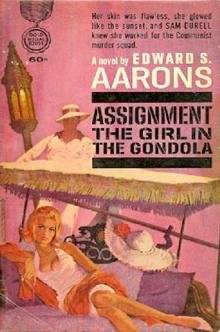
Assignment helene, p.4
Assignment Helene, page 4
part #9 of Sam Durell Series


Twill sat. He put his hands on his knees and squeezed hard, his body held upright in a tense and awkward attitude. The anger on his face subsided again as he stared at Durell, and then uneasiness and fear became evident and his voice was uncertain.
“Listen, I didn’t tell anyone you were with the CIA.”
“Shut up,” Durell said. “Inspector Dak knows. This Madame Phan knows. It’s an even bet it’s not a secret with the Xu Bhien, either.”
“Those are the risks you take,” Twill said sullenly.
“I prefer risks of my own choosing—not those handed to me gratuitously by your stupidity.” Durell’s hands were flat on the desk. His dark blue eyes looked black in the single lamp over the Consul’s chair. “You know why I’m here, Twill. It’s a touchy situation with Bakitra. We can’t be placed in the position of interfering internally here, but one of our nationals has been running guns to the Xu Bhien. That’s why Hansen was killed, right?”
“Well—”
“And that’s why Van Arden has disappeared. He was here the night Hansen was murdered. He knows the answers, right?”
“Maybe,” Twill admitted.
“Is Van Arden dead?”
“I don’t know.” Twill looked strange. He glanced away, up at the ceiling, at the ornate double-leafed door, at the draped flags behind the desk—everywhere but at Durell. “Hansen was investigating this arms racket—but he wouldn’t let me in on it. He claimed Van Arden knew something about it. But he didn’t tell me.”
“Why?”
“I don’t know.”
“Did he suspect you of making a quick buck by buying guns from the KMT up in Taiwan and running them to General Trang?”
“They came in by LST,” Twill said sullenly.
“How do you know that?”
“I found out that much on my own. When the Xu Bhien took over here in Salangap, there was a small flotilla of old LST’s in a fishing village up the coast—Batingpor is the name of the place. The locals told me the thing was in charge of an American—but I couldn’t even get a description of the bastard. Neither could Dak. I told Hansen about it, anyway.”
“It’s not in any of the reports.”
“I told you, he kept me out of it.”
“But he confided in Dr. Van Arden?”
“I don’t know,” Twill said again. He drew a deep, slow breath. “You know about Van Arden—botanist, philosopher, the old gray-bearded author of books on neutralism, one world, and so forth.”
“I want to know why he was here the night Hansen was killed,” Durell cut in.
“He was upset, but I don’t know why. Excited by something. He had a long huddle with Mr. Hansen right in this room, but I wasn’t invited to sit in on it.” Twill was sullen again. “Afterward, he went upstairs to turn in—he’d had quite a bit to drink, I guess, and—”
“Was that usual?”
Twill’s face went blank. “What?”
“Was Van Arden drunk? And was that usual?”
“I don’t know.” Twill bit his lip. “The old man drank a lot, yes. Anyway, the first thing I knew about the murder was when Hansen called out. I wasn’t quite asleep. It was a hell of a hot night, hotter than usual, and I was reading some late mail in bed—and I heard Hansen cry out in this strange voice—”
“What did he say?”
“It wasn’t anything definite. Or even articulate. Just a call for help, I guess. At least, I was alarmed enough to jump up and grab my gun and go for him.”
“Where did you see Hansen first?”
“In the corridor, outside his room. He still had the dagger in his stomach.” Twill’s mouth worked a little, and his eyes flattened with the memory of horror. “There was a lot of blood. He died right there outside his bedroom before I could do anything.”
“And the Malay boy?”
“I heard him running downstairs—toward the foyer here. The Marine guard was bowled over by him—taken by surprise—and so I used my gun myself. I was just lucky, nailing him with the first shot.”
“Lucky?”
“Now look here, Durell—”
“All right. And Selim was killed instantly?”
“Yes.”
“How did he get in here in the first place?”
Twill shrugged. “Hard to say. There was a lot of confusion, naturally. It was a hot night, the screens are easy to open. The girls—the clerks, you know—began to scream like hell. I went looking for Dr. Van Arden—”
“Why?”
Twill looked startled and confused. “I just thought I’d better get him, that’s all. But he wasn’t in the room Mr. Hansen gave him. He wasn’t anywhere, by that time. And nobody’s seen him since.”
Durell looked dissatisfied. “Was his bed slept in?”
“Oh, yes,” Twill said quickly.
“And he slept right across from Hansen’s room?”
“Yes. But as I said, the old man had been drinking and—”
“And he didn’t show up when Hansen yelled right across from his door, or when you fired at the assassin?”
“No.”
“And nobody has seen him since?” Durell insisted.
“No.”
“What more have you learned that you haven’t told me yet?”
Twill said stiffly, “You son of a bitch. What kind of a man are you?”
“I’m just doing my job,” Durell said.
“But you don’t care who or what you hurt when you do it, do you? I know your kind. You’re a new breed, Durell. The Twentieth-Century Man. The Atomic Age Man. With ice in your blood, an electronic calculator for a brain, an engine for a heart. And when a man looks into your eyes, Durell, all he sees is the cold, black emptiness of outer space.”
“Very poetic,” Durell said drily.
“When you talk, you kill. But by God, if you hurt Bettina, or if you do anything or say anything to make people believe that Betts and I plotted to kill Hansen-then I’ll kill you, Durell. I mean it. I’ll kill youl”
Durell’s face was expressionless. “Just answer my question, will you?”
“You don’t make allowances for human weakness in anybody else, do you?” Twill’s voice shook. “I love Bettina. I always have. Maybe I’m no good, maybe what we decided long ago between us is a lousy, immoral thing to do. But we didn’t kill anybody. And you ought to take human weaknesses into account.”
“There’s no room for weakness today,” Durell said. “Not if we want to survive.” He drew a deep breath. “Let’s get back to the point. I want to know, for instance, if you know anything more about Abi Selim.”
Twill’s breathing made a harsh sound in the room. “I’m sorry. Dak gave me a report. Selim was on Dak’s payroll, but we can’t seriously accuse the Bakitra people of ordering Hansen’s death. Somebody else put Selim up to it. Maybe the Xu Bhien. Maybe Stainer. Do you know about Fred Stanier?”
“Yes.”
“Or maybe Van Arden.”
Twill had regained his composure. He looked at Durell with cool challenge now. “Whatever you do, don’t try to pin the guilt on me. I warn you. I hated Hansen’s guts, sure. I’ve always wanted to marry his wife. Betts and I go ’way back together. I’m sure that’s no secret to you. But I didn’t kill Hansen to get her.”
Twill paused. “You’ve got trouble, Durell. You need some answers from Dr. Van Arden, and he’s gone. Even if you can find him, the old man won’t be easy to talk to, assuming he’s still alive.”
“Why not?”
“The whole world knows and admires and idolizes the good bearded doctor for his philosophy, his work in tropical botany, his books on peace, and so forth ad nauseum.” Twill took a deep breath. “But the world doesn’t know that the living man, this gentle man, was a triple-dyed son of a bitch.”
Twill stood up with a lurch. “There’s one thing I kept from Dak and our own people in Bakitra, pending your arrival. About Van Arden, I mean. He left a note.
“A note?”
Twill grinned suddenly. “It makes your job stickier, and it won’t do the U.S. any good if the world learns about it. The point is, Van Arden admitted killing Hansen before he disappeared.”
Durell said flatly, “I don’t believe you.”
“Oh, I know. The famous philosophical doctor, the gentle botanist. A bastard! A drunk, a womanizer, a trouble-maker from the word go. To read his books, you’d think he was a saint. Well, I happen to know he’s got feet of pretty poor clay.”
“Where is this note?” Durell asked harshly.
“I found it in Greg's bedroom. Apparently Van Arden got out of the Consulate that way, leaving Selim to take the rap after sticking Hansen with the knife. As for motive, I guess you already suspect that Van Arden sympathizes, in his woolly thinking way, with the Xu Bhien.
I heard enough of his quarrel with Hensen to know that Hansen was trying to persuade him not to take a course of action in the matter. Were supposed to be neutral, remember?”
“Give me the note,” Durell interrupted.
Twill reached in his wallet and took out a folded piece of ordinary notepaper. He dropped it to the desk in front of Durell with a gesture of contempt. Durell did not pick it up immediately. For a moment he searched Twill’s bland, handsome face, looking for something that wasn’t there, or was hidden too deeply to appear. Durell read the note.
It was brief, written in an aged, crabbed hand.
The fault and the responsibility are mine. All my life I wrote and spoke and pleaded for peace and the unity of mankind. But one cannot remain aloof from humanity like Zeus on Olympus. I have chosen to act and atone for my sins. I am sorry about Gregory Hansen.
Dr. H. Van Arden
The room was quiet. Durell struck a match and burned the note in an ashtray on the former Consul’s desk. When there was nothing but small curls of blackness in the crystal bowl, he crushed the curls into further fragments, until they were reduced to no more than black dust.
He heard Twill breathing, and looked up.
Twill said, “So go ahead. Go get your murderer.”
FIVE
From the steps of the Consulate, Durell could see the warm blue of the sea, the brassy sky, the aching green of the jungle. The sky breathed down heat that blew in from over the water, and the glare of sunlight, at eleven o’clock in the morning, reduced vision to a wavering, misty haze over the tin roofs, the palm-thatched huts, the blinding white European buildings of Salangap. A second Salangapese destroyer had joined the warship he had noted yesterday at the mole. There was a cooing and burbling of doves in the oleander shrubs, the bright purple of ground orchids near the compound wall, and the clicking of a typewriter operated by one of the consulate clerks.
He could see the traffic clearly on Government Road, the women in black silk trousers and shell-shaped straw hats walking with burdens on their carrying poles. Farther down was a crush of cyclos, the tring of bicycle bells, and the coughing sputter of small European cars.
There was no sign of the death that had stalked the streets and canals of Salangap last night, not in the road or in the gold of rice fields reaching away along the terraced slopes of the hills around the harbor. The fishing boats were working near the Horn, where the Bakitra troops were quartered in a complex of ancient Dutch forts.
Wayne Twill stood beside him, immaculate in white sharkskin, his face bronzed and healthy, his crew cut standing stiff and erect and vital. Durell hadn’t seen Bettina Hansen at breakfast. She still slept, probably.
“You’re sure you want to go alone, Durell?” Twill asked, squinting at the sun.
“I’ll be all right.”
“DeGarcia could work as your interpreter—”
“I don’t think I’ll need one.”
Twill snapped his fingers in a nervous pattern of clicking sounds. “Look here, old man,” he began apologetically. “You’re not sore about last night, are you? I mean, we seem to have gotten off on the wrong foot, and I’m afraid I blew my stack—I was resentful, naturally, the way you came in and took over at my desk—”
“It was Gregory Hansen’s desk,” Durell said.
“Well, of course, but—” Twill broke off and laughed in friendly fashion. “I was on edge. Seeing Bettina again, after all those years—by God, she’s marvelous, you Imow—well, you understand how it is with us.”
“I’m trying to.”
“Well, if there’s anything I can do to help you . . .”
Durell did not bother to reply. The heat of the morning sim, the steamy atmosphere, made him think once again of his boyhood home in the Louisiana bayous, and for a moment he had the illusion of standing on the deck of his grandfather’s ancient sidewheeler that was moored in the mud at Bayou Peche Rouge—the only home he had known for his first fourteen years of life. He lit a cigarette. He thought of the boy he had been then, and the man he had become. He thought of the way Twill had described him. It wasn’t altogether true, but there could be no compromise with his duty, and perhaps it was this lack of compromise that had inspired Twill to call him a special kind of man.
He knew there were three cyclos drawn up outside the wall of the Consulate compound, and he debated which, if any, was safe to use. Twill had offered the official car, but that would be too conspicuous, of course. Probably all three of these cyclos had been planted here for him, he reflected. It wouldn’t matter which one he hired.
Twill’s words still lingered in his mind. Four days ago, he had been enjoying autumn in Washington. He had been breakfasting with Deirdre Padgett, in her rose-brick colonial house in Prince John, on the Chesapeake shore, when General Dickinson McFee had phoned him and sent him off on this assignment. He hadn’t wanted to go. He didn’t want to leave Deirdre. He wished, in one moment of fierce rebellion, to be free to live as other men, to marry her, to live in bland and comfortable routine, to know that each night he would come home to her and see her face and know her in the hours of darkness, becoming one with her. But it was impossible. The very things he wanted so desperately for himself, that millions enjoyed as a matter of course, were denied to most of the world’s people. Only his work, and the work of that small army of which he was only a small party, kept freedom and dignity alive, kept safe the things that were precious to him. Lovely Deirdre, her calm and peaceful house, the boxwood hedges and the green sloping lawns and massive willows going down to the cool reaches of Chesapeake Bay, were all like a distant dream now. Pie wiped sweat from the back of his neck.
“Any word on what went on in town last night?” he asked Twill.
“Trang’s terrorists were at work. Bakitra is sending in more troops for a final push into the mountains before the monsoon season begins. After all, General Trang and the Xu Bhien need hold out only another month, and then they’ll be safe for the winter.”
“But last night?”
“It was in the Continental Cafe on Rue Gamelin. Some grenades were thrown against the shutters, and one of our Filipino clerks was nicked by a steel splinter.”
“Did they get the grenade thrower?”
“It was just a boy on a bicycle. That’s the sort of terrorist the Xu Bhien employ. He got away, of course. And this morning, you can see Bakitra’s reaction. That second warship out there. I understand they plan to land two more battalions today.” Twill looked at the doves on the lawn, walking foolishly with bobbing heads among the wild orchids. “It’s none of our business, this Trang rebellion. We stay out of it.”
“Yes.”
"You’ll have to be careful, Durell.”
“I intend to be,” Durell said.
The Marine Guard came trotting down the white steps and spoke to Twill respectfully. “Telephone for you, sir. Urgent.”
Twill nodded. “Excuse me, Durell. Will you be going now?”
“In a moment,” Durell said.
When Twill vanished into the Consulate, Durell studied Government Road, snaking down past the golden rice fields and the women in black trousers and bright silk scarves, working in water to their waist among the brittle reeds. Beyond, the road merged into the Rue Gamelin, the name being a brief souvenir of fleeing French occupancy. The light reconnaisance tanks of the Bakitra troops, salvaged from rusty dump heaps abandoned after the Japanese occupation, were like unnatural scarabs as they rumbled about or remained parked on the canal bridges, their helmeted crews smoking, laughing, spitting, or staring vacantly at the crowds.
Thunder rumbled from the mountains. The rounded uplands were like sleeping women asprawl over the island. The wind blew from the sea and carried with it the stench of the harbor that provided Salangap, together with the canals, with its open sewer system.
Durell finished his cigarette and looked at the carefully tended shrubs under the limp, browning coconut palms, and he remembered Gregory Jay Hansen’s cool Connecticut home of long ago, his summer retreat from Texas, when he had been invited there as a classmate of Ralph’s. Long ago, in the dead, buried past. There was a frozen caricature of flesh in an ice-locker down there in Salangap’s police station, and that was all that remained of what had been.
Twill came hurrying back, scowling and perturbed. He looked nervously at his watch and then at Durell.
“Good thing you hadn’t left. That was Dak on the phone. He says he knows where Van Arden is.” Twill licked his lips and squinted at the hot, impossible sun. “Dak says that Van Arden has definitely gone into the jungle to join the Xu Bhien.”
Durell showed no surprise. “How did Dak know?”
“Through his spies, I guess.” Twill shrugged and bit his lip nervously. “He doesn’t know if the old man went willingly or not, though. But he’s sure that General Trang won’t release him unless there’s a swap.”
“A swap?”
“Trang wants a different man—sort of a hostage, I guess—in place of Van Arden. I’ll have to call Bakitra on this. It’s a mess. We’re supposed to stay out of this goddam local war, but—”
“Not when an important national like Dr. Van Arden is taken prisoner and held as hostage,” Durell said sharply. “Who does Trang want in Van Arden’s place?”
“Fred Stanier,” Twill said, with odd satisfaction.