The velvet touch, p.1
The Velvet Touch, page 1


The Velvet Touch by Edward D. Hoch
Copyright © 2000 by Edward D. Hoch
Individual stories copyright © 1975, 1976, 1977, 1980, 1983,
1984, 1985, 1987, 1988, 1991, 1993, 1995, 1998, 1999
by Edward D. Hoch
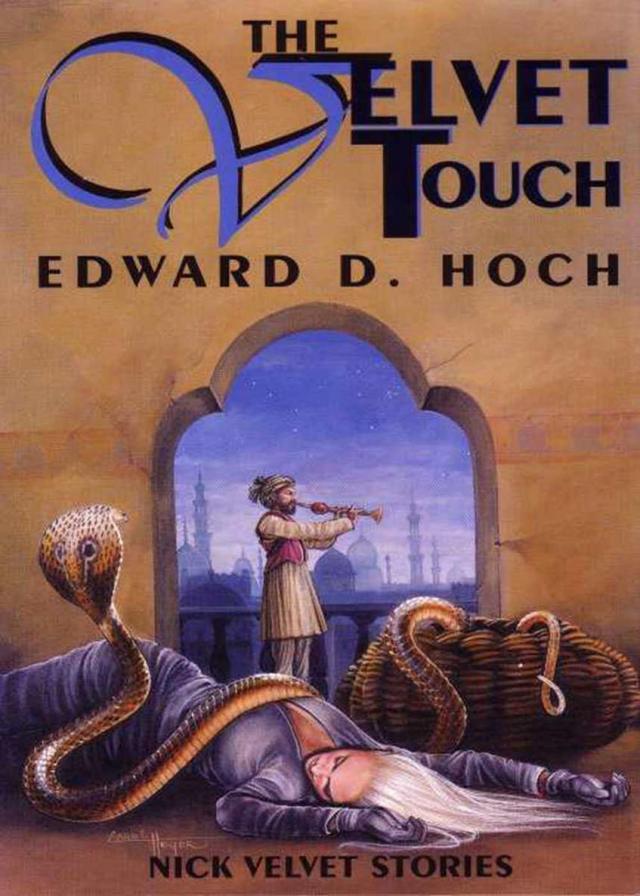
Cover painting by Carol Heyer
Cover design by Deborah Miller
Crippen & Landru logo by Eric D. Greene
ISBN: 1-885941-42-0
Printed in the United States of America
Crippen & Landru Publishers
P. O. Box 9315
Norfolk, VA 23505
USA
Email: CrippenLandru@earthlink.net
Web: www.crippenlandru.com
CONTENTS
Introduction
THE VENTURES OF NICK VELVET
The Theft of the Venetian Window
The Theft of the Sherlockian Slipper
The Theft of Nothing at All
The Theft of the Four of Spades
The Theft of Cinderella’s Slipper
The Theft of Gloria’s Greatcoat
THE WILES OF THE WHITE QUEEN
The Theft of the White Queen’s Menu
The Theft of the Overdue Library Book
The Theft of the Cardboard Castle
The Theft of the Faded Flag
The Theft of Leopold’s Badge
The Theft of the Bald Man’s Comb
The Theft of the Snake Charmer’s Basket
The Theft of the Birthday Candles
A Nick Velvet Checklist
Introduction
I have written elsewhere that the Nick Velvet series started out in 1966 as my answer to James Bond. He was to be a modern, sophisticated thief who used high-tech gadgets to pull off unlikely thefts of valueless objects. Most of the gadgets vanished after the early stories, and Nick has gone on to survive pretty much by his wits. He quickly became the most popular and profitable of my many series characters, widely reprinted overseas and almost constantly under option for films and television.
Like many fictional thieves before him, Nick evolved into an amateur sleuth as well, forced to solve crimes in order to accomplish his mission, free himself from a frame-up, or collect his fee. The series continued like this, without major changes, until I decided in 1983 to introduce a highly skilled antagonist into the mix, a sort of master thief who could top even Nick. If he performed the impossible by stealing valueless objects, his nemesis would perform impossible feats before breakfast, in the manner of the White Queen from Through the Looking Glass.
Thus was born Sandra Paris, who has crossed paths with Nick in eight stories so far. Because fictional characters tend to insist on leading their own lives, the relationship between Nick and Sandra has not developed exactly as I’d imagined it would. There has been no romance between them, and they have become admiring adversaries rather than enemies, sometimes helping each other when one of them is in trouble.
When my publisher suggested that this volume might bring together all eight of the White Queen stories published so far, it seemed like a fine idea. One of the stories requires an added word of explanation. In 1991, for the fiftieth anniversary of Ellery Queen’s Mystery Magazine, editor Eleanor Sullivan suggested I write three stories, each featuring a pair of my series characters. It seemed most likely that Nick Velvet would encounter Captain Leopold, my police detective, and just as likely that Sandra Paris should figure in the plot as well. The result was “The Theft of Leopold’s Badge.”
I’ve added six other previously uncollected Velvets to these eight. Two of them were special favorites of well-known anthologists. “The Theft of the Venetian Window” was chosen for Jacques Barzun’s & Wendell Hertig Taylor’s Classic Stories of Crime and Detection (1983), and Martin H. Greenberg included “The Theft of the Four of Spades” in his Masterpieces of Mystery and Suspense (1988). Two others, “The Theft of the Sherlockian Slipper” and “The Theft of Nothing at All” have also been anthology favorites. “The Theft of Cinderella’s Slipper” and “The Theft of Gloria’s Greatcoat” are reprinted here for the first time, the former because it features an impossible disappearance and the latter for those who might have wondered how Nick and his long-time companion Gloria first met. It was written in 1998 to mark my twenty-five years of monthly appearances in Ellery Queen’s Mystery Magazine.
As I write this at the end of 1999, there have been seventy-six Nick Velvet stories published in all. You’ll find a list of the titles at the back of the book. They wouldn’t have been possible without the encouragement of the three editors of EQMM who have guided the series over the years — Fred Dannay, Eleanor Sullivan and Janet Hutchings.
Since these stories began in 1966, no year has passed without at least one new adventure, and I hope Nick will be around well into the next century.
Edward D. Hoch
Rochester, New York
December 1999
THE VENTURES OF NICK VELVET
The Theft of the Venetian Window
Nick Velvet arrived in Venice on the morning train. It was the first time he’d ever taken a train to an island, unless one counted Manhattan, and there was something just a bit strange about traveling across the long railroad bridge that led into the city. Looking out the window to his right, he could see cars on the highway bridge, the Ponte Della Liberta, racing the train to its destination. Since cars were allowed in such a tiny section of the city itself, he wondered why anyone bothered.
It was Nick’s first visit to Italy, though he’d once had a stopover at the Rome Airport. He’d never had the desire of some Italian-Americans to seek out the mountain villages from which their ancestors had come. To Nick home had always been a few square blocks of Greenwich Village where he was born and raised, back in the days when the area was more Italian than bohemian.
No, it was not nostalgia that brought him to Venice — only money. He’d been offered his standard fee of $20,000 to steal a mirror.
“It is the most valuable single object on the face of the earth,” Milo Mason had told him a few days earlier in a New York hotel room. There was a time, early in his career, when Nick avoided meetings in hotel rooms on the theory they could be bugged too easily. Now, in a day when even the olive in a martini could conceal a listening device, there seemed little point in his caution.
He’d stared at the fat man with the strange, far-away eyes and answered, “I never steal anything of value, Mr. Mason. I guess the job’s not for me.”
“You’re turning it down?” Mason had asked incredulously.
“A month ago a man wanted me to steal the weather vane from the top of an old New England church. I was ready to do it until I found out that these days antique dealers are offering small fortunes for historic weather vanes. I made a rule years ago to steal only the worthless, the valueless. These days, when everything seems to have value for someone, it’s increasingly difficult to live by my rule. But I still try.”
“I can assure you no antique dealer wants this mirror, Mr. Velvet. It’s a simple rectangle framed in plain wood. No jewels, no gold. It may be old, but the workmanship has no value.”
Nick had smiled, trying to kid the man along, trying to relieve the tension he saw in those deep dark eyes. “But it’s Venetian glass, isn’t it? And that’s valuable.”
The man shook his head. “It’s glass, and it’s in Venice. But it’s not Venetian glass.” The eyes hardened. “If you must know, I will tell you why this mirror is the most valuable object on the face of the earth. Then you can decide whether you dare to steal it!”
“Fine. Tell me.”
“Do you believe in an alternate universe, Mr. Velvet? A world in which everything is quite a bit different, in which I might be a king and you might be a priest?”
“I used to read some science fiction,” Nick admitted.
“This is not science fiction! This is fact! An alternate universe does exist. As you may not know, these two universes touch at only one point on earth. That mirror in Venice is more than a mirror — it is a window connecting these alternatives. We live in one world, but a step through that mirror would put us in another, far different world!”
Nick nodded. “I think I know the mirror you mean. Fellow named Lewis Carroll used to own it.”
“Don’t scoff, Mr. Velvet! There’s some evidence that the story of this very mirror might have inspired Through the Looking-Glass.”
“I’m sure.”
“Will you do it? I warn you, the mirror is well guarded.”
Nick stared at him for just a moment longer. Then he said, “Mr. Mason, you’ve got yourself a deal.”
That had been three days ago in America. Now he was here, approaching Venice, and feeling just a bit guilty about taking $20,000 from a man who was obviously insane. “Your first time in Venice?” a tall man in the next seat asked. He was obviously American, with graying hair and a pleasant smile.
“First time in Italy, really,” Nick responded.
“Mine, too. I’m Vincent Cross, here to see a dealer about some tapestry business.” He peered out the window as the train came into the station. “Looks like a fascinating city. I wanted to fly in and see it from the air, but the connections weren’t right.”
Nick agreed. Venice had a small airport in the Lido resort area and the larger Marco Polo Airport on the mainland, but many visitors found it more convenient to take the train up from Bologna. The two men left the train together at the main passenger terminal on the Grand Canal, and Nick told Cross he hoped to see him again.
“Look me up,” the tall man urged. “I’ll be at the Excelsior.”
Nick arranged for his bag to be sent ahead to his hotel, then wandered in a park across from the station, visiting the little booths where souvenirs and trinkets were sold. He had the look of an uncertain tourist, and he wasn’t surprised when a raven-haired young woman in a green pants suit approached him.
“Pardon me. Would you like a tour of the city?”
She was American, and quite lovely. “I don’t really need one,” he replied with a grin, “but it’s good to hear a voice from home.”
“I thought you might not care for the standard tour of churches.”
“Don’t I look the type?”
“I offer something more personalized to your interests. My name’s Sally Gilbert.”
“I’m Nick Velvet. You a student?”
“An overaged one. You’re from the New York area, aren’t you?”
“How’d you know?”
“I’m studying linguistics. New Yorkers are easy to spot.”
“What’s this tour business you have?”
She shrugged. “Just a way to make money. I meet the new arrivals and offer personally conducted tours.”
He took some lira from his pocket. “I’m game. If I like it I’ll buy you a drink as a tip.”
“We’ll start with a vaporetto trip on the Grand Canal.”
The vaporetto proved to be a small steam ferry that operated much like a bus along the canal, stopping first on one side and then on the other to pick up passengers and let them off. Nick gazed up at the drab splendor of the old buildings and said, “It’s quite a city. But do the canals always smell this bad?”
“They do in the summer, I’m afraid. Some say the whole city is just rotting away. It’s built on 118 islands, divided by 160 canals, and linked by nearly 400 bridges. The Fifth Century Veneti sought refuge here from invaders.”
“They picked a good place.”
“Because of the high arched bridges and narrow streets, only pedestrian traffic is allowed in most of the city. All other traffic, including police, ambulances, and even funerals, is by water. People phone for a gondola as they would a taxi back home, or else they ride the vaporettos or motorboats.”
“You certainly know everything!”
“A guide has to,” she replied with a grin. By the pale light reflected off the canal, her face was even prettier than he’d first realized.
“I must confess I’m seeking a specific address on the Calle Lion,” he told her. “But perhaps we could meet for that drink later.”
Sally Gilbert threw back her head, letting the breeze catch her long black hair. “This is the famed Rialto Bridge,” she said as they passed beneath a covered walkway with arched sides. “You must have seen pictures of it.” Then she turned her gaze back to his, as if only now hearing his previous words. “I’ll take you to the Calle Lion. We should get off at the next stop.”
Once on land she led the way through a maze of narrow streets that opened suddenly into the Piazza San Marco. “I recognize this,” he admitted, watching a swirl of pigeons take to the air.
“It’s a bit out of our way, but I wanted you to see it. This is the heart of the city — the symbol of Venice.”
They strolled past the splendor of St. Mark’s Basilica and the Doges’ Palace, mingling with the noonday tourists. Then she led him deeper into the city, across narrow canals where the odorous water seemed barely to move. “Is it far?” he asked once.
“Not far.” They crossed a last canal — and he saw the rusty sign on a corner building. Calle Lion.
“This is it,” he said, turning to thank her.
“Be careful,” she said simply, and she was no longer smiling. He started to speak, to ask where they could meet later, but a group of passing tourists separated them. And then she was gone, back the way they’d come.
The mirror which Milo Mason had described was located in the first building on the left — a weathered stone structure that crowded the narrow street and the canal. Nick climbed the worn staircase to a second-floor apartment and knocked on the door of the dimly lit hall. A small plaque read simply: Giorgio Lambazi — Tappezzerie.
He heard a bolt being drawn, and the door opened. “Who is it?”
“My name is Velvet. I’d like to interview you for a news story.”
“I grant no interviews,” Lambazi said, starting to close the door.
“A man named Milo Mason has made certain statements to the American press.”
“Mason? That troublemaker? The man’s mad, you know!” But he sighed and reached up to undo the chain. “Very well, come in. I was half expecting him to come in person. I understand he’s in Venice. But I can only give you ten minutes. I’m alone here, and there’s work to be done.”
Nick followed him into a cramped living room that obviously doubled as a study. It was bizarrely decorated with great hanging tapestries, like some sheik’s domain. The largest of the tapestries, reaching from floor to ceiling over much of the room’s south wall, showed a strange other-worldly scene of American Indians coming ashore from native boats at a European fishing village.
“Do you like it?” Lambazi asked Nick.
“What is it?”
“An Eighteenth Century tapestry titled The Indian Discovery of Europe.”
“Oh?”
“Perhaps in an alternate universe it happened that way,” Lambazi said. He spoke good English with only a trace of accent, and though he looked close to 70, he moved with the step of a much younger man. He was completely bald, but wore a short pointed beard that went well with his piercing eyes.
Nick sat down opposite him, trying not to look at the conspicuous mirror on the far wall. “Milo Mason mentioned these somewhat wild theories of yours.”
“Mason is a writer on occult and paranormal subjects whose work has succeeded in softening his brain. He believes, Mr. Velvet, and that is a very dangerous thing.”
“Then you don’t believe in an alternate universe?”
“I believe only in the money such things can bring me. I have this tapestry, I have that mirror once believed to be a window to another universe, and I have other such trappings of the bizarre. But to say that I believe in them as Milo Mason does . . .”
Nick walked over to examine the mirror, now that Lambazi had brought it into the conversation. It was not large — perhaps 18 inches wide by two feet high — and it was set in a plain wooden frame held flush to the wall by four screws. Nick knew he could have it off the wall and out of the apartment in minutes. It would be the easiest money he ever earned.
“He believes this to be a window to another world,” Nick said, but he could see nothing other than his own face in the clouded glass.
“A foolish superstition! I keep the mirror here to amuse people like Milo Mason. It is a mark of his insanity that he believed what I told him.”
“He believed it, all right.” Nick noted the bolted steel shutters over the room’s only window. “Maybe you do too, the way you guard it.”
“The window overlooks the Rio di San Lorenzo, one of our dirtier canals. Hardly worth the view. And the precautions are for my tapestries, not the mirror.”
“But don’t you ever go out?”
“Certainly! I have a shop near here. A friend downstairs, Malamocco, looks after the apartment when I’m away from it.”
Nick wondered why he was wasting his time. He knew — as did Lambazi — that Milo Mason was in the city. Nick was to meet him that evening to deliver the mirror. He needed only to tap this man on his bald head, take the mirror, and leave.
“I see the cups,” Nick said. “Might I join you in some espresso?”
“Certainly.” The old man rose. “Let me make some fresh.”
Nick was remembering the sleeping pills he carried in the tool kit around his waist. It might be easier this way. He followed Lambazi into a tiny cluttered kitchen that lacked the baroque grace of the main room. Here, instead of hanging tapestries, there was only a fly-specked calendar that still showed the preceding month.