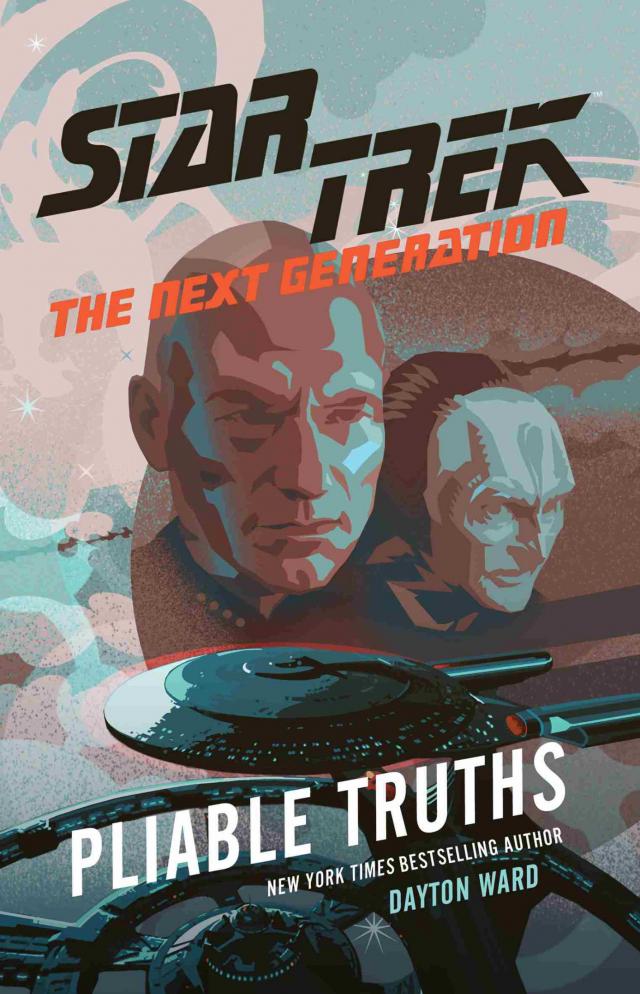
Pliable truths, p.1
Pliable Truths, page 1


Thank you for downloading this Simon & Schuster ebook.
Get a FREE ebook when you join our mailing list. Plus, get updates on new releases, deals, recommended reads, and more from Simon & Schuster. Click below to sign up and see terms and conditions.
CLICK HERE TO SIGN UP
Already a subscriber? Provide your email again so we can register this ebook and send you more of what you like to read. You will continue to receive exclusive offers in your inbox.
Dedicated to my wife and children
HISTORIAN’S NOTE
The events of this story take place in the year 2369, soon after Captain Jean-Luc Picard’s capture and torture at the hands of the Cardassian interrogator Gul Madred (Star Trek: The Next Generation “Chain of Command”), and before Starfleet’s assuming tactical control of the Cardassian space station Terok Nor and establishing a permanent Federation presence in the Bajor sector (Star Trek: Deep Space Nine “Emissary”).
A lie runs until it is overtaken by the truth.
—Cuban proverb
1
Emerging from the tunnel while balancing the oversized rock on his shoulder, Panat Hileb noted the thin sliver of orange sky separating the sun from the distant horizon. The horn declaring shift change was imminent, he knew, but any pause of work before that welcome sound brought with it the promise of swift punishment. Having seen others suffer for such a lapse, Panat did not break stride or spend any time appreciating what was a breathtaking view.
With just enough purpose to avoid provoking the guards, he shuffled from the tunnel entrance and past other workers on his way to the nearby mining tram, where he tossed the rock into one of the bins that still had room. In response to his action, the car shuddered where it sat hovering on its antigravity sled just above the flattened path that served as a service road leading to and from the mine. Knowing a fellow laborer was right behind him, Panat turned and headed back toward the tunnel where more rocks awaited. One constant about this work detail was that there were always rocks waiting to be removed from the mine for transport to the nearby quarry, which was little more than a refuse pit.
And a graveyard, Panat reminded himself. Filled with bodies of those our oppressors no longer found useful. It also included workers who slackened their efforts before the end of their scheduled work period.
Clearing rubble from the mine’s work areas was one of the cruelest labors demanded by the Cardassians running the prison colony. Inside the mine, other Bajorans drudged through the arduous task of extracting uridium ore from the planet’s depths. That valuable mineral, once separated from the surrounding bedrock, was placed in containers for transport to a location unknown to Panat and the other workers. None of the Bajorans knew if the ore was refined here or placed aboard cargo freighters bound for a processing facility on another world.
One more mystery for Panat and his fellows, along with not knowing the planet’s name, location, or strategic value. Were they near some boundary separating Cardassian territory from that of an interstellar neighbor or rival? Despite the best efforts of the intelligence-gathering network threaded through the Bajorans, such information remained closely guarded secrets, which to Panat made sense. Assuming one was able to call for help, it was an all but useless effort when there was no way to know where to summon assistance.
Proceeding to the mine entrance, Panat made eye contact with other forced laborers. Some of them were friends, others he knew only by name. It was a matter of degrees; in a place like this, all who shared the same plight were colleagues, companions, and—when the time was right—comrades-in-arms. While they were here to serve their overlords, all the laborers also shared the desire to be rid of the Cardassians. Even for those like Panat, born during the Occupation, they longed for freedom.
One day, he mused. One day, hopefully the Prophets will help our people.
He noted the lengthening shadows stretching across the ground ahead of him as well as the surrounding canyon walls at the mine’s entrance, which was cut into the face of the hillside as part of a larger excavation effort completed earlier in the year. The shadows at this time of day told him the days were getting shorter. Soon, the temperatures would begin to cool, and even here in the planet’s temperate zone, another winter would make its presence felt.
Assuming you live that long.
“Step with greater purpose, friend.”
He heard the comment, uttered in a quiet tone, from his left, and he looked up to see Ranar Ehu walking past him while carrying his own large piece of stone. Like Panat, he wore tattered clothes made from scraps of cloth and other materials provided by the Cardassians with irregular frequency or which he had scavenged or fashioned from discarded clothing. His hair, once dark and long, had gone gray and was thinning on top, and what remained was secured at the back of his neck with a strip of cloth. They had not known each other before being shipped to this planet but had become close companions in the years since. They shared many of the same interests from their lives before being transported here from Bajor. This included a fondness for the outdoors, a love of music and the arts, and constant plotting to undermine their oppressors.
With a small, guarded smile, Panat nodded at him. “All of my steps are with purpose.” It was an innocuous response to an innocent salutation, which of course carried great meaning for those Bajorans who, like him and Ranar Ehu, participated in the resistance effort on this world.
Born during the Cardassian Occupation of Bajor, Panat had been content to do what he considered necessary to survive and keep his aged, frail parents safe. That meant enduring much hardship and sacrifice, doing as he was told by those who subjugated Bajor. It was not an ideal existence, but he could secure his parents food, shelter, and medication, and for a time that satisfied Panat. All of that vanished one horrific night when a Cardassian security detail descended on Panat’s village in the Lonar Province, killing anyone they considered a waste of resources. His parents vanished in a hail of disruptor fire.
Panat was still reeling from the shock of their deaths when he was put aboard a transport ship and brought to this forsaken planet. From his first moments, he had sought out any Bajorans who might be part of the resistance movement he knew was gaining momentum on the planet of his birth. It had taken nearly a year before Ranar approached him and brought him into the fold, beginning their friendship and their partnership in arms.
And now we toil by day, and plot by night.
Indeed, Panat and Ranar, along with other trusted members of the Resistance, convened at irregular intervals after the work detail’s return to camp and before curfew. They discussed possible disruptions. Given the isolated nature of the forced-labor camp and the relatively small population of Bajorans—fewer than two hundred, by Panat’s count—doing anything too drastic would leave them no room to hide among the population. This abundance of caution forced them toward smaller acts that on the surface did not point to insurrection. Sabotaging equipment was a common ploy, though even that had to be done with care and proper timing. The same was true with finding methods of interrupting the workflow in a manner that did not arouse suspicion. Then there were the more challenging acts, such as eliminating one of the guards.
If things went according to plan, that would happen here, today.
The horn sounded, echoing off the hillside and making every worker look up from whatever task had consumed them. Those still carrying rocks to the tram continued forward, looking to add their final burden of the day to the bin.
“Finish up,” said one of the Cardassian guards, Lubak, an older trooper whose disinterest had long ago become evident. His command was not a harsh order but a simple recitation of a directive given at this time every day. “Put those last rocks on the tram and get in line.”
Rumors around camp held that Lubak had been passed over for promotion enough times that he was resigned to completing his term of required military service in as expedient and uneventful a manner as possible. To his credit, he had chosen not to take out his frustrations on the Bajorans, instead doing only the minimum necessary to maintain order and efficiency while overseeing their work. Like Panat, many of his fellow Bajorans knew Lubak’s apathy was their good fortune, and therefore conducted themselves in a manner that would not cause trouble or otherwise draw the ire of more attentive and less benevolent guards.
Many of the other guards on the detail appeared to be of similar mindset. There was no denying this was tedious duty, perhaps punishment for infractions real or perceived. Deviations from the normal schedule of activities consisted in large part of accidents or a laborer suffering from exhaustion. Otherwise, most days followed a routine. Repetition, Panat knew, begat boredom, which in turn bred inattention. Sabotage was most effective when it could exploit that laxity in a fast, decisive, and even violent manner.
Changing direction so that he now proceeded toward the rally point where the laborers formed columns for marching back to camp, Panat cast a quick glance toward the front of the tram where another trooper, Locin, stood watching the daily ritual play out. As Bajorans brought the day’s last chunks of rock to drop into those tram cars that still harbored room for additional debris, the Cardassian pulled a device from a holster on his equipment belt. He pressed a control on the unit and the tram’s internal power systems activated. Utilizing antigravity plating, the entire set of twelve cars rose to hover less than a meter above the ground, emitting a low-frequency hum as it idled while awaiting further instructions. Under normal circumstances, whoever controlled the tram could send it on i ts programmed course with the touch of another control. Panat had seen the exercise play out on uncounted occasions over the years.
Today, however, the tram did not wait for that command. Instead, it lurched forward without warning, proceeding not at its normal, near-walking speed down the worn service path but accelerating as it altered direction toward Locin. With no time for him to move out of its way, the tram’s front end slammed into him at waist level, knocking him backward and off his feet. Tumbling to the ground, he had no chance to scramble for safety before the tram hit him again, this time striking his head and pushing him back to the dirt before all twelve cars glided over him. The sound of Locin’s death scream echoed off the canyon walls as the antigrav plating exerted force downward, keeping the tram above the ground while crushing the Cardassian to pulp.
Instead of stopping, the tram shot across the path and over open ground before slamming into a pile of oversized boulders. The collision caused the other cars to decouple, sailing off in different directions to either smash into the canyon walls or tumble into the ditches on either side of the pathway. Several of the Bajorans and even a pair of Cardassians, all clueless to the reality of what had just happened, stared in disbelief at the scene unfolding before them.
“Help!” Panat yelled, playing his part as a distressed Bajoran witnessing a traumatic event. “Guards! Help!” He knew there would be no helping Locin, but he had to play out the scenario the same way as those laborers who had not known this was coming. Running to what remained of the guard, Panat confirmed he was dead, likely before the tram had even finished its work. In a surprise bonus, his control pad had also been destroyed by the force of the tram’s antigravs. There would be no examining the unit to see if it had suffered any tampering. Panat knew that it had, but even that contingency had been anticipated.
“What happened?” The question was loud and forceful, uttered by another Cardassian, Glinn Irvek. An officer in charge of the working detail as well as the guards assigned to oversee it, he was younger than several of the troopers around him, and prone to callousness and even brutality when it suited him. Panat and others had learned to give him a wide berth whenever possible, but even that was sometimes insufficient to avoid the glinn’s wrath.
Pushing his way past Bajorans and a pair of guards, Irvek stopped near Panat and beheld for himself Locin’s ghastly remains. “Who saw this?” He turned, his eyes boring into Panat with growing fury, and he even moved his right hand to rest on the sidearm holstered on his hip. Panat, who from the moment he and Ranar had hatched this scheme knew quick and severe retribution might be a possibility, braced himself for whatever might come next, but Irvek’s hand was stayed by another voice.
“I saw it, sir,” said Lubak, his voice carrying past Bajorans who moved out of his way as he approached. “Trooper Locin activated the tram as he does each day, and it ran him over.”
As if exerting physical effort to tear his eyes from Panat, Irvek turned to his subordinate. “You’re saying this was his fault? He did this to himself?”
Exhibiting the experience and wisdom of a seasoned soldier, Lubak replied, “I can’t assign fault, sir. All I know is that there was no one on or near the tram when he activated it.”
“Sabotage, then.” Snarling as he glanced once more to Panat, Irvek said, “Get the workers into formation.” Before Panat could move, the glinn pointed a finger at his chest. “You.” He shifted his aim to Ranar, who stood at the forefront of the gathered Bajorans observing the scene. “And you, collect Locin’s remains. Leave so much as a stray drop of blood on the ground and you’ll die the same way he did.” He glared at Lubak. “Watch over them.”
They waited while another Bajoran retrieved a cadaver transport container from the supply building near the mine’s entrance.He offered it to Panat before Lubak ordered him back to the formation of laborers gathering on the service path under the watchful eye of other guards.
Is Irvek going to kill them?
The question hung in Panat’s mind, and he waited to see if the glinn might order his troopers to execute the entire work detail. Standing orders at the camp called for the immediate execution of any Bajoran found to have assaulted any Cardassian. Such drastic action had not occurred for some time, but it was not out of the question. When he first arrived here, a guard might kill a Bajoran for the feeblest reason. Laborers at that time were as expendable as they were replaceable, and it was not uncommon for the Cardassians to make an example of a hapless worker, often an elderly prisoner or some other, weaker member of the population. Panat had noticed that the guards never targeted anyone who could still provide manual labor. Likewise, he was aware that new arrivals to the camp had slowed as time passed. This corresponded with a subtle yet distinct change in how the garrison treated them. Punishments grew less severe except in the most egregious of circumstances, at least as defined by the Cardassians. So far as Panat knew, it had been over a year since any new Bajorans had been brought to the planet. What reason would the Cardassians have not to replenish the workforce?
With this in mind, Panat dismissed his worrisome thought. Still, there was a distinct chance Irvek would find or invent a justification to punish someone from the work detail. He would deem it necessary to set an example, or to remind the workers that disobedience carried penalties even though he possessed no evidence for misconduct. Such things were not needed when one carried the power of life and death over those under him.
Sunlight grew weaker with every passing moment as Panat and Ranar set to work collecting the trampled remains of Locin’s body. Under Lubak’s watchful eye, they exercised care in placing the remains into the cadaver pouch. Without gloves or other protective equipment, the task was even more gruesome thanks to the blood and other bits of bone, skin, and destroyed uniform that soon covered their hands and clothing. In keeping with Irvek’s instructions, they also collected bloodstained rocks and loose dirt, placing these into pockets on the pouch’s exterior. Ranar sealed the pouch, and they both stood to face the guard.
“Take… him… to Glinn Irvek’s vehicle,” said Lubak. Rather than conveying anger or impatience, the guard’s mood seemed even more sober than it had been before the incident. He pointed toward the armored skiff parked outside the supply building. The antigrav vehicle was of the type preferred by the officers among the camp’s garrison.
Shouldering their grisly burden, Panat and Ranar headed off in that direction. Without looking too obvious, Panat cast a look over his shoulder to confirm Lubak was not following them but instead had joined other guards in organizing the formation of Bajoran workers.
“You think he was pondering the idea it could just as easily have been him?” asked Ranar. “Accidents happen, and so on.”
Panat shifted his part of the cadaver pouch on his shoulder. “I’m guessing all of the guards are thinking that.” He also knew that Irvek and others were considering the possibility that Locin had not fallen victim to a tragic accident.
They would be right, of course.
“He got what he deserved,” said Panat, remembering to keep his voice low.
Known for his excessive cruelty toward the elderly and his wanton advances toward many of the Bajoran women, Locin’s fate had been decided four months earlier. It had come after the unnecessary execution of an older worker who had stumbled and fallen while loading tools onto a cart. One of the tools had landed on Locin’s foot, and despite not causing injury, the Cardassian had erupted in fury at the perceived disrespect. He had beaten the old man senseless, cracking his skull along with several ribs, causing internal damage and bleeding. Even if the camp doctor had been able or willing to help, the worker’s injuries were too severe, and he died within moments. The murder had stirred many of the Bajorans, coming within a hairsbreadth of triggering a riot. Only the other guards, including one or two appalled by Locin’s actions, kept the situation from spiraling out of control. Resentment persisted for days afterward, to the point the trooper was assigned to other duties away from Bajoran work details.