Rasputins bastards, p.1
Rasputin's Bastards, page 1


DAVID NICKLE
ChiZine Publications
RASPUTIN'S BASTARDS
FIRST EDITION
Rasputin’s Bastards © 2012 by David Nickle
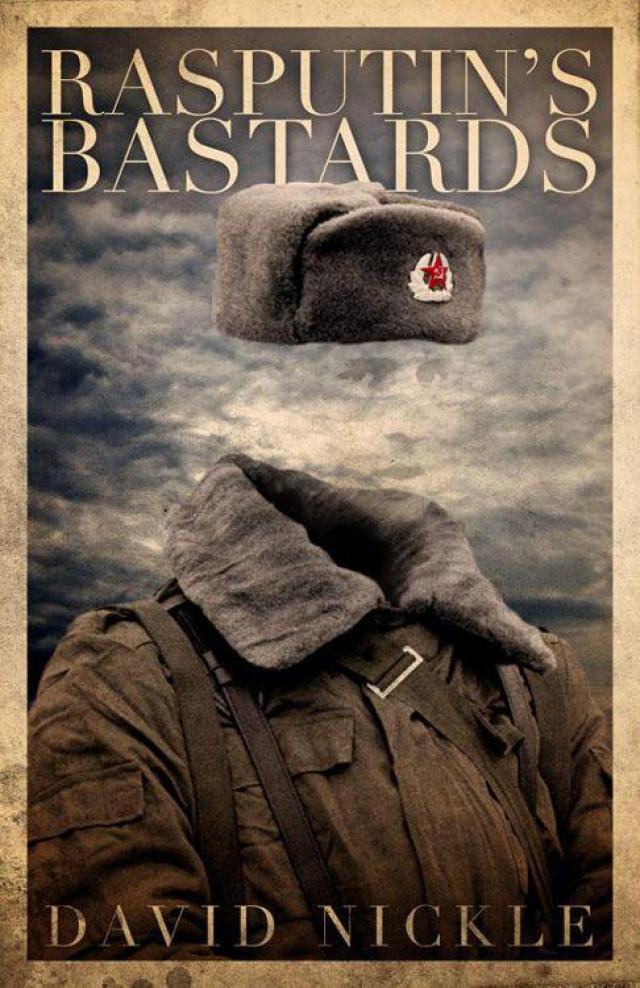
Cover artwork © 2012 by Erik Mohr
Cover design © 2012 by Samantha Beiko
Interior design © 2012 by Samantha Beiko
Cyrillic translations © 2012 by Vaike Rannu and Tatiana Ignatenko Ranaweera
All Rights Reserved.
CIP data available upon request.
This book is a work of fiction. Names, characters, places, and incidents are either a product of the author’s imagination or are used fictitiously. Any resemblances to actual events, locales, or persons, living or dead, is entirely coincidental.
CHIZINE PUBLICATIONS
Toronto, Canada
www.chizinepub.com
info@chizinepub.com
Edited and copyedited by Sandra Kasturi
Proofread by Samantha Beiko
to Olga Nickle
who dreams better dreams than anyone within these covers
DRAMATIS PERSONAE
THE SPIES
ALEXEI KILODOVICH — A spy who remembered
FYODOR KOLYOKOV — A spy who loved too much
LENA — A spy who adored life
BABUSHKA — A spy who disdained death
JEAN KONTOS-WU — A diligent spy
VASILI BOROVICH — A spy who dreamed badly
THE KOLDUN — A spy who slept quietly
RICHARD [REDACTED] — A spy who broke
MILES SHUTE — A spy repurposed
ILYICH CHENKO — A spy who made his fortune in real estate
TANYA PITOVOVICH — An associate of Chenko’s; a spy who is good at it
THE AMERICANS
STEPHEN HABER — A talentless orphan
HOLDEN GIBSON — A terrible father
HEATHER [REDACTED] — A rebellious daughter
JAMES [REDACTED] — A recalcitrant son
LEO MONTASSINI — A man in who fell into mystery
GEPETTO BUCCI — His boss
THE TURKS
AMAR SHADAK — A purveyor of arms and collector of submarines
KONSTANTINE UZIMERI — A “submarine guy”
THE CHILDREN
VLADIMIR — A baby, filled with too much wisdom
ZHANNA — A girl, filled with too much love
THE VILLAGERS OF
NEW POKROVSKOYE
DARYA ORLOVSKY — A shopkeeper of surpassing beauty
PAVEL ORLOVSKY — Her father, who stopped killing without regret
NIKOLAY TROLYNKA — A fisherman
MAKAR TROLYNKA — His son
“A particle of the Supreme being is incarnated in me. Only through me can you hope to be saved; and the manner of your salvation is this: you must be united with me in soul and body.”
— GRIGORI YEFIMOVICH RASPUTIN
“All happy families are alike.”
— LEO TOLSTOY
TABLE OF CONTENTS
Cover
Title Page
Copyright
Dedication
Dramatis Personae
Epigraph
Prologue
The Idiot
A Lost Opportunity
The Idiot
The Gambler
The Idiot
There Are No Guilty People
The House of the Dead
The Idiot
The Gambler
The Insulted and the Injured
The Grand Inquisitor
The Idiot
The Gambler
The Stranger-Woman
The Gambler
The House of the Dead
The Grand Inquisitor
The Little Hero
Awakening
The Grand Inquisitor
The Idiot
The Little Hero
The Idiot
The Insulted and the Injured
The Grand Inquisitor in the House of the Dead
The Idiot
Master and Man
The Idiot
Resurrection
The Honest Thief
Resurrection
The Idiot
The Little Hero
There Are No Guilty People
The Little Hero
The Insulted and the Injured
The Honest Thief
The Insulted and the Injured
The Idiot and the Honest Thief
The Double
Resurrection
The Honest Thief
The Grand Inquisitor
The Idiot in Youth
The Little Hero
The Idiot
There Are No Guilty People
The Little Hero
There Are No Guilty People
The Idiot
The Honest Thief
The Grand Inquisitor
The Idiot
The Little Hero
The Idiot
The Honest Thief
The Little Hero
The Idiot
Epilogue
Acknowledgements
About the Author
Praise
PROLOGUE
The steam carried the smell of Babushka’s death like a soaked sponge. It leaked between the wooden slats of the bath house’s door, and whipped and whirled from there in thin, hot tendrils to mingle with the ice fog that had enshrouded the village of New Pokrovskoye since the early days of March.
March was an important month. It was the month that Babushka had first set down a schedule for her own death; the month the giant squid came to the harbour and presaged it all, by dying there itself.
The squid arrived sometime in the night. It thrashed and twisted underneath the translucent grey ice for hours before it died, its tentacles braiding and spreading — a woman’s long dark hair in a suicide bath.
Suicide seemed the best explanation. The squid could have dived — gone back south, and deep, into the cool dark ocean where its brethren dwelled in unguessable numbers. But something stopped it; or it knew, somehow, that its time was up. Whatever the reason, it stayed there beneath the harbour ice of New Pokrovskoye, thrashing and twisting until finally it slowed — its giant form stretching under the grey-green sheet for fifteen metres, like a great, dark stroke of watercolour.
Babushka wheeled herself out onto the ice in the predawn, breath making a contrail behind her as she huffed along to the squid’s remains. The ice creaked as she leaned forward in her wheelchair, propped on her walking stick, and glared down at the creature.
The walking stick was old. It was said that it had been carried to St. Petersburg by a holy man a hundred years ago, and was cut many years before that — and it was hard as iron. She leaned over, hacking at the ice, eventually tumbling out of her chair and falling to her knees with the effort. By this time, someone had called the Koldun — the fishing village’s lodge wizard and healer, second only to Babushka herself in esteem and influence.
He went out and joined her for a time. A growing crowd of villagers watched at the bank as he wheedled and cajoled and finally took hold of her arm. But she shook off his attempt angrily, and that was all it took. The Koldun had known Babushka for many years. But neither he nor anyone else dared confront her when she became like this.
She glared down into the squid’s eye for a full minute — then finally, drew back, barked a harsh laugh, and spat in it.
She turned to the Koldun and the rest, and that was when she said it, loud enough to carry through the whole, ice-bound village:
“When this kraken is gone — I go too.”
The Koldun and the others laughed, uncomfortably at first — and then, as she joined them, with more assurance.
And because of that, the people of New Pokrovskoye concluded:
Everything is fine. It’s just another of Babushka’s jokes.
But it was no joke.
Babushka knew the lay of her years the same as she knew the lay of this foreign and rocky earth, the hearts of the men and women who believed they controlled it, and the movements of the long, dreaming war that had long ago faded to mere skirmishes. As the ice from the waters in the north mingled with the waters to the south, so would Babushka mingle with the air.
And so Babushka reached from the bath house, and quit of her flesh, she joined the icy air swirling in the breaths of her grandchildren.
To each one, Babushka’s scent was different. Darya Orlovsky, who had suckled at the Babushka’s teat and loved her more dearly than her own mother, smelled breast milk and coffee and sausage. “Oh,” she said, as she lifted a crate of caviar from the back of the truck and turned to carry it into the store. “Babushka.”
Old Nikolay Trolynka, who was in his fishing boat as it crossed the part of the harbour where candle wax chunks of the iceberg had still floated just a day before, smelled ginger and garlic. “Ah,” he said, nodding to himself. “‘The kraken goes, and so do I.’ That explains it.”
“Heh?” said Makar, Nikolay’s oldest son. His nostrils flared around a sharper smell — of sulphur and mint — as he wheeled the fishing boat.
“Babushka,” said his younger brother Oleg, smelling old sweat not his own. “She has gone, and drawn the fish with her.”
“Makes as much sense as anything.” Makar ran his arm across his nose and snorted. It did no good; the smell remained.
It remained, and it spread — through the town store, in hues of blueberry and whiskey and pine needle; in shades of clove an d musk and olive, through the rambling Museum of Family History that was the Koldun’s gift many years past; and across the fishery, where the flatulent stench of rotting cod guts was replaced by a mélange of odours — each one better or worse than fish death, depending upon the predisposition of the particular grandchild’s nose that it touched.
Babushka’s body lay still on the top bench of the bathhouse. Babushka herself rested somewhat higher, suspended above her great, still breasts, in a concentrated cloud of vapours.
The Koldun removed his coat and set it on the peg in the dressing chamber, before he pulled the door shut behind him.
So you did it, said the Koldun. His eye moved up and down, from the Babushka’s body to her essence and back again. I confess, my dear, I am puzzled. You had obviously been planning this. Yet why?
The essence of Babushka whirled and twisted, as the air from the closing door swept to the rafters. The Koldun understood it as a shrug.
Why now? You should have to ask. Look at the world, my dearest. It is past ten years ago that our masters are fallen. Yet we still live for their dying will.
Not so, said the Koldun. When was the last time that any of us were called in the night? When was the last time we even heard them in Discourse? And really — you never lived for them. We all live for ourselves. For our children.
The essence of Babushka loosened itself, and spread across the cedar ceiling planks like a pool of liquid, inverted.
For our children. Her voice was a whispering in the Discourse. The ones we know of, perhaps . . .
What are you talking about? ‘The ones we know of.’ The Koldun rocked back and forth on his heels uneasily. He looked again at the Babushka’s body — heavy and naked, its flesh was yellow as an old bruise. He looked up again at the steam at the ceiling. It was dissipating; the Babushka’s voice was fading.
The Koldun stepped over to the water barrel, and dipped the ladle in to pull out a cup of rainwater. Eyeing the ceiling, he flung the water onto the rocks by the fire. Hot steam stung his eyes and burned down his throat.
What do you mean? said the Koldun again. ‘The ones we know of?’
The Babushka was angry now, though; she roiled and burned across the ceiling, and crept toward the crack above the door.
Enough, she said. I will go see my grandchildren now.
You already have, said the Koldun. Your passing is known across the village.
Across the village perhaps it is, she said, but I must yet visit my grandchildren. All of them. Across the world. They must all know.
The Koldun raised an eyebrow at that. The world? he wondered, but he didn’t pass that thought on to Babushka.
That’s a great many grandchildren, he said, if you mean the whole of City 512 and —
City 512 — pah! The cloud rolled back from the door now. It thickened, and began to descend. You have no idea, my love. You could not have had an idea, until a time such as now.
A time such as now?
A time of gathering, my love. The cloud crept further down the walls of the sauna. Its belly fattened. A great gathering, here in the harbour — here in New Pokrovskoye. A gathering of the children we’ve loved and dreamed. And more. Of children whose fine luck was to never know their fathers. Who never knew us.
What are you planning?
You know, said Babushka, and drew in upon him.
They cremated the body a day later, in a pyre near the lighthouse. There was no shortage of ceremony to go with the burning. The town gathered first in the greenhouse, where they sang and drank and wept in accordance with their understanding of the Babushka’s final wishes. Then they moved, with the body, up the hill to the pyre of driftwood. It took five men to lift the Babushka’s litter onto that pyre. All stood and watched as the wood lit, and breathed deeply of the scent, as the fire grew to consume her ancient flesh.
Everyone in the village attended — everyone but for one, and he was excused for obvious reasons. For the past day, the Koldun had lain wrapped and snoring in the Babushka’s blankets at the bathhouse. When he was finished dreaming on her behalf, no doubt he would join the village to remember their matriarch in fitting form.
Or such was the word around the village. In truth, the Koldun would have no trouble remembering Babushka, whom he had loved and served in life.
And now, in death, whom he was preparing to betray.
In his dreams, the Koldun found himself drawing back to Babushka’s whispered answer to his question.
What am I planning?
Many things: to be loved; to be remembered; to be worshiped, maybe; to set things right, perhaps.
But one thing for certain.
Not, my love, to ever die.
THE IDIOT
The face looming over his own could have belonged to God: an old, tired, and infinitely pissed-off God.
Well, thought Alexei Kilodovich as he gazed up into His heavenly glare, He has every right to be. God must have better places to be than here out in the rain on the deck of a boat in the middle of an Atlantic night, pulling an undeserving wretch like Alexei Kilodovich out of the drink. One small eye squinted as a rivulet of water ran into a tiny pink tear duct from the broad slope of His forehead.
“What the fuck happened to you?” He demanded.
Alexei looked back at the face and considered the question, and the unspoken questions that cascaded from that one.
How did you get that bruise on your own forehead, all yellow and blue and soft? How did you wind up in that little dingy, here in the Atlantic? How could you let Mrs. Kontos-Wu down? Leave her to the Romanians?
How could you be so stupid?
Alexei opened his mouth to answer. But the truth stuck in his throat like a bone.
“I remember nothing,” he lied, and with that lie he settled into a new role: the amnesiac castaway, confused and grateful and frightened — but most of all confused — as much a mystery to himself as he is to his benefactors.
“Ah,” said God, “should have let you drown.” And He pulled away and vanished in the dark.
“Did your boat sink?” It was a new face this time — a long one, with a little van Dyke beard and a head shaved bald. His breath smelled funny — like burning sugar, and something beyond. The smell came and went as a sea breeze.
“I do not — ” Alexei paused, to frown and think on the question, or at least give the appearance of honest thought “ — I do not remember.”
“What about its name?” asked a young woman who sounded American — possibly from the southern States, maybe Georgia. “Your boat’s name.”
“It was — ” Alexei made a show of snapping his fingers, as if the noise alone would summon up the name like a well-trained dog.
“No,” he said. “I am sorry.”
“What are you doing off Maine?” said the bald man. “You sound Russian or something.”
“Maine?” said Alexei. The woman was pulling up the rope ladder from their own boat. This one was at least as large as the Romanians’ big cabin cruiser — from the brief glimpse of it he’d gotten as it approached his raft, he’d guessed it might be even larger, and more opulent. From inside the main cabin, Alexei could hear faint music — although he couldn’t tell what kind, against the noise of the ocean. Yellow light shone warm as a fire through the curtains of a nearby porthole. It all should have conspired to give him comfort. . . .
Comfort is the torturer’s first tool. Succumb to that, and you’ve failed already. Who had said that? Alexei frowned, and shivered. Maybe the amnesia trick wasn’t such a lie after all.
“You can’t not know where Maine is,” said the woman. She had the hood of her raincoat up, so he couldn’t see much of her. But the skin on her face shone like a seal pelt in the misting rain, and her eyes, small and suspicious, flashed at him. “You can’t,” she repeated.
“It is in the United States,” replied Alexei. He let a sliver of uncertainty creep into the trailing sentence for effect. “Sure.”
“So you haven’t forgotten everything,” said the woman. “What year is it? You know that?”
“1997,” he said, and she said, “See?”
She threw her hood back, damp hair falling to her shoulders in faux-Rasta Medusa-snakes. She was younger than he’d thought — not more than twenty-five, certainly, with an oval face, scorched eyebrows and small dark eyes — and in the act of pulling back the hood, the accusation in her eyes had changed to a kind of triumph.
Alexei let his hand flutter up to the cut on his forehead. “Ah,” he said, and loosened his knees. Take me to a bunk, he willed, as he let his eyes turn up into his skull and relaxed his shoulders before he hit the hard wood slats of the deck. Take me inside, make me warm and well, and save your questions for the morning.