

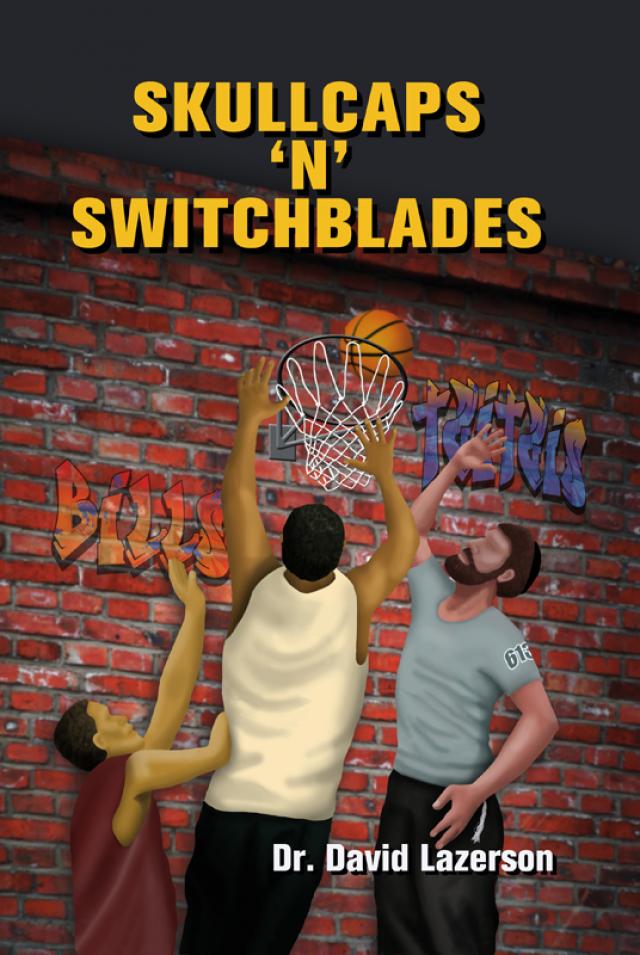
Skullcaps n switchblades, p.1
Skullcaps 'n' Switchblades, page 1


ISBN: 9781626752917
PREFACE
Picture a classroom of tough, inner-city adolescents with learning and behavioral problems who fulfill all the crazy stereotypes – guns, knives, drugs, broken families, and tough-guy personas. Now, infuse the scene with a bearded, skullcapped teacher – an Orthodox Jew – whose physical appearance musters presumptions of non-athletic stoic merchants, or doctor/landlord/lawyer-types. This scenario fascinated me in a dreadful sort of way. I was this teacher.
It was probably the Good Lord's sense of humor that brought me to Dr. Martin Luther King Jr. Community School in Buffalo, NY. My only question was: Why me?
Years earlier, if I had changed a few courses, met different people, or taken alternate routes while commuting, I could easily have fulfilled a more conventional Jewish role such as becoming a fine pediatrician with a nice, successful practice, or attaining the moniker, "My-son-the-CPA." In truth, making a tough-but-honest living as a sanitation worker seemed more inviting than acclimating to life as a special education teacher in the inner-city. You gotta be flippin' kidding me!
But here I was, smack-dab in the middle of what promised to be a dramatic clash of cultures: White vs. Black, Jew vs. Gentile, Middle Class vs. Lower Class, Rap Music vs. Chassidic melodies, chicken soup vs. grits. Clearly, the dilemma centered on whether skullcaps and switchblades could get along. Would either of us overcome our biased notions about the other? A more crucial question was: Would I survive?
I had never intended to leave the Rabbinical College of America in Morristown, New Jersey to tackle a degree in learning disabilities. And even though I received my training at a local school in my hometown of Buffalo, NY, I felt as if I had left the womb.
However, once I accepted this scenario, I became impassioned by idealism. I envisioned applying my newly acquired skills to the realm of Jewish education, hoping to disperse the cobwebs of disinterest and denial I perceived by organizing some sorely needed LD programs, (learning disabilities), within the Yeshiva world. Little did I realize that the fulfillment of that dream would only come to fruition after eight full years in inner-city public schools; schools that were a far cry from the Manhattan Day School Special Education Department, (Yeshiva Ohr Hatorah), I would later direct.
But my stint in the public school system, (which began at Dr. Martin Luther King Jr. Community School), was far more significant than time spent simply to "earn tenure." It was a remarkable period where I was able to explore the question of whether or not academia had properly prepared me for teaching in the trenches.
Those early years, and especially my very first year, was a right-of-passage that was full of sharing, infused with laughter, interspersed with tears, and leavened with migraines. But most importantly, it was here that I began learning from my students. In fact, among all the things I learned while teaching at this school, it amazes me that somehow, in their own crazy, straightforward way, my students taught me to be secure in my own culture and to take pride in my roots.
As I reminisce about the events that transpired in the Buffalo Public School System, it still amazes me that my students and I actually survived them. However, the lessons learned still resonate. Today, I continually utilize and finetune the educational strategies I discovered while teaching at Dr. Martin Luther King Jr. Community School. In fact, these tried-and-true tactics currently contribute to the success of my pupils at The Quest Center in South Florida's
Broward County Public Schools. I am always humbled when I acknowledge the fact that they were heat-forged in that very first classroom, at the school of "hard-knocks."
I also discovered something else, equally as profound, at MLK: That each and every one of us on this planet was put here for a good reason, and that everyone has something positive to contribute.
It's time we help one another do so.
Table of Contents
PREFACE
Chapter 1
What's a Nice Jewish Boy Doing in a Place Like This?
Chapter 2
Getting the Job
Chapter 3
Welcome to the "Real World"!
Chapter 4
Dr. Martin Luther King Jr. Community School
Chapter 5
Day One
Chapter 6
Victory Number One
Chapter 7
Trouble with a Capitol L
Chapter 8
"Ah-Jew, Ah Jew"
Chapter 9
Oh You Oil
Chapter 10
Taking Off for the Holidays
Chapter 11
My Escort
Chapter 12
Kissin' Those "Jew Strings"
Chapter 13
Show 'n' Tell
Chapter 14
The Freaky Pet Center
Chapter 15
Lenny's Grand Entrance
Chapter 16
Lenny's Amazing Return
Chapter 17
Music Man And Cool Breeze
Chapter 18
You Forgot Yo Blessing!
Chapter 19
"I'll Fix His Jaw!"
Chapter 20
Some Strange Folks
Chapter 21
But I Got Me a Jewish Name!
Chapter 22
Rabbi Gurari and the Buffalo Sabres
Chapter 23
Curtis Crosses The River
Chapter 24
Go Help Your People
Chapter 25
Emergency Call
Chapter 26
Visit From A Moon Girl
Chapter 27
Scuba Adventures Above Water
Chapter 28
An Unusual Shabbos Guest
Chapter 29
We're All Learning Disabled
Chapter 30
A Grandiose Idea
Chapter 31
Trouble In The Woods
Chapter 32
Stuck On A Mountaintop
Chapter 33
I Ain't Afraid Of No Bear
Chapter 34
Teacher Of The Year
Chapter 35
Like an Angel
EPILOGUE
1
What's a Nice Jewish Boy doing in a Place like This?
I WATCHED WITH ANTICIPATION as my students entered the classroom. It was my first day. Somehow, for some unknown reason, fate had taken me, a potential Jewish doctor or lawyer, and turned me into a teacher for inner-city, Learning Disabled, (LD), students.
A week ago I had been ceremoniously presented with their files. "Forewarned is forearmed," my supervisor told me with a strange smile on her face.
Three students had criminal records. Another two were simply too young to be classified as juvenile delinquents. Most came from broken homes. Only three of the ten had fathers living at home. Some had witnessed actual murders. To make matters worse, not only were they all males, but some were nearly as tall as me, all 72" worth!
They entered the classroom slowly and quietly, eye-balling me from top to bottom. I'm certain they had never seen such a creature before – I stood out like a sore thumb. Not only was I white, but I also had a long, scraggly beard, and for a finishing touch, I wore a yarmulke on my head, (a Jewish skullcap).
I eye-balled them back. Guessing it was my responsibility to speak first, I turned nervously to write my name on the board. (It seemed a "teacherly" thing to do).
"Fellows," I said. "My name is Mr. Lazer -" I didn't get a chance to complete the sentence.
"What are you wearing on yo head?" one student asked.
"Good question," I responded. "You see, I wear this because I'm a -."
"You in the Navy or sumpin'?" another blurted out.
Nervous laughter. It was starting a lot earlier than I had anticipated. I had been advised that my students would probably test me during the very first week of classes. Perhaps even the first day. But no college professor or textbook ever predicted this challenge might occur during the first minute on the J – O – B.
"It's gonna be an interesting year," I answered, my eyes nervously scanning the room. "We're going to learn a lot about each other's cultures. The reason I wear this, fellows, is because I'm..."
"Maybe he's bald," one student remarked.
More nervous laughter; this time a bit louder than before.
"Act. Be a good actor." It was sage advice given by my current mentor and cooperating professor, Dr. Herb Foster, (in addition to teaching, I was working toward my Ph.D. at The University of Buffalo). He wrote the best-seller, Ribbin' Jivin' & Playin' the Dozens, long considered the bible on Urban Education.
"If you're heart starts firing away and your mind begs for the "flight response," nonetheless, break out the acting skills. Pretend the outbursts and the in-your-face wisecracks don't faze you in the slightest. Assert yourself – get control."
"Okay, okay." I held my outstretched palm toward their faces. "Rule number one in my room is...close the mouth when someone is talking. As they say in French, fermez la bouche." Close the mouth. When I talk you, close your mouths and listen. Got it?"
They slowly nodded their heads. Piece o' cake, I thought to myself. I got this covered.
"Good," I continued. "And it works both ways. When you talk, I'll listen to what you have to say."
More nods as I lowered my outstretched hand. I had just leaped from greenhorn to superstar pro. My acting skills were working like a charm. This teaching thing was no big deal. Or, so I thought.
"Now, yo u asked me a question and I'll give you an answer. Like I started saying, it's going to be an interesting year. We will learn a lot about each other and our different cultures. I wear this cap on my head because..."
"Maybe he's got lice," the tallest and biggest kid in the room blurted out, completely ignoring the sanctity of rule numero uno.
They exchanged glances, laughs, head nods, and even a few hand-slaps. I felt my heart beating in overdrive
For a few seconds, time stood still. What the heck was I doing here? My dad was right. I should've gone to pharmacy school and helped him with his business. I would have made a much bigger salary, had zero disciplinary headaches, and could have forgone all the nonsense teachers put up with.
I suddenly felt like a Martian from outer space. An invading foreigner.
"God," I whispered, "Don't let me die in Dr. Martin Luther King Jr. Community School! I have so much to give. Please. So much to live!" I quickly amended my heartfelt prayer, "And please. Get me the heck outta here!"
So much for acting skills. I no longer needed to ponder the question of flight or fight. My brain was telling me to zip-on-out-the-door ASAP. "Well, now that you're all here," I wanted to say, "let me step out and get your real teacher. T'was a pleasure meeting you all. Later."
"If I don't get control of this classroom immediately," I told myself, "I'll be eaten alive."
Skullcaps 'n Switchblades was beginning to feel a lot like oil and water.
2
Getting the Job
IT ALL BEGAN, I SUPPOSE, when I was a student at Mo-Town, (the nickname for the Rabbinical College of America in Morristown, New Jersey). I had recently married and was attending classes at "the Yeshiva" on a part-time basis. To help make ends meet, I held a variety of part-time jobs. Quite frankly, I was running around like a chicken without a head. It was probably Divine intervention though, that ensured that each job dealt with education and social work.
Even though I had only been at Mo-Town a year, (and had no formal training in Jewish subjects), I was nevertheless offered a job as the principal of a small Hebrew School. I was puzzled by the invitation. True, I had a college degree, but why would that alone qualify me? "Fresh blood," was the reply. They wanted someone young, with new approaches and ideas. Soon I realized that they meant the term literally: They wanted a young sacrifice to throw to the lions!
I had plenty of enthusiasm, but I lacked any formal training in education. Still, I accepted the job. Was it because of the challenge; or was it perhaps, because I was suicidal? Only time would tell. But before I signed that contract, I took a vow. It went basically like this: "I, David B. Lazerson, promise not to do to my students what most of my teachers have done to me for far too many hours and years; bore the living daylights outta me! I pledge to do whatever it takes to motivate, stimulate, and even inspire my students. If not, I get myself another line of work. Scout's honor."
During high school, when I was attending Buffalo Public Schools, I squeaked by with an absolute minimum amount of effort. For the most part the classes and teachers were depressingly boring. Surviving school became an exercise in patience, a matter of watching clocks, yearning for fresh air, passing notes, and getting into the kind of trouble that would help me make certain my classmates were still alive. I had a few good teachers, but in general, I "cruised by" with a mid-80 average.
My father once broached the subject with me: "Look," he said. "I know you're not thrilled about school, but being satisfied with a paltry half-effort is not good for you or anyone else. Whatever you do, do it wholeheartedly. Make the best of it."
Next, he quoted a Beatles song to me: "Take a Sad Song and Make It Better." Now, that was hitting below the belt!
In addition to the principal/teaching job, I also found myself working as a "big brother" for a Jewish counseling agency, and conducting courses in Judaic studies at two local universities: Farleigh Dickinson, (dubbed Fairly Ridiculous), and Drew University. The latter job I procured through the Yeshiva. Besides teaching Jewish studies, I was in charge of organizing our customary parties and events. We had many a wild, intoxicated moment during our campus succah parties.
I considered these jobs an opportunity to put my dad's advice into practice; so I wholeheartedly threw myself into each task. Fortunately, I worked with people from all walks of life: College students, professors, a paraplegic senior citizen, a Jewish kid left over from Newark's inner city who was all of ten years old; and sixty-five wild-and-bloodthirsty Hebrew School students. From here I would determine whether to work with people or machines for the rest of my life. It was, I guess, sink-or-swim for me. And since my "training" arose almost entirely from life experiences, I was to a large degree, swimming without a life-jacket.
Somehow, I survived the two years these jobs required. At some point I concluded that in spite of the obstacles, my Hebrew School students really did want to learn. Sure, they were only there because their parents forced them to attend. I could relate to that. When I was a Hebrew School student I felt the same way. In fact, I amassed some truly impressive awards while attending Hebrew Classes: "Most Absent," "Most Thrown-Out," and "Most Obnoxious." Nonetheless, I felt that when my students were exposed to Torah-true feelings and values, they responded in a positive way. They genuinely liked it, in spite of themselves.
With teaching now a realistic option, I decided to go back to my hometown of Buffalo to attain my master's degree in special education. I needed to get the basics of teaching "under my belt." In preparation, I reasserted my original premise for choosing this path – that no matter what else happened, no matter where I might end up, I would stick to my promise and determinedly attempt to motivate and stimulate my students. Little did I realize then, that my resolve would be tested on the front lines of inner-city public schools.
3
Welcome to the "Real World"!
MY MASTER'S DEGREE PROGRAM was time-consuming. In addition to intensive studies, was the imperative to feed my growing family. Thus, I took a job at a dry cleaning business in Buffalo's inner city. I made about $100 a week while concurrently attending classes several afternoons and evenings. My job consisted of two tasks. First, I would schlep clean clothes into the van, and then I would deliver them to stores and customers. Surprisingly, this job proved to be almost as useful at preparing me for urban teaching as my master's program.
While I was employed at this inner-city business it was held up twice at gunpoint. Fortunately, I was out doing deliveries both times. But on one occasion I almost wasn't as lucky. I had been loading clothes and noticed two black teenagers approaching on bikes. After crawling into the driver's seat and merging the van onto the street, I realized that these bicyclists were moving extremely fast and approaching unusually close. Without warning, each of them crashed into opposite sides of the vehicle. I heard the sound of hands pounding metal on the passenger side.
Of course, I immediately stopped, but I cautiously stayed inside while I checked out the situation. Looking into the rear-view mirrors, I could see both "victims" writhing on the ground in apparent pain, their bikes immobile beside them. Still, the incident just didn't seem real to me. In spite of the fact that I was trained in first-aid, I went with my intuition: Wait and see. Don't go out yet. I was leery because I wasn't in "my territory." There weren't very many folks in this neighborhood who would feel safe enough to come running to my rescue if I got jumped while trying to assist my "casualties."
Suddenly, after a long ten seconds or so, the guys jumped up, began laughing, grabbed their bikes, and cursed me as they rode away. I breathed a sigh of relief. As I resumed my errand, I felt somewhat wiser for the experience. In fact, this wait-and-see attitude has served me well on many occasions since then.
After two hard years of work, I completed my Master's Degree in Learning Disabilities. Unlike much of my previous schooling, the program had been amazing. For one thing, I was more goal-oriented. But in addition, nearly every class was pertinent and worthwhile – taught by instructors who were sincere and dedicated. Some of my profs at Buff State were downright brilliant, and at the same time, entertaining. I actually looked forward to these evening classes, (despite the fact that they were taught in marathon sessions lasting three-and-a-half hours). I regarded these courses as "ammunition" for my future in the classroom battle zone.






