

Richard iii, p.1
Richard III, page 1


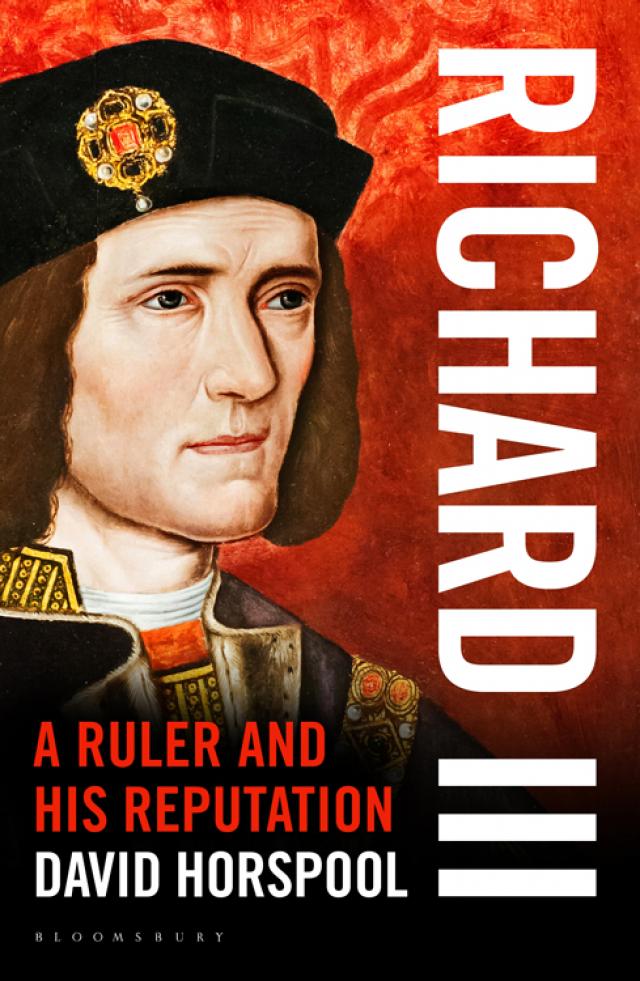
Richard III
A Ruler and His
Reputation
David Horspool
In memory of Christopher Horspool (1940–2013)
Table of Contents
List of Illustrations
Introduction
1 Son of the ‘high and mighty Prince’
‘His wit and reson wt drawen’
‘Infants, who have not offended against the king’
At Fastolf’s Place
‘Into the parties of Flanders’
Duke of Gloucester, Squire of Warwick
‘Little body and feeble strength’
2 Exile and Recovery
Richard of Wales
‘My lord of Gloucester travelled to Holland’
‘Ledyng the vaward of Kyng Edward’
3 Warwick’s Heir
A Bride for a Prince
A Bridge on the River Somme
Family Business
Lord of the North
‘To fight against James, King of Scotland’
4 ‘To Catch the English Crown’
Uncle and Protector
Friday the Thirteenth
‘Ordeigned to Reigne upon the people’
5 ‘Her comyth Richard the third’
‘The Princes in the Tower’
‘To shine as a king’
‘The most untrewe creature lyvyng’
6 ‘In one body there are many members’
Castle of Care
‘All Engeland, undyr an hogge’
Evil Reports
7 ‘Tant le desieree’
8 ‘My shadow as I pass’
‘By broken faith’
‘To secure a reassessment’
Richard at Rest
Acknowledgements
List of Abbreviations
Notes
Bibliography
Index
List of Illustrations
1 The Falcon and Fetterlock badge of the Yorks from Heraldry for Craftsmen and Designers by William St John Hope (New York: Macmillan, 1919).
2 The seal of Richard of Gloucester as Admiral of England from Heraldry for Craftsmen and Designers by William St John Hope (New York: Macmillan, 1919).
3 The Middleham Jewel. Image courtesy of York Museums Trust: http://yorkmuseumstrust.org.uk/: Public Domain.
4 A facsimile of Richard’s own addition to a letter to the Lord Chancellor, 12 October 1483 from The Handwriting of the Kings and Queens of England by W. J. Hardy (London: The Religious Tract Society, 1893).
5 A replica of the ‘Bosworth Boar’ badge. Photograph: Thea Lenarduzzi.
Introduction
A famous portrait: a man gazes distractedly off to the left, his hands held lightly together in front of his chest. The eye is drawn to those hands. In a nervous gesture, the left thumb and forefinger pinch off, or on, the ring on the little finger of the right hand, one of three rings he is wearing. The man is sumptuously dressed and ornamented, his sleeves lined with fur, a ruby and pearl jewel in his hat, and a rich collar in which fourteen more rubies and twenty-four more pearls are visible. These are the trappings of very high status, but the sitter has none of the placid self-assurance associated with the wearers of such finery. His eyes seem those of a youngish man, perhaps in his early thirties. They are bright and keen, if mournful, while his skin is pale and his features are drawn. The lines on his brow and around the eyes age the face. Here is a picture of nervous energy, and of gnawing conscience.
This painting, hanging in the National Portrait Gallery in London, a detail of which is reproduced on the cover of this book, remains the most familiar of all images of Richard III, though it is not the oldest. It was painted long after its subject’s death in 1485, probably around a hundred years later. It is based, like dozens of others that once decorated the corridors of great houses throughout the country, on a portrait in the Royal Collection, which was painted between 1504 and 1520 – that is, also not from life. Intriguingly, despite the hints of troubled conscience, the National Portrait Gallery version is far more sympathetic than the earlier Royal Collection one. That portrait was touched up fairly soon after it was first done, to thin the lips and set the mouth in a hard line, and to raise the right shoulder – only very slightly elevated in the National Portrait Gallery version – rather more acutely. The skin in the Royal Collection portrait is sickly pale, almost yellowing, and the eyes are harder, while the thumb on the right hand, which is bent in the National Portrait Gallery version, seems to have sharpened into a point. This picture, recorded in the collections of Henry VIII and Edward VI, son and grandson respectively of the man who replaced Richard III on the throne, seems to have been painted to capture the classic ‘Tudor’ view of Richard, as an incarnation of evil, a usurper and mass murderer, deformed in mind as in body. Here is the wicked uncle, killer of the Princes in the Tower (among others), awaiting his deserved comeuppance in battle against the rightful king.
The fact that the Tudors themselves kept a deliberately exaggerated version of ‘bad King Richard’ on their walls is less puzzling than the fact that, towards the end of the sixteenth century – by which time Shakespeare’s monster had probably already appeared onstage and the material on which he based his version was certainly well established – somebody should have commissioned a portrait that turned out to be so broadly sympathetic. The Richard in the National Portrait Gallery doesn’t look like a bad man: he looks like a man with a lot on his mind. The portrait prompted similar reactions in Richard’s most famous (fictional) advocate, Inspector Grant, hero of Josephine Tey’s extraordinarily successful pro-Richard detective novel The Daughter of Time (1951). This is, Grant thinks, a painting of ‘Someone too-conscientious. A worrier; perhaps a perfectionist’. It is emphatically not an image of villainy. For Grant, the painter, whoever he was, turns out to be on to something, after the policeman has conducted an investigation into Richard from his sickbed. The last words of the novel, spoken by a nurse, are: ‘When you look at it for a little it’s really quite a nice face isn’t it?’
What neither the nurse nor Inspector Grant reflect on is that this ‘nice face’ was as much a work of imagination as any of the nastier faces of Richard made by painters or conjured by chroniclers or playwrights. The National Portrait Gallery painting reminds us that there has very rarely been a settled opinion about Richard III, even in the supposedly propaganda-filled Tudor years. But it also cautions us that all our efforts, like those of the anonymous artist who decided to give back to Richard a little humanity, are prey to some form of wishful thinking. The National Portrait Gallery describes its picture of Richard as using ‘the pattern from an original likeness’, and art historians think that the very earliest surviving portrait of Richard, now in the collection of the Society of Antiquaries, was based on one ‘painted from life’.1 But we are still at one remove, at the very least, from Richard himself. There is no contemporary portrait of Richard, no record of his sitting for one. Here, in visual form, is the problem for anyone approaching a life of Richard III. For a king who spent just over two years on the throne, he has received an extraordinary, perhaps even an unsustainable, level of attention and range of opinion. Some of that material was contemporary, but the most powerful, the bits that have stuck in the public imagination longest, like Richard’s portrait, are not. Reconstructing Richard is often an exercise in admitting our ignorance – in stark contrast to the confidence of those who wrote about him shortly after, or even long after, his death – and deciding on the balance of probabilities. We can demonstrate how Tudor ‘propaganda’ or Ricardian advocacy has, in the past, overstated its case, but being sure what isn’t right is not the same as knowing what is.
The confirmation that Richard’s remains had been discovered in Leicester in 2012 offered the hope that in some areas, science could replace speculation about him. But most of the problems with understanding Richard have not been solved by the discovery. These can be summed up as too little to go on, and too much. Too little, because the evidence for Richard’s life, particularly his life before he became king in 1483, is not exactly super-abundant. He features in royal grants and parliamentary rolls, and is mentioned in near-contemporary chronicles of the period, though the tradition of monastic chronicle-writing was in terminal decline, and the town chronicles that survive are mostly terse records of events, with little embellishment. There are mentions of Richard or things to do with him in the chance survivals of private family correspondence, chiefly that of the Pastons of Norfolk, whose business just happened to overlap with his on occasion. There are a few letters dictated, and fewer lines still actually handwritten, by Richard. The great majority of this material is available in printed editions, of which this book will make copious use. We know about some of Richard’s own books, though for most of them we can’t be sure he read them, let alone what he thought about them. In almost all his earlier appearances on the historical stage, Richard is not the protagonist. As a child he is often invisible, and, even in his ‘formative years’ as Duke of Gloucester, he is frequently missing from the record. For much of his life we don’t know precisely where Richard was at specific times, nor when some very major personal events happened. We don’t know, for example, exactly when he got married, nor when his legitimate son or (at least) two illegitimate children were born.
But those gaps are nothing compared to the difficulty of reconstructing Richard’s personality. Overwhelmingly, the imprint that Richard left on his time was impersonal. It is a record of acquisitions, of political and judicial decis ions, of hiring and firing, of public building and foundation, and military planning. The personality that lay behind those acts is thus ripe for speculation. For centuries, Richard has tended to be characterized as a puzzling bundle of contrasts: loyal yet treacherous, pious yet ruthless, courageous yet paranoid. It will be part of the contention of this book that many of these contradictions are more explicable than at first appears. One way of doing that is by trying to stick closely to chronology. The order in which things happened can often go a long way towards explaining why they happened. In the case of Richard, he seems to have been able to adapt to change in an often changeable world. It may seem strange to argue that a man who was killed before he reached his thirty-third birthday was a born survivor, but given the circumstances of his upbringing and the fact that two of his older brothers had died violently, he must have learned to be one. As for the remaining contradictions, they may be due to lack of evidence, or to a Walt Whitman-like multitudinous character. Nobody is consistent throughout their life, and acting in ways that seem to contradict a perceived personality trait is hardly unique. To take an example from Richard’s own family, his brother, Edward IV, is often characterized (including by contemporaries) as indolent and given to sensuality rather than vigour. Yet he was undoubtedly the greatest military leader of the Wars of the Roses, and despite years of relative peace, was apparently gearing up for a renewed assault on France when he died in 1483. Richard is often categorized, some might say dismissed, as a ‘man of his time’. One eminent historian of the Tudors went further, calling him a ‘bore’.2 He lived at the heart of one of the most dramatic periods in English history, and it would be strange if those experiences had not shaped him. But the fact that he could be so unpredictable makes him more than a typical fifteenth-century aristocrat, and very far from boring. Of course, Richard was a man of his time and class. But he was also an individual, and one who has constantly attracted attention over the centuries.
This leads us to the problem of too much to go on. In the century or so after 1485 a picture began to emerge that read back the drama of Richard’s brief reign into the life that preceded it, in some ways taking advantage of the lack of contemporary accounts of Richard to create a villain in the making. This was also the beginning of an age of national historiography, a tradition begun by Polydore Vergil and carried on through the writings of Edward Hall (1548), Richard Grafton (1568) and Raphael Holinshed (1578). The influence of Shakespeare, who drew on this tradition, is naturally the most powerful in the construction of a myth of Richard that makes uncovering the reality so difficult. But the later development of a counter-myth, if not as dazzling as Shakespeare’s monster, has been almost as influential. The pattern was set for a debate over Richard’s merits very early. As the National Portrait Gallery painting reminds us, this was not a case of an unchallenged version of history holding sway for hundreds of years before finally being swept away in more enlightened times. Richard has had historical defenders from the early seventeenth century to the present day. But on the other side, he has continued to be attacked. His great Victorian biographer James Gairdner, for example, after a thorough immersion in contemporary sources, was still convinced of the ‘general fidelity of the portrait with which we have been made familiar by Shakespeare and Thomas More’.3 More recently, at least since Paul Murray Kendall’s sympathetic account published in 1955, a more charitable view has taken hold. Subsequent academic historians, including the author of what remains the authoritative biography of Richard III, Charles Ross (1981), have tried to move beyond the study of Richard as being a matter of taking sides. Most continue to find Richard guilty of the murder of his nephews, for example, but are sanguine rather than censorious about it. This book aims at neutrality, too, taking account of the latest historical and archaeological arguments and discoveries to present a comprehensible Richard, without keeping a foot in either pro- or anti-Ricardian camps. Readers will learn my conclusions about the perennial Ricardian mysteries, but they will also read that there is a lot more to him than whodunnits, and that making moral judgements about medieval monarchs, while perfectly legitimate, is a very small part of any attempt at historical biography. I am also interested in the reasons why, more than five hundred years after the event, there are still people apparently keen to fight the Wars of the Roses.
Biographers and historians often write about ‘stripping away’ the myths created by later writers, but it is probably worth admitting that, for Richard, this is an almost impossible task. Part of the fascination of Richard is that he has become a myth, a model of evil or of wronged righteousness, depending on the storyteller. The task of anyone trying to reconstruct the life of Richard III is to be alert to the temptations that these myths and counter-myths offer, and to make use of them to understand how we have ended up with the composite figure who is at once so familiar and so alien. In most of this book, consequently, while I tell Richard’s story based on contemporary or near-contemporary accounts, I also discuss later versions where those have come to dominate the received view of events. In the last, ‘posthumous’ section of the book, I focus more closely on the constructors of Richard’s reputation, as well as following his final journey to reinterment in Leicester Cathedral. The sustained excitement following the discovery of his remains in Leicester in 2012, culminating in the burial of the king with full royal honours in March 2015, shows how much Richard continues to matter to contemporary Britons. The debates occasioned by the discovery show that his reputation is still by no means a settled argument. The same pattern of competing narratives – and even, despite the fact that Richard has been dead for over five centuries, of competing loyalties – has re-emerged. Our continuing fascination with Richard III offers a reflection of what British history means to us, and how we interpret it.
***
On 2 March 2013 all 485 seats in the Peter Williams Lecture Theatre at Leicester University were taken. The occasion was the first big meeting of the Richard III Society since the confirmation that the bones discovered at the Grey Friars dig the previous year were, indeed, those of the missing king. There was something of the air of a party conference about the event, though it would be beyond the fantasies of the most authoritarian of mainstream political party leaders to have followers of such loyalty and broad agreement. And there was, too, a sense of celebration, as if a minority party had, against all the odds, won a general election.
The Society had attracted many new members in the wake of the discovery, we learnt, but a fair number of those in attendance were old hands. Some wore their allegiance proudly. Here was a lady in a home-knitted cardigan featuring the Yorkist Sun in Splendour, and men and women of all ages sported white-boar T-shirts and badges – Richard’s own device. Others were more discreet, and claimed no great expertise, but could point to more than thirty years of membership, and quietly revealed an intimate knowledge of fifteenth-century dynastic politics. There were more women than men, and while the best known of them, the newly famous Philippa Langley, the screenwriter who had pushed the project to dig for Richard forward, laughed off suggestions that she was ‘in love’ with a man who had lived and died so long ago, other attendants were less shy. I spoke to one woman who admitted that, yes, she was ‘a little bit in love’ with Richard, a man who fought for what he believed in – went down fighting, too.
The stall that opened between sessions was typical of the day’s combination of scholarly antiquarianism and outright fandom. Facsimiles of the Beauchamp Pageant and volumes of the Society-sponsored scholarly edition of a vital British Library manuscript source sat alongside Richard III headscarves and white-boar pendants. The father and son that I sat next to, both new members with a passion for medieval history, proudly showed me their new lapel badges from the stall.
The discovery of the ‘king in the car park’ is undeniably an extraordinarily unlikely thing to have happened. Who could blame the backers of the project for exuding an atmosphere of festivity, even of triumph? The keynote speaker, Chris Skidmore, a historian who also happens to be a Member of Parliament, duly sounded a note of caution, like a new minister warning the party faithful not to expect miracles in the first year of office. But the theme of the conference, ‘A New Richard III?’, even with that concessionary interrogative, was more in keeping with the mood. What had been the ‘Looking for Richard Project’ could move into a new phase now that the king had been found.






