Smoke, p.1
Smoke, page 1


ALSO BY DARCY WOODS
Summer of Supernovas
This is a work of fiction. Names, characters, places, and incidents either are the product of the author’s imagination or are used fictitiously. Any resemblance to actual persons, living or dead, events, or locales is entirely coincidental.
Text copyright © 2021 by Darcy Woods
Cover art copyright © 2021 by Agustina Gastaldi
Interior art credits: p. 1 mikeledray/Shutterstock.com, p. 173 Jan Havlicek/Shutterstock.com, p. 227 Boyan Dimitrov/Shutterstock.com, p. 317 PopFoto/Shutterstock.com, p. 357 mikeledray/Shutterstock.com
All rights reserved. Published in the United States by Crown Books for Young Readers, an imprint of Random House Children’s Books, a division of Penguin Random House LLC, New York.
Crown and the colophon are registered trademarks of Penguin Random House LLC.
Visit us on the Web! GetUnderlined.com
Educators and librarians, for a variety of teaching tools, visit us at RHTeachersLibrarians.com
Library of Congress Cataloging-in-Publication Data
Names: Woods, Darcy, author.
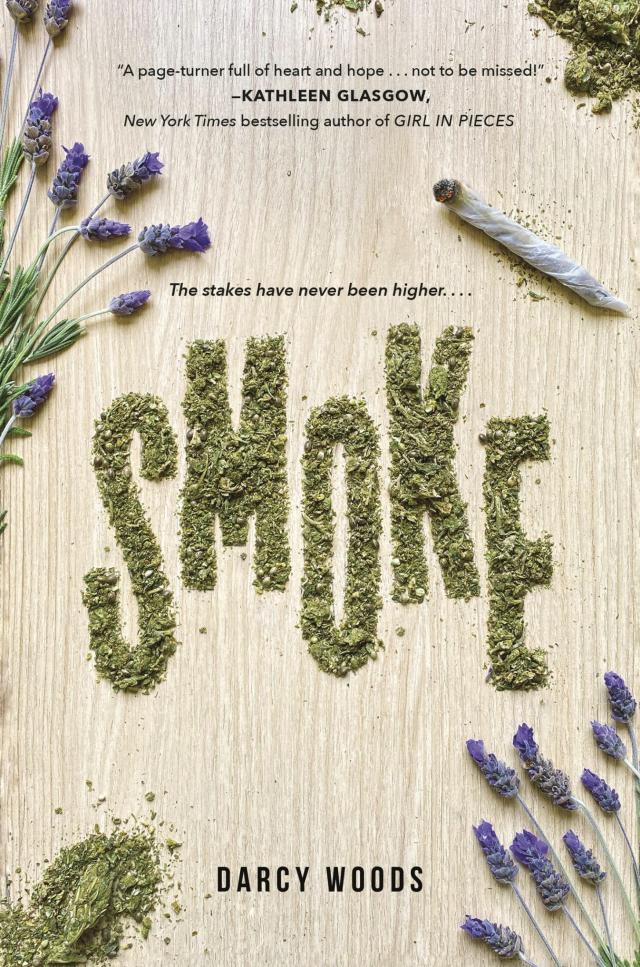
Title: Smoke / Darcy Woods.
Description: First edition. | New York : Crown Books for Young Readers, [2021] | Audience: Ages 14 & up. | Audience: Grades 10–12. | Summary: Sixteen-year-old Honor Augustine is determined to save her family’s greenhouse and keep her veteran father afloat, even if it means breaking the rules—and a few laws.
Identifiers: LCCN 2020046321 (print) | LCCN 2020046322 (ebook) | ISBN 978-0-593-30590-4 (hardcover) | ISBN 978-0-593-30591-1 (library binding) | ISBN 978-0-593-30592-8 (ebook)
Subjects: CYAC: Fathers and daughters—Fiction. | Brothers and sisters—Fiction. | Dating (Social customs)—Fiction. | Post-traumatic stress disorder—Fiction. | Marijuana—Fiction.
Classification: LCC PZ7.1.W66 Smo 2021 (print) | LCC PZ7.1.W66 (ebook) | DDC [Fic]—dc23
Ebook ISBN 9780593305928
Random House Children’s Books supports the First Amendment and celebrates the right to read.
Penguin Random House LLC supports copyright. Copyright fuels creativity, encourages diverse voices, promotes free speech, and creates a vibrant culture. Thank you for buying an authorized edition of this book and for complying with copyright laws by not reproducing, scanning, or distributing any part in any form without permission. You are supporting writers and allowing Penguin Random House to publish books for every reader.
ep_prh_5.7.0_c0_r0
Contents
Cover
Also by Darcy Woods
Title Page
Copyright
Dedication
Part I: The Seed
Chapter 1
Chapter 2
Chapter 3
Chapter 4
Chapter 5
Chapter 6
Chapter 7
Chapter 8
Chapter 9
Chapter 10
Chapter 11
Chapter 12
Chapter 13
Chapter 14
Chapter 15
Chapter 16
Chapter 17
Part II: Vegetative Phase
Chapter 18
Chapter 19
Chapter 20
Chapter 21
Chapter 22
Part III: Flowering Phase
Chapter 23
Chapter 24
Chapter 25
Chapter 26
Chapter 27
Chapter 28
Chapter 29
Chapter 30
Part IV: The Reaping
Chapter 31
Chapter 32
Chapter 33
Chapter 34
Part V: The Yield
Chapter 35
Author's Note
Acknowledgments
About the Author
For my father, who taught me the meaning of strength and sacrifice
And to my brothers and sisters in the armed forces, who remind me of these lessons every day
1
Sometimes you feel the whisper of a storm before it hits. Smell the tang of ozone as it punctuates the air. Watch the once-lifeless hair on your arms rise like the dead. The energy, the charge, it becomes a real and palpable thing.
But other times, like tonight, you sense nothing.
No whisper.
No warning.
And it’s of little consequence to the storm whether or not you’re prepared. Because, either way, it’s coming.
Lightning carves jagged marks across the sky. My attic bedroom explodes with brightness. I squeeze my eyes tight, willing the storm to pass. Praying for it to pass. But the foreboding zigzag pattern that lingers behind my eyelids kills those fragile hopes. My pulse gains speed.
One Mississippi. Two Mississippi. Three Mississippi…
I get all the way to seven Mississippi before the deafening crash. Thunder punches like a fist through the atmosphere, pounding against the earth. The powerful echo carries inside my body, reverberating through every limb.
By my count the storm’s about a mile away and closing in.
Dread sinks into my skin, takes residence in my bones. My fingernails, barely long enough to scratch an itch, dig hard into my palms. Because I know what comes next. And it’s a force as unstoppable as the storm.
This is going to be bad.
I fling back the covers, my feet hitting the rug as the sloped walls flare again with light. Seconds later the boom of thunder hits.
And a scream follows. Just like I knew it would. I feel the cry like it’s borne from my own throat.
I race down the narrow staircase to the second floor, where Geronimo paces. He whines, scratching at the bedroom door as the sky breaks open to release its sadness. Tears tick against the hall window like tiny pebbles.
“I know, Geronimo. I wish I could make it stop, too.”
Our beloved boxador—boxer-Lab mix—knows I’m not talking about the rain.
“Stay back,” I say into his good ear, giving his frayed collar a tug. “You can’t help him this time.”
Geronimo whines again in response, blinking his helpless onyx eyes before reluctantly backing away.
I open the door to where my father lies, painted in shadows, imprisoned by a past that stays all too present.
His breath erupts in sputtering gasps. “Foxtrot niner two seven…Bravo Company under attack. Repeat, Bravo—” His chest hitches before unleashing another bloodcurdling cry. “Noooo!”
“Dad!” I lunge to his side, where he’s tangled in sheets. “Dad, wake up!”
He doesn’t hear me. I grip his arms in hopes of tethering him back to reality. To this reality. But he’s too strong; the muscles the military trained into him never left. And his skin is too slippery with sweat to keep hold of him anyway. My father’s face contorts in agony as he thrashes away, knocking a picture frame from the nightstand. It clatters to the floor.
“Dad, it’s Honor. Listen to my voice. Whatever you’re seeing isn’t real. Not anymore. Wake up. Please, you have to snap out of it!”
His sparse bedroom is illuminated with pulses of light, glancing off the brass latches of the footlocker at the end of his bed. Ancient windowpanes tremble with the battle cry of thunder. A battle cry that transforms an ordinary storm into the terrifying sounds of warfare. Atmospheric cracks become the pop of rifles, while thunder detonates like bombs.
My father’s eyes are open now, but they don’t see me. They see the Iraq War. Tears slip from the outer corners of his eyes, held captive by silvering sideburns. “His leg…I found his leg.”
My heart throbs with a dull, all-consuming ache. I hate this. Hate seeing him lost in the dark place I can’t reach him. The room empties of air. When I go to swallow, a fist feels lodged in my throat. Hold it together. You cannot fall apart.
So I take a slow, deliberate breath. Try once more. “You’re safe now, Dad. You’re home. Far away from the—”
“You’re gonna get yourself hurt again, Honor,” Knox groggily mutters, clicking on the lamp on the dresser. But even with the light, the shadows in the room are smothering. “I got Dad. You roll.” My brother staggers across the room, still in yesterday’s jeans and T-shirt, and flops beside me on the bed. “Go on,” he says, before turning toward our father, who’s now curled away from us, whimpering like a wounded animal.
If I could claw the sound from my ears, I would. Focus on something. Anything else. “You reek of cheap beer,” I tell Knox.
“Yeah? You reek of sad. Trust me, cheap-beer smell’s an improvement.”
“Whatever, Knock Knox.” Not sure why I choose this moment to call my brother by the nickname I haven’t used since I woke up crying from my own nightmares, but here we are. Only this time, my brother can’t chase away these monsters with terrible jokes.
Knox jerks his chin toward the dresser, then resumes coaxing our father back from the abyss.
Opening the top drawer, the drawer that used to be Mom’s, I remove the old cigar
Somehow the ritual calms me, quelling my hyperactive heart, soothing my fraught nerves. Ironic I should find the same relief in the simple act of rolling a joint that my father will have in smoking it. But there’s comfort in the way my fingers know what to do without being told. Following one step with blissful surety into the next. Knowing that the outcome will be the same even as the sky falls around me.
“Honor?” Dad rasps, sitting upright. He rubs his eyes and sees me, for real this time.
And it doesn’t matter that my brother’s buzzed. He is, and will forever be, the PTSD Whisperer when it comes to our father.
“I’m here, Dad,” I reply, filling the crease of the rolling paper with bits of pungent green. And with painstaking care, I roll the most perfect joint imaginable. Tight. Fat. No holes for smoke to escape.
My father cradles his head, running his hands along his shorn hair as his breath steadies. “Did I hurt you?” He looks up. Worry deepens the faint grooves in his forehead. “I couldn’t handle it if I hurt you or—”
Knox squeezes Dad’s shoulder, putting a tourniquet on his words. He has our father’s hands, large with pronounced knuckles. Although my brother’s hands don’t have calluses and scars from years of manual labor like our father’s. “She’s fine, Dad. We’re both fine. That was the nightmare talking.”
“I’m fine,” I repeat firmly. For my own sake as much as his.
His color slowly returns—shifting from chalk white to deep tan, the result of countless hours of construction work. “Thank God,” he murmurs. “I’m…I’m sorry you had to see that. Again.”
“Dad…” A sharp twist of pain prevents me from saying all the things I wish I could say. But he’s not—might never be—in a place to hear them. To hear it’s not his fault. That he didn’t choose to be sent to some war-torn desert thousands of miles from home. That his struggles don’t make him weak. Quite the opposite. My father’s one of the strongest people I know.
But in the end, all I can manage is a quiet “Please, don’t.”
Last year, right after he and Mom split, Dad suffered one of his worst night terrors. Which is how I wound up with a hellacious black eye. He didn’t remember a thing. So Knox and I concocted a fantastical tale involving my face and a wayward baseball. Plausible given my complete lack of athletic ability. Then I wore sunglasses the size of satellite dishes until the bruise turned sunshine yellow.
“Need to use the head?” Knox asks in his easy way, giving our father’s back a gentle clap.
Dad wipes his face and nods. Squinting at the clock, he says, “It’s after one in the morning. Don’t you two have school tomorrow? You should be in bed. Go on now. Your old man can take care of himself.” He trembles as he rises, checking to see if we notice.
We feign oblivion.
Dad ruffles Knox’s hair like he’s five, repeating the gesture as he passes me. The action’s meant to convey everything is fine.
But it isn’t.
Geronimo’s tail thumps the wall like an enthusiastic battering ram as Dad steps into the hall. That dog would surgically attach himself to my father if he could.
I wait until I hear the bathroom door close. “I feel like he’s getting worse.” I sink down beside Knox on Dad’s bed of bricks.
“Yep.” My brother catches a burp in his fist and stretches out his long legs. His big toe peeps out of the hole in his sock like a fleshy periscope.
“You think there’s something else going on? Besides the storm.” With PTSD, the trigger could be anything—sights, sounds, smells…even feelings that associate with a trauma.
Knox sways a little as he ponders. “Dunno. He’s been a little quieter. Spending more time in the barn than usual.”
Something I noticed, too. I anxiously twist the ends of the joint. “What am I going to do when you leave for college this fall? I mean, how will I handle Dad?”
“I hear scientists are making major headway with clones. Imagine a world with two of me.” His dark brows bounce up and down. “Utopia, right?”
I jab him with my elbow. “This is important. Can you at least try to be serious?”
“Is this a trick question?” He snorts at my stony expression. “I swear to God you were born like eighty years old.” Knox curls his hands into fists, rubbing his eyes like a sleepy toddler. “Look, it’s just community college, Hon. I’ll be living half an hour from home. Not like I’m headed off to some faraway, fancy Ivy League school with gold-plated urinals.”
The water pipes let out a soft moan, the sound overlapped by the scrape of the shower curtain along its rod.
Guilt stabs me in the belly. While my brother’s never had the academic prowess for the Ivy League, it’s the mention of “faraway” that’s piercing. Because Knox traded his dream, reflected in every snowcapped mountain poster on his bedroom wall, to stay here in northern Michigan.
You could still end up in Colorado, I want to say. Working at a resort and snowboarding your heart out. But the reality is my brother doesn’t postpone. He either does things or he doesn’t. And that’s not a character trait I can reverse tonight.
“But you won’t be here,” I add. “So you have to tell me exactly what you say to Dad. I must be doing something wrong, because he never comes out of it when I try.”
God, school is so much easier—study, apply yourself, get an A. The path is direct and linear. But real life doesn’t work that way. Real life resembles the messy root systems of plants, with tangled, squirrely paths branching out in dozens of directions. How can anyone ever be sure they choose right?
“How do I bring him back?” My brother does one of his patented full-body shrugs. “I just…talk to him, I guess. Remind him to breathe and where he is. Then once he starts to come around I talk about dumb stuff, like how much I hate algebra. I mean, what kind of flaming asshole dreams up math with letters?”
I shake my head. Because I honestly don’t know the flaming asshole who dreamed up algebra.
He sniffs. “Really, it’s the same thing you do with the plants at the greenhouse. Sort of, I don’t know, remind ’em what they’re there to do.”
For once my brother doesn’t mock me for talking to the plants. Or for how much I love the feel of dirt in my hands and the intoxicating scent of things that grow.
Knox plucks the J and lighter from my hand. “This is a masterpiece,” he says, inspecting my handiwork. “How’d you get so good at this, anyway? You don’t even smoke.”
I lift a shoulder. “Practice makes perfect.”
“See, that’s where you’re wrong. Perfection’s an illusion, sis.” His words are muffled by the joint bobbing between his frowning lips. “Nothing but smoke and mirrors. Every person on the planet is messed up. ‘Perfect’ people are just better at hiding it. But me? Won’t do it. I’m not into the bullshit game. What you see is what you get.”
I snatch the joint from his mouth when he goes to light it. “Last I checked, the name on the medical marijuana card was John Augustine. Besides, Dad catches you and he’ll make you drop and do push-ups till your arms fall off.”
“Truth,” he concedes with a sigh, resting back on his elbows. “And being armless would definitely cramp my style with the ladies.”
Push-ups were often Dad’s preferred method of punishment when he wasn’t doling out extra chores. Our father never raised a hand to us. Probably because he’s seen enough violence to last a lifetime.
Now it’s my turn to frown as I dissect Knox’s comment. “So, what, you’re calling me an illusion? Because of my grades? Because I try? Sorry we all can’t embrace mediocrity with your level of enthusiasm.”