It starts with trouble, p.2
It Starts With Trouble, page 2
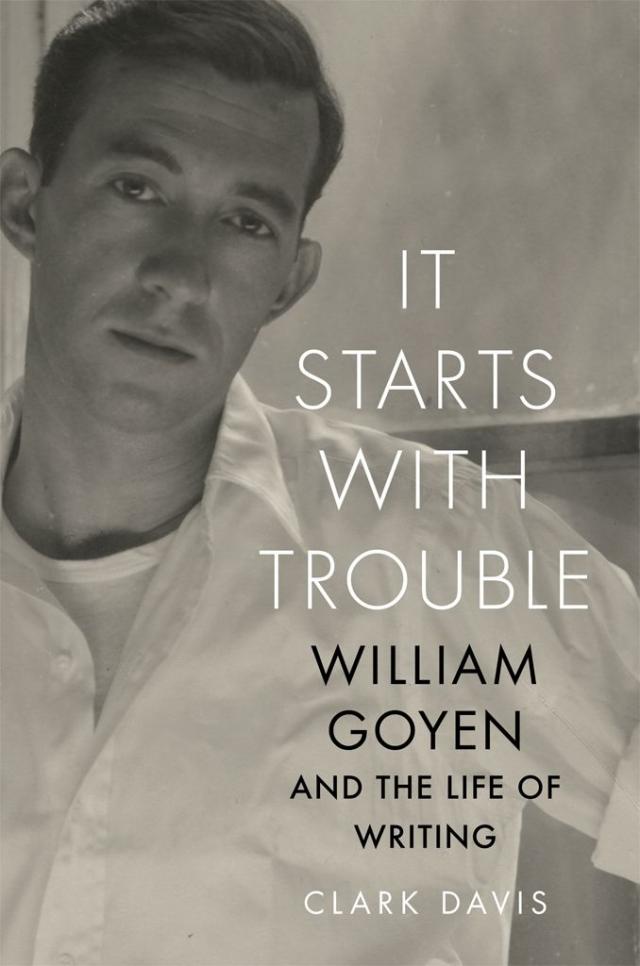


It Starts with Trouble emerged out of a basic desire to gather and present the facts of Goyen’s life as they relate to the production of his art. Goyen has been fortunate in attracting very good criticism, but the efforts of the relatively few commentators devoted to his work have necessarily been partial and introductory. Robert Phillips, a close friend and important promoter of Goyen’s work, produced the first book-length guide, including a short biography, in 1979. This was followed by Reginald Gibbons’s William Goyen: A Study of the Short Fiction in 1991 and Patrice Repusseau’s William Goyen: de la maison vers le foyer, published in Paris the same year. Repusseau’s account, based on his earlier master’s thesis, covers Goyen’s formative years through his time at Rice. Though unfortunately never translated into English, it remains one of the most thorough accounts of Goyen’s childhood and youth and is particularly valuable for its investigation of Goyen’s student writings. The publication in 1995 of a selection of Goyen’s letters, edited by Phillips and chosen to highlight Goyen’s writing career rather than his personal life, provided the first close look at this writer’s deeply thoughtful and passionate attempts to find and maintain his idiosyncratic vision.
Relatively few independent critical articles were published during the later years of Goyen’s life and the period since his death in 1983, but there have been notable attempts by literary journals to solicit and publish a range of important materials, including critical readings. In France, Repusseau oversaw a special edition of Delta in 1979 that included French and American criticism, some of Goyen’s letters, and one of his most revealing late interviews. The Mid-American Review assembled its own Goyen issue in 1992, collecting several new and important critical essays and publishing excerpts from manuscripts and remembrances by an array of friends and colleagues. This tribute issue provided material toward the publication of A Goyen Companion: Appreciations of a Writer’s Writer in 1997, a volume produced by the editors of the Texas Review, another journal, along with TriQuarterly, that has been consistent in its devotion to Goyen studies.
Despite this steady if periodic level of interest, no complete study of Goyen’s life and work has been produced, and it is arguable that further critical exploration of his writing has been handicapped by a general lack of information.6 It Starts with Trouble is meant to fill this gap and to be a starting place for scholars, critics, and general readers who want to know more about this unusual and deeply affecting writer. In this sense, the book serves the traditional purpose of a literary biography but does so, I hope, with a more than usual sensitivity to the limits of the genre. Journalistic life writing as it is currently conceived and frequently practiced, despite disclaimers to the contrary, leans heavily on the conceit of exhaustiveness. While all biography intends to give shape and wholeness to the welter of facts that constitute personal history, there is something to be said for reminding ourselves of the brokenness of individual experience, particularly for a writer who saw the fragment as a fundamental feature of reality. Goyen understood the essentially tragic nature of existence as a function of our inability to gather what we have lost. He saw the wonder and hope of life in our determination to save what remained nevertheless, to bring order to the salvaged remnants of time and remembrance. Such arrangements, like the quilts sewn by his mother and women like her, were acts of salvation in the face of loss, ways of making that did not and could not reclaim everything but made something new out of the broken. All lives, literary or otherwise, are similarly piecemeal. All archives are metaphors for how memory speaks to us through both presence and absence, through the remnant and the space between what remains. And so the biography, no matter how assiduously it wrestles to find a communicable form, should always do so within the shadow cast by what is missing or lost.
In Goyen’s case, many aspects of his early life do remain in the shadows. We have only a limited sense, for instance, of the background of his extended family, the Goyens and the Trows, who inspired many of the characters in The House of Breath. Likewise, only hints and indirect suggestions remain that can tell us what this wider family thought of his writing, his style of living, and his refusal to settle in Texas. Goyen’s early relationships, particularly romantic attachments, are especially veiled, and his romantic life in general, outside of his major relationships, is often more the stuff of rumor than reliable fact. As a consequence, much of the information about Goyen’s early years is limited to what the writer himself chose to share, an absence of perspective that appears to reflect, at least partially, an embarrassed reluctance among surviving family members to speak of his life and work. Goyen’s nephew Don Gerrard indirectly suggested Goyen’s reputation within his family when he explained that his mother, Goyen’s sister Kathryn, had once told him that he could do anything he wanted with his life, “Just don’t be like your uncle Bill.”7 The attitude may have been justified; Goyen was often both an emotional and financial burden to his family and could be so consumed with his own trials that he failed to tend to others’. But it also indicates that his sense of exile was not a figment of his imagination: there was resentment and disapproval beneath the politeness of family interaction, and some of that chill may survive to this day, if only as a socially conservative culture’s distrust of its own complexity.
Was this strategy of avoidance a family attitude that led to Goyen’s own penchant for secrecy? Possibly. The habit of not speaking can be difficult to break, particularly when the bonds of affection are intensified by absence. Whatever the case, Goyen was often sharply protective of his personal information. Despite the very large collection of materials housed at the Harry Ransom Humanities Research Center, his archive is by no means exhaustive, and in some instances he clearly preferred to avoid a document trail. When it comes to information regarding sales of his books, for instance, he could be defiant against requests for statistics, particularly later in his life when editors tied approval of new publications to evidence of past revenues. In gestures that were both aggressive and defensive, Goyen worked very hard throughout his life to maintain control of his image. A letter to the bibliographer Clyde Grimm provides a brief glimpse of this sometimes intense vigilance. After answering Grimm’s long questionnaire in detail, Goyen concluded with this caveat:
It’s very important that it be clear that this is only information that I’m giving you. Please do not quote me in my own words. I can’t give you my approval to do so. In other words, I am not writing these things for the pamphlet or for you to quote. Thanks for understanding this; and I ask you to write to me telling me that you will give me approval of the manuscript when it is finished and before it is published. I’d also like the right of approval of proof before the pamphlet is finally printed.8
Such an eye to his public persona might be considered merely prudent and less than fearful if it weren’t for the regular secrecies and omissions of Goyen’s correspondence over the years. Many of these elisions issued directly from attempts to conceal his sexuality, though more generally they seem motivated by a desire to avoid bad or upsetting news when writing to his parents. The impulse to hide—to avoid trouble and create private spaces for protection and dreaming—was fundamental to his personality. And he knew it. Working through his past to understand his alcoholism in the 1970s, he identified his “creative being” as one associated with “hiding”: “1. Blanket over chairs—hidden world, exquisite aloneness. Self-pity, abasement, secretiveness. 2. What is ‘reality’? I said. ‘And whose reality? Who wants that reality. Let those others have that. I’ll make my own reality’” (HRC 29.6). To make a secret space and construct there your own imperium may suggest a childish retreat, but it was also Goyen’s way of nurturing a self that could hold out against the hostility and misunderstanding of his upbringing. One of the triumphs of his art was the recognition that the hidden always remains; writing was not confession but a way to gather emotions made stronger by confinement and repression.
Describing his second book, Ghost and Flesh, to his editor Robert Linscott, Goyen insisted that the artist is not only isolated, cut off, an outcast “longing for the whole” but
a kind of magnet that attracts and carries about, seeks for, heavily loaded with it, the enormous burden of humanity’s ghosts—and that in this sense he exists in a kind of twilit graveyard world surrounded by the ghostly part of everything that ever had flesh or blood or light in its face and upon its limbs—he is laboring to make the epitaphs for all things dead and so keep them alive, to return life to them. It is, then, a divine project that he is about, and a very human one, too; for with one hand he is handling and caressing life and with the other he is warming death.9
The project slowly formulated by the boy hiding under the blanket—initially perhaps little more than an emotional response to loneliness—became the idea of rescue, salvation: to save, not as a minister might in a church but as an exile can when burdened with the task of remembrance. To be devoted to this province of spirit is to be separate, but it is also to understand more keenly how physical desire drives the need to recover. The “handling and caressing” of life is always shadowed by the ghost’s burden, the sense that what is held and loved is momentary, spectral, already lost.
William Goyen chose—or was chosen—to give his life to this task. As a consequence, each story he wrote was a kind of trial, less an occasion for a display of sharpness or wit than a test of devotion. How can one possibly “make the epitaphs for all things dead” and come out whole or happy? How can art that asks so much not take from its creator some of the shine of his living?
Prologue
The Drowning
The bridge from Trinity, Texas, to the nearby town of Riverside is like any other on a modern rural highway—a twin span of concrete sliding low and flat over dark water. In the early 1920s, however, this important link between the two small towns was made of a combination of wood and steel, and it creaked and groaned to such an extent that Emma Goyen, the young mother of William Goyen, was afraid to cross it in the family car. To her husband’s exasperation, she made him pull off the road before they reached the river. Then she got out, let the car pull away, and walked. Many years later, her son would write of the strange sight of his mother moving fearfully across the beautiful but unstable bridge: “My sister and I peered back at the small figure of our mother laboring darkly and utterly alone on the infernal contraption which was her torment. I remember my father getting out of the car, on the other side, waiting at the side of the road, looking toward the bridge, watching my mother’s creeping progress. When she arrived, pale, she declared, as she did each time, ‘I vow to the Lord if my sister Sarah didn’t live in Riverside I’d never to my soul come near this place’” (CS 284).
The Goyen story that contains this brief but significant anecdote is called “Bridge of Music, River of Sand.” It concerns a man’s return to the town of his birth and the site of a family legend. The narrator, a slightly off-center, not entirely stable personality, is searching for signs of his past, scraps of memory. He drives to the river a mile or so outside of town, out onto the decayed bridge now slated for demolition, and just as he himself begins to feel his mother’s terror (“the whole construction swayed and made such a sound of crackling and clanking”), he sees something extraordinary: a naked man, “diving from the old railroad trestle” into the moist sand of the dry riverbed. Horrified, he makes his way off the bridge and out of his car, hurrying to where he can still see the body, “a figure on its knees with its head buried in the sand, as if it had decided not to look at the world any more. And then the figure began to sink as if someone underground were pulling it under. Slowly the stomach, lean and hairy, vanished; then the loins, thighs. The river, which had swallowed half his body, now seemed to be eating the rest of it. For a while the feet lay, soles up, on the sand. And then they went down, arched like a dancer’s” (CS 281–282).
The narrator has no idea what to do about the fallen man. He climbs onto the railroad bridge, as though to see what the man has seen. He finds no evidence, no clothes or footprints; he isn’t even sure he saw it happen now that the body is gone. He wonders if he’s suffering a “kind of bridge madness” or from hallucinations brought on by “going back to places haunted by deep feeling.” Then he remembers his mother’s fear and through that memory a related story, barely mentioned, repressed actually, but essential to the vision. It is his sister’s voice that prompts it, making clear a family ritual:
“Mama,” said my sister, trying to pacify the situation. “Tell us about the time you almost drowned in the river and Daddy had to jump in and pull you out.”
“Well, it was just right over yonder. We’d been fishing all morning, and . . .” (CS 284)
We don’t hear the rest of the mother’s story; the narrator moves on, casually dodging the hidden center of his own telling. But Goyen did tell the rest, and more than once. In an interview conducted not long before the publication of “Bridge of Music,” he explained the significance of this spot near the bridge:
I was in my mother’s body when she almost drowned in that very river . . . and she was with . . . the terrible thing was that she was with another girl friend . . . they were just seventeen . . . young things, and the girl drowned, and it was she whom they pulled out and rolled over a log—the way they did Otey [in his first novel, The House of Breath], so you see my mother witnessed that and my father pulled them both out, and it was hideous, for poor country people. . . .1
Some childhood stories have, or attain, a defining force. This prenatal scene of death, drowning, and near-drowning—as though the one girl might be the other’s double—seems already mythic. Its frequent repetition (“They told me this so early—they kept telling me this story, and for years . . .”) often in the context of his mother’s understandable fear of water, set firm its significance.2 Orphanage. This was the word Goyen eventually chose for the sense of isolation and loneliness he had felt since he was a child: “it’s not physical, it’s not material, it’s truly spiritual. I have always had it from a tiny boy, lying on a pallet. I had a sister and a brother. But that permeated most everything. I was the oldest. . . . My mother was an invalid most of the time, and so I took care of my sister, and took care of her, she was always in the bed.”3 And it isn’t difficult to picture a young boy able to imagine his own mother’s death by drowning, able to feel in some sense connected to it, possibly responsible, somehow the product of both rescue and loss.
The idea of the unborn child saved from drowning surreptitiously feeds and haunts the story’s naked figure drowned in sand; his slow absorption is a birth in reverse, a more intense sterility unmaking the past. But true to Goyen’s deeply probing, oneiric method, the story never unpacks these burdened signs. They remain integral, fully charged, thick with unspeakable feeling. The narrator has returned to his sacred place, the site of birth, death, and fear—the site of crossings, transitions, a gateway both dangerous and destabilizing—to see in his blurred condition a vision of himself, of his own disturbed seeking, a telling suicide of the bared self pitching forward into dryness.
PART I
The House in the Bitterweeds
CHAPTER ONE
Trinity
1915–1922
O Charity!
THE HOUSE OF BREATH
East Texas is a pine barren. Across its densely forested, slowly swelling hills the soil is sandy and poor, and though it produces admirable kitchen gardens of tomatoes, okra, and mustard greens, the only crop that grows in true abundance is the pine tree. Virgin forests of ancient longleaf pine brought large numbers of people to the region in the late 1800s. Across the American South, some 230,000 square miles of Pinus palustris once stood in what historians describe as vast “open parklike stands, where travel was easy and a person could see a long way. The reddish-brown longleaf trunks were huge, often exceeding three feet in diameter and soaring fifty feet to the first limb.”1 At the turn of the century, lumber companies moving west from Alabama and Mississippi discovered this region of cheap and abundant “stumpage” and invaded in force, building towns and mills and railroads and systematically cutting all the old growth in a period that extended from approximately 1890 to 1930. When the towering stands of ancient yellow wood were gone, many of the sawmill towns went with them, reclaimed by weedy thickets or left to fade into slumping, rusty ghosts.
“Little goodbye villages,” Goyen once called them in a magazine article that never made it into print. “They were once towns of the Depot (the train is gone), the Railroad Hotel, the Drugstore as meeting-place, the General Merchandise store. . . . Where there are big, honey-comb-like houses, they are tree-sheltered and stand alone and wide-faced, and there is a generous gallery flowing half-way round them. Some vine is usually climbing on strings on the front porch, the swing behind; there are ferns in green-glazed jardinieres or in washbuckets on the front steps. . . . Or there are little ‘Shot-gun’ houses with a cap-like porch; or flimsy, tilted, boxy houses with swept dirt yards.” The people go to church twice a week. “Their faces are lean, their ears usually large for their small heads, and they are small-boned. In times past, the womenfolk’s hair was generally long and pulled round to a loose knot in back. They were slumped from carrying children on their hips; their dresses were straight-down.” When forced to leave these “deep nature-towns, hazy, moist, viney, dreamlike under great brethren trees,” the small country people grieve in their city neighborhoods, holding “fast, for a time, to an old romance way that is lost. They were, for a time, forever talking of ‘goin back to Bedias’ (pronounced Bead-eyes) or of ‘when we go back home to Groveton,’ and they lived in city neighborhoods like country people, one foot forever trying to find home again” (HRC 27.2).
It was in a town like this, Trinity, that Charles William Goyen was born on April 24, 1915. His father worked at the local sawmill. Members of his mother’s family painted houses, did repairs for the railroad, and ran the town post office. The small community—in 1914 the population was roughly 1,800—relied on the lumber industry and the freight lines that linked the mills to Houston, 85 miles south. The Trinity River, brown and turning in its sandy banks, touched its outer limits; it had once seen small river boats carry cotton bales from central Texas down to the Gulf Coast, but when the railroad arrived, commercial river traffic ceased. By the time Goyen was born, the town consisted of a main street of essential shops up against the train tracks, a small graveyard fenced and planted with cedars and crepe myrtles, and a scattering of bungalows and shotgun houses tucked into the shade off hard-packed dirt roads.