

Jubal cade 06, p.1
Jubal Cade 06, page 1


The Home of Great
Western Fiction
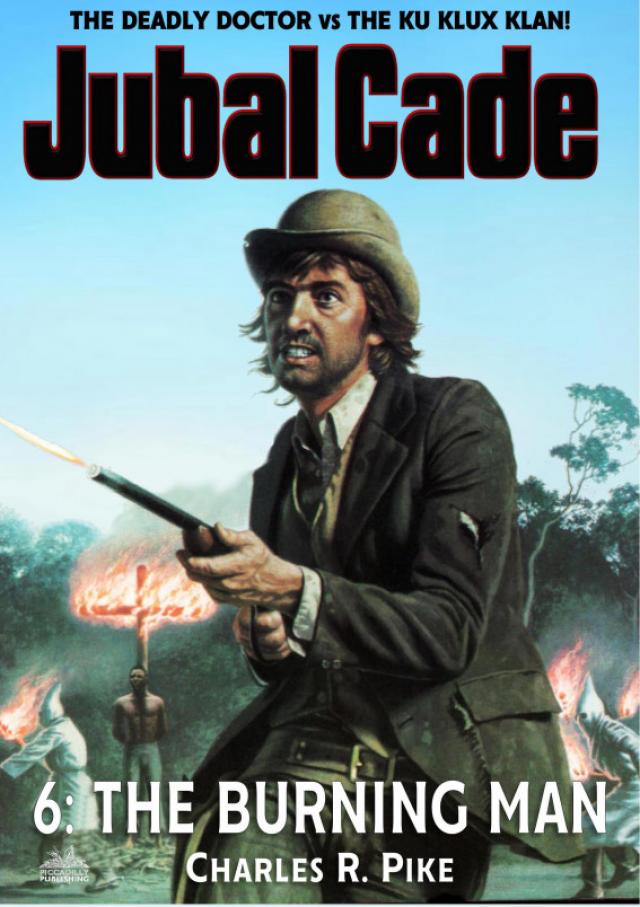
The Negro hung from the flaming cross and watched. In front of his burning cabin the white-robed figures of the Ku Klux Klan repeatedly raped his wife. Then came Jubal Cade to spit death from his .30 caliber Spencer...
When they post the reward for the capture of the Klan’s Grand Dragon, bounty-hunters flood into St Louis. But Jubal Cade is there before them. He has seen the Klan’s savagery firsthand. And Jubal is a man who knows all about vengeance.
JUBAL CADE 6: THE BURNING MAN
By Charles R. Pike
First published by Mayflower Books in 1976
Copyright © Charles R. Pike 1976, 2023
This electronic edition published July 2023
Names, characters and incidents in this book are fictional, and any resemblance to actual events, locales, organizations, or persons living or dead is purely coincidental.
You may not copy, store, distribute, transmit, reproduce or otherwise make available this publication (or any part of it) in any form, or by means (electronic, digital, optical, photocopying, recording or otherwise), without the prior written permission of the publisher. Any person who does any unauthorized act in relation to this publication may be liable to criminal prosecution and civil claims for damages.
This is a Piccadilly Publishing Book / Text © Piccadilly Publishing
Series Editor: Mike Stotter
Published by Arrangement with the Author’s Agent.
Cover Illustration: Richard Clifton-Dey
Visit www.piccadillypublishing.org to read more about our books.
Chapter One
THE NEGRO SCREAMED as the flames licked at the soles of his feet. From where he hung on the roughly made cross, he could see his makeshift cabin burning, the flames counteracting the flickering of the bonfire beneath his feet. Painfully, he twisted his head around to look across in the other direction, over what was left of his tiny chicken farm, towards the figures outlined by the blaze.
They were hard to see against the dancing flames, the white robes blended in too well. But he could make out the delineations of tall hoods and flowing capes. And he could still see, in his mind’s eye, the legend that was lettered crudely across each high, face-covering hood: KKK.
In amongst the prancing figures he could just about make out the darker body of his wife, her lustrous, brown flesh sheened by the sweat of terror. And even over the roar of the flames and the yells of the Klansmen, he could hear her screams. He closed his eyes as one of the men lifted his robe and dropped heavily across her lissome body. Then opened them again in sheer agony as a hand-held brand wrote a message of pain across his belly.
‘You was told, boy,’ the hooded man giggled, mad eyes staring out from the ragged slits in the hood, ‘that we’d come see you if’n you didn’t quit.’
‘Hell, Abe.’ A second figure had left the rapists clustered around the screaming woman. ‘Leave him be. He’s got nothin’ to do but die.’
He reached down to grab a chicken running in crazy circles by his feet, terrified by the flames and the noise, and waved it towards the Negro.
‘Ain’t nothin’ but chicken shit, anyways.’
He roared with laughter at his own joke and hurled the croaking chicken straight into the Negro’s face.
The black man turned his head aside as the bird hit him, his nostrils catching the smell of singed feathers along with the rank odor of his own fear. He was frightened, he knew that, but he was damned if he would let these mad white bastards in their hoods and robes know it. He would rather die up there on the cross, trying to forget the pain, than allow them to see the fear that possessed him. He looked down at the two capering figures.
‘You go to hell, whitey,’ he snarled through dry lips.
‘Ain’t you heard, boy,’ snarled the man who had thrown the chicken, ‘Hell’s reserved fer you folk. Why’d you think we gave you a taste of it?’
He punctuated his words with a savage kick that stoked the banked branches around the base of the cross, sending flames leaping over the Negro’s body so that the man twisted against the chains that held him in position. His writhing lifted him from the precarious balance he had achieved, so that one shoulder dislocated, dropping him screaming down closer to the fire. His tenuous dignity faded at the fresh onslaught of agony and his cries joined those of his wife in an unheard plea for mercy.
It was answered by the vicious blast of a .30 caliber rifle. The bullet hit the Klansman high in the right shoulder, spinning him around so that he careened against his companion, pitching them both into the fire.
The wounded man lent his own yells to the Negro’s as the flames danced over his hood, rapidly transforming the dry burlap into a crown of fire. He elbowed his fellow torturer aside, knocking him back into the blaze, as he ran madly across the clearing, tugging desperately at the crackling hood. A second shot ended his agony, smashing hard into his breastbone before it ricocheted upwards through his throat and out of the top of his disguise. Exiting, the bullet lifted a column of sparks that crackled high into the air, sizzling as fire, blood and brain matter mingled in a roman candle of destruction.
The Klansman twisted around once, spraying bloody sparks over his comrades, and then toppled over, dead.
Abe had dragged himself out of the Negro’s funeral pyre with a gun in his hand. He triggered the single-action Navy Colt in the direction he thought the shots had come from. Then he sat back on his heels, staring at the mangled remains of his right hand. He was beginning to weep at the unexpected loss when a bullet ploughed a neat, round hole through the crossbar of the K in the middle of his hood. Unlike his fellow night-rider, he made no sound as he died, simply pitching back towards the burning cross as life rushed from his body.
As he fell he triggered his gun again, the bullet exploding upwards as he fell back, smashing into and through the pain-racked body stretched on the cross.
Almira Jones screamed afresh as she saw her husband die. Partly, she screamed because he had died; partly she screamed with the sheer relief of his agony; partly she screamed for what she had suffered. But most of all her screams were of joy at the deaths of the Klansmen.
Around her they were dying. From out of the night the hidden rifle spoke, its message of death punctuated by falling bodies. White Klan robes turned red as bloody holes appeared in chests and hoods. Like the terrified chickens the Klan had sought so drastically to stop them raising, the Kluxers were running, firing, seeking escape. But the rifleman allowed them no respite. His gun hammered death across the farm, smashing them down as they raced, panic-stricken now, for their horses. Smashing them down as they tried to make a defensive stand.
Over to one side of the little farm she and Jebediah had worked so long and hard to build, a group of hooded Klansmen bellied down behind a chicken-run. She remembered the time and money it had taken to construct as the bullets out of the dark blasted splinters from the structure as lead ploughed into the defenders.
She laughed, rolling naked in the muddy filth the Klansmen had laid her in, as she watched them die.
Then the laughter froze on her lips as she saw the figure of the Klan leader racing towards her over the bullet-ridden ground. She recognized him by his size and the scarlet hood, and the deep voice, so smooth that it could almost be a deep-throated woman’s. And she turned, trying hard to burrow into the ground at the raw fear the figure evoked This was the one who led the riders, who strung her husband on the burning cross, who laughed as the Klan raped her.
Almira did not see the person who killed her. She was face down into the ground, trying hard to dig a safe hole, somewhere to hide from the sheer inevitability of being a Negro in Southern America, when the bullet shattered the back of her skull.
The shot spat brain matter, mingled with bone and curly black hair,, out over the feet of the tall, scarlet-hooded Klansman who pulled the murderous trigger. The killer laughed as Almira died, then turned, shouting orders to the Klansmen hiding behind the ramshackle chicken-coops.
‘Let’s get the hell out of here. They’re both dead an’ that’s what we came for.’
One Klansman was foolish enough to stand up and shout a reply.
The hidden rifle barked again and the hooded figure leaped high into the air. From his chest, he pumped a driving stream of blood over his companions, twisting violently as he fell across their temporary cover, smashing the coops to matchwood and sending chickens flying in all directions. The Klan took advantage of the moment, racing individually for their horses, disregarding their comrades in their wild flight from the hidden marksman.
Jubal Cade watched them ride away from his vantage point under the branches of a tall Missouri redwood tree and sighed as he pushed fresh cartridges into the converted .30 caliber Spencer rifle.
‘They’re hot on barbecues,’ he muttered to himself, ‘but if you lay on the sauce, they’re purely chicken.’
Chapter Two
WHEN HE EMERGED from the cover of the trees the horsemen were long gone into the night, fleeing crazily from the deadly rifle fire. Jubal edged warily out into the clearing, his finger on the trigger of the converted Spencer. Cautiously, he checked the hooded bodies for any sign of life, but his marksmanship had been too accurate to leave any vestige of existence remaining in the corpses.
As soon as he was sure that the chance of a surprise attack was eliminated he turned to the Negroes. The woman was dead, her skull shattered by the Klansman’s bullet. But the man still lived. Just. His body was hideously burned and the Navy Colt had blasted a shot upwards through his rib cage, splintering bone as it went before exiting above his collar-bone. Jubal ignored the flames that seared his hands as he lifted the body down from the cross. It was not easy and he could smell his own hair singeing as he wrestled with the chain holding the Negro in position. But at last he succeeded in freeing the man, laying him gently down on a carpet of bloodstained chicken feathers.
‘Thank you, suh,’ the Negro could barely speak through his blistered lips, ‘I appreciate what you done.’
Jubal replied as his deft hands applied salves taken from the black medical valise he carried to the worst of the burns. There was, he realized, no chance of saving the man’s life, but he could make the final parting a little easier.
‘It’s all right, you just rest easy.’
He pillowed the Negro’s head on his own jacket; the grey cloth, cut long ago now in London when he was studying medicine,i was marked and faded by long months on the trail. Indeed, he looked less like a qualified doctor than a travel-stained saddle-bum, even though the hard glint had faded from his deep-set brown eyes, becoming replaced by a look of pure compassion. He set the rifle down where he could reach it fast and shifted the long-barreled Colt holstered on his left shoulder to a more comfortable position.
‘Who were they anyway?’ he asked gently, inserting the needle of a syringe filled with pain-killing morphine in the man’s arm. ‘And why’d they do this?’
‘You don’t know?’ Surprise registered even above the pain on the Negro’s face. ‘You started shootin’ without even knowin’ who they was?’
‘I was heading across country,’ answered Jubal, ‘from the rail depot. Then I saw the flames. It looked like you needed some help.’
‘Suh,’ the man lifted his good arm to clutch Jubal’s shirt sleeve, ‘you don’t know what you done. That was the Klan.’ The words carried dreadful emphasis.
‘The Ku Klux Klan?’ responded Jubal Cade. ‘I’ve heard about them, but I thought they were finished now.’
‘No, suh,’ the answer came through waves of morphine-induced contentment, ‘down around St. Louis the Klan is one mighty big power. They don’t like us black folk makin’ an honest livin’, so they burn us out. Me an’ Almira—I’se Jebediah, suh—we built this farm off’n my pay from the Union Army.’
A look of pride suffused his ravaged face with sudden dignity.
‘I was with the 4th at Petersburg. Made sergeant there after I took the colors through the defense lines. We figgered, Almira an’ me, to settle here when the war finished. We was raisin’ chickens.’
He coughed, spraying bloody froth over Jubal’s supporting hands. ‘Guess we raised our hopes too. ’Ceptin’ they got raised too high.’
‘Why are the Klansmen so against you?’ asked Jubal. He had heard of the hooded riders and their crazy dreams of rebuilding the old, dead South, but he had never encountered any of them, never suspected the insane limits to which they would go in their wild terrorizing.
‘Oh hell, suh,’ mumbled Jebediah, ‘they just plain hate black folks. Don’t like to see us get on nohow. ’Specially the Knights of Missouri.’
‘The Knights of Missouri?’ Jubal queried. ‘Is that what they call themselves?’
‘Yeah,’ came the faint, fading answer, ‘they all got fancy names. But over the past few months they got fancy ways too. Burned out just about every black in the territory. Was black folks goin’ like they’se disappearing off the face of the Earth.’
Jubal Cade shook his head at the sheer horror of the situation. He had known violence. Known it better and closer than he had ever wished. Like the black man dying before his eyes, he had seen his wife, the soft-spoken, gentle girl he had brought from England to the big, wide-open land of America, killed by a blood-crazed gunman. Yet still he found it hard to imagine a society dedicated to wiping out a whole race. Killing was no stranger to Jubal Cade; death walked beside him since the murder of Mary, but to torture and kill in this fashion, that was something else. He remembered the big figure of the Klan leader racing across the farm, risking death for the sole purpose of killing Almira, and he shook his head at the enormity of Klan hatred.
‘Could be, Jebediah,’ he murmured, ‘that I’ll meet them again. If I do, I give you my word that more’ll die.’
Jebediah clutched his hand as life drained from his body along with the hopes he had carried from the Civil War, hopes built through the long months of the freedom fight, nurtured in the blaze of battle and brought home like battle honors along with his sergeant’s stripes, medal of honor and back pay. Hopes that died in the flames of a single night, like a black tallow candle snuffed out by a waxen hand.
He sucked one final breath through the blood that was filling his throat and died.
Jubal cradled the Negro’s head as he pulled his jacket free, then let it fall to the ground. He stood up, pulling on the dusty coat, and began to walk back towards his horse.
He had arrived in St. Louis exactly, according to the gold hunter he carried in a vest pocket, twenty-four hours before.
He had been tired after the long trip from Denver, keyed up by the killing of Les Riley and the long, overland journey. He had reached the depot in St. Louis tired, hungry and looking forward to a hot bath. He had met trouble in the shape of Ben Agnew and the two hulking thugs who flanked the rancher like badly designed pillars siding a door. Jubal had left the far west as the snow was beginning to melt, the weeks’ long train journey brought him to Missouri as Spring began to fade into Summer and he felt the heat in the confining walls of the overland railroad. So he had not been in the best of tempers when Agnew and his hired bullies met him.
The train pulled into St. Louis and Jubal said goodbye to the teacher he had met, Miss Willes, before hefting his medical bag and the small valise that held everything he owned apart from his guns, in his right hand. He swung down off the platform at the tail-end of the last car in the train. Ingrained caution prompted him to pause, watching the crowd that milled around the plank platform serving the incoming engines of the Kansas Pacific, deliberately leaving time for the travelers, and the groups of smiling people meeting them, to depart. When the crowd had thinned out to a last straggle of voyagers, he headed down the boardwalk towards the ticket office.
He handed over the stub that proved his fare was paid and set out for the livery stable he remembered lay a block down the street.
A familiar voice stopped him in mid-stride.
‘Hello, Cade.’ It was not a friendly greeting. ‘I’ve been waiting for you since Kansas City. Riley was supposed to wire me from there.’
Jubal turned around slowly. His bags were in his left hand, the rifle in his right. Warily, he eased his thumb back to rest on the hammer, index finger curling around the trigger.
‘Agnew. I should have known you’d be here.’
‘I told you I’d kill you.’ Agnew smiled, eyeing Jubal appreciatively, like a rattlesnake watching a mouse. ‘When you killed my wife I promised you that.’ii
Jubal looked at the rancher, noting the two gunsels waiting with murderous disinterest for instructions to open fire.
‘I didn’t kill her,’ he said evenly, ‘you know that.’
‘Damn you, Cade,’ Agnew snarled, fury flecking his lips with spittle, ‘she died because of you. That’s why I hired Riley. What happened to him, anyway?’
‘I guess you could say he dropped out,’ answered Jubal. ‘Out of a moving train, the job kind of ground him down.’
As he spoke he edged around to put a wall at his back, all too conscious of the gunmen accompanying Agnew.
‘So what now?’ he asked. ‘You planning to gun me in broad daylight in the middle of St. Louis?’
‘Cade,’ Agnew spat the words like a bad taste, ‘I aim to kill you, but right now I just figure to give you a taste of the future.’
‘That could be a shock,’ grinned Jubal, easing the Spencer up so that it pointed directly at the rancher’s belly, ‘for you.’
Agnew saw the gun and the hard, cold light in Jubal’s eyes and opted for caution. He motioned at his hired men, waving their hands away from the Colts tied down to their hips.






