The book of eve, p.1
The Book of Eve, page 1
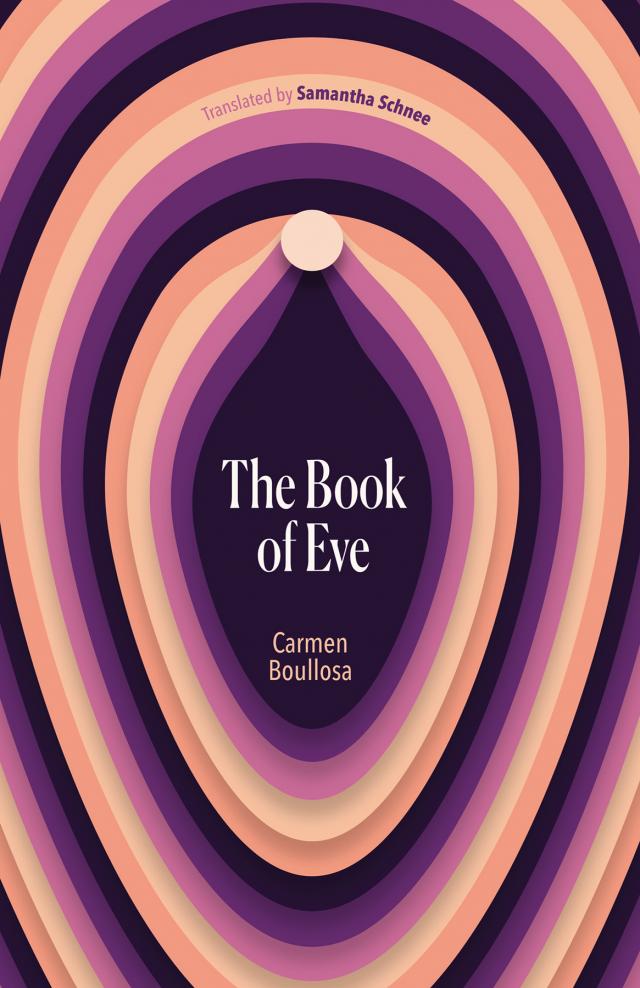


THE BOOK
OF EVE
CARMEN BOULLOSA
Translated by Samantha Schnee
DEEP VELLUM PUBLISHING
DALLAS, TEXAS
Deep Vellum Publishing
3000 Commerce St., Dallas,Texas 75226
deepvellum.org · @deepvellum
Deep Vellum is a 501c3 nonprofit literary arts organization
founded in 2013 with the mission to bring
the world into conversation through literature.
Copyright © 2020 by Carmen Boullosa
Translation copyright © 2023 by Samantha Schnee
Originally published as El libro de Eva by Alfaguara in 2020.
“Perhaps the World Ends Here,” from The Woman Who Fell from the Sky by Joy Harjo. Copyright © 1994 by Joy Harjo. Used by permission of W. W. Norton & Company, Inc.
FIRST EDITION, 2023
Support for this publication was provided in part by grants from the National Endowment for the Arts, Amazon Literary Partnership, the Texas Commission on the Arts, City of Dallas Office of Arts & Culture, and the George & Fay Young Foundation.
LIBRARY OF CONGRESS CATALOGING-IN-PUBLICATION DATA
Names: Boullosa, Carmen, author. | Schnee, Samantha, translator.
Title: The book of Eve / Carmen Boullosa ; translated by Samantha Schnee.
Other titles: Libro de Eva. English
Description: First edition. | Dallas, Texas : Deep Vellum Publishing,
[2023]
Identifiers: LCCN 2022056724 | ISBN 9781646052240 (trade paperback) | ISBN 9781646052509 (ebook)
Subjects: LCSH: Feminism--Fiction. | LCGFT: Novels.
Classification: LCC PQ7298.12.O76 L4513 2023 | DDC
863/.64--dc23/eng/20221202
LC record available at https://lccn.loc.gov/2022056724
ISBN (TPB) 978-1-64605-224-0
ISBN (Ebook) 978-1-64605-250-9
Cover design by In-House International Creative, weareinhouse.com | @weareinhouse
Interior layout and typesetting by KGT
PRINTED IN THE UNITED STATES OF AMERICA
To the memory of Psiche Hughes, my polestar, in celebration of the joy we shared, and her generous intelligence.
To Marisa Arango, because she was taken from me before her time.
To Ana Luisa Liguori, Magali Lara, Marta Lamas, Alicia Rodríguez, Lucía Melgar, María Teresa Priego, Merce Gómez, Giuliana Bruno, Betsy Sussler, Kim Baker, the two Raquels (Serur and Chang Rodríguez), and Marcela Rodríguez.
To my formidable Mike Wallace, my greatest source of strength, a much better companion than Adam was to Eve.
Every poem is a genesis.
Every new poem
memorizes the future.
Every poem is beginning.
—Eduardo Lizalde (paraphrased)
… knowledge is good,
And Life is good; and how can both be evil?
—Byron, Cain
The world begins at a kitchen table.
… Perhaps the world will end at a kitchen table,
while we are laughing and crying,
eating of the last, sweet bite.
—Joy Harjo
What follows is a transcription of private papers relating the deeds of Eve, which have been preserved for generations. The tale encompasses
the genesis of the universe,
woman in Eden,
the bite of the apple,
the voices of the trees,
the leaves of the speechless ficus,
Thunder and its crime,
the departure from Eden,
the taking of fire,
the discovery of Earth,
the cold,
the weeping,
the laughter,
the nights,
the desire to have children,
the arrival of Cain—
the farmer,
a comment on Eve’s attempts at pottery,
the conception and birth of Abel,
his flock,
the bread,
the story of Adah,
the beer,
the offering or sacrifice imposed by Noah,
the fratricide,
the dream of the homunculi,
Eve’s skiff,
the Tower of Babel,
among other well-known passages,
as well as other unknown ones,
such as the birth of the clitoris,
Adam’s frustration and resentment,
the horse’s progeny,
and how the penis came into being, after much exertion.
Other voices accompany that of Eve: those of her daughters—Adah and her sisters—interspersed between chapters, and the two voices of Cain (one from the Land of Nod), as well as that of Abel in the underworld, along with a few further annotations, anecdotes, and versions that differ from those that Eve proffers when she takes up the reins of this tale.
CONTENTS
Teresa of Avila’s Prologue
BOOK ONE
1.The Beginning
2.Presenting Eve, the Apple, Eden, and Eve’s Daughters, Who Ask about the Serpent
3.Nakedness, the Look, the Voices of the Trees
4.Thunder
5.Thunder Butchers the Animals, Their Hides
6.Eden Stank
Loose papers which were interspersed among the pages of the first book
BOOK TWO
7.The Hooves and the Memory of Eden
8.The Sight of Earth
9.The First Ridge
10.The Guardian Angel and Fire
11.The Second Ridge. The Slope. The Cold and the Weeping
12.The Moon (Absent and Present). Laughter
13.Night
14.Eve Dreams
15.Eve and Adam
16.Adam’s Skin
17.Thirst
18.Fire, the Protector
19.Words
20.White Darkness
21.The Rain. Eve’s Dance
22.The Bee
23.The Beast and Our Flight
Eve’s Loose Papers
BOOK THREE
24.Descent
25.The Rivulet of Water
26.The CaveHouse; Making Fire; The Song; The First Cave Painting; The End of Our Hooves
27.Curiosity, Fear, Cooking
28.Fingernails, Hair. One Anus, the Other, Defecation and Hunger
29.To the Plains, the Beasts, the Clay
30.Molding Clay, the Conversation
Loose papers from the pages of Book Three
BOOK FOUR
31.The Wellspring with Light: Our Refuge
32.The Smoke and the Bees, the Honey. Another Dream of Eve’s
33.The Seed of Paradise
34.The Clitoris
35.The Seeds, the Flower, an Angel, and Another
36.Clitoris Envy. The Penis.
37.We Poison Our Refuge
Loose pages
BOOK FIVE
38.The River’s Mud and Its Beasts
39.The Stink of Sulfur, the Rescue, Our Fence, the House-Tent
40.The Kitchen: Keeping Track of Time, the Pursuit of Pleasure, Decoration
41.Wanting Children. First Attempts
42.I Tell Our History on Stone, Adam Tells His Lie
43.More Attempts at a Child
44.Further Attempts
45.The Horse Is Born unto Them
46.Copying the Beasts, and What Happened When We Tried
47.Cain Arrives
48.Eve Calls to Adam
49.Eve Gathers the Creatures
50.Menstruation
51.Adam Said
52.Abel Arrives
53.The Thing Called Abel
54.Adah Is Born
55.Fraternal Rivalry
56.Adam and Abel Invent Prayer, and the Slaughterhouse
57.I Birth Two Daughters
58.There Are Almonds and Then There Are Almonds
59.Glazed Pottery, Jewelry
60.Adam’s Dogged Lie
61.Earth’s Strength
Eve’s loose papers, including the story of one of Eve’s daughters
BOOK SIX
62.Adah’s Story
63.Cain and I See What We Didn’t See
64.The Splinter of Bone
65.The Next Morning
66.The Offerings of Cain (the Tiller of the Soil) and of Abel (Shepherd)
Loose pages, including the story of Lilith
BOOK SEVEN
67.Cain’s Exile
68.Abel’s Body
69.Barren Earth
70.Beer
71.The Dream of the Homunculi
Mixed loose pages
BOOK EIGHT
72.It Rained
73.Adam’s Illness and Death
74.Eve’s Flight from her Flock
75.Cain’s City
Loose papers (containing The Book of Cain, as well as others)
BOOK NINE
76.Enoch in Nod
77.The Story of Lamech
78.What Became of Cain and Adah
79.Who Was Noah, Really?
80.More About Noah
81.With Noah, His Imaginary Flood and Ark
82.Escaping from Noah
BOOK TEN
83.Eve Alone on the Plain
84.Noah Divides the Land, Creating Princes
85.Nimrod
86.The Arrival of Nimrod’s Hordes and Nimrod’s Decree
87.The Tower of Babel and Our Great Dream
88.Opposition to the Tower
&nb sp; 89.Surviving Babel. The New Cain
90.Eve Wonders
91.Eve’s Laughter
The Book of Eve
Containing ten books in ninety-one parts
Accompanied by a selection of loose papers—differing versions or those of others
You have been granted the privilege of receiving Eve’s papers. If, upon reading them, you think they’re not for you, give them to someone you deem appropriate. Take good care of them, they have been entrusted to you.
But if you appreciate them, when you feel your light diminishing, choose the personage of their next destination with great care and confidence. Do not hold on to them, risking their destruction.
The Letter
If your daughters do not heed you, if your friends and kin do not believe what you tell them, keep these books of Eve out of their hands. As soon as you are able, copy them and give them to someone you are sure will be their loyal guardian. And when you copy them, remember you should transfer them into your own tongue and manner of speaking. You must never allow Eve’s voice to remain hidden in the past.
Loose paper from the books of Eve
Teresa of Avila’s Prologue
They gave me a crude manuscript from Toledo. It purports to be a version of Genesis written by Eve.
They asked me to write about it. Here I shall tell what it entails:
It’s an infuriating, absolutely outrageous text, because its pages do not acknowledge the righteousness, the majesty, the greatness of the Creator of all things.
Cursed pen, whoever wrote it did so to please the Devil. What wretched, feeble soul who, having lost their wits, was incognizant of the mercies and works of God before their very eyes.
The vulgarity of the vessel of this self-absorbed soul is astounding! Their blindness is an abomination. It’s about nothing but bodies and desires, which are both servants of the soul, nothing but our God-given senses and powers.
The words herein are like a worm, so brimming with foul odor that its fetidness is repugnant to the very words themselves, as if one enters into sunshine, blinded by dirt.
Alas! So much wickedness, like serpents and vipers and other pernicious things.
It’s sheer nonsense, illustrating the advanced illness of this soul in such deep misery that they speak of God as of the cruelest, most despotic master, most infamous among slaves.
The manuscript bears the imprimatur of one who is unredeemed by the blood of Christ, which is why the Son gave himself up, to redeem each and every one of us. It’s besmirched by a nefarious being who refused Redemption. But even bearing that in mind, the voice that speaks herein—a voice so far from light, with its disturbed senses, ungoverned and deliberately deaf—treads blindly upon the path of hate and vengeance.
Wrought completely from the darkness they have sought, fallen into mortal sin, shut away in a place where there is no darkness more sinister, nor any blacker thing than this deformed soul itself, whoever wrote these words in the name of Eve is a filthy insect that instinctively and deliberately chose to veer from the righteous path in favor of poisonous, pestilent black waters.
Every single word that flows from this so-called Eve is a vessel of misfortune and filth.
She has no fear of offending the Creator. The Sun does not warm a single one of her works, let’s not call them her words, but rather what she tells us she has done: thief of fire, creator of the very bowls that boiled the devil’s bile, poisoning the victuals of her family, wanton, lost soul … She admits atrocities more vile than the most detestable of vices.
Let’s forgive her madness, she’s unimportant, a lost soul in service to the devil. Let’s forgive her, just as divine Jesus will, when he recovers from his state of dejection, because surely, she provoked his Majesty as well.
Let’s forgive her, but let’s not listen to her. Let’s remember that the Devil made her wicked, and that he likes to trick us with illusions. Let’s just ignore her. Absorbed in her world, consumed by her pleasures, and lost in her ambitions, wherever the light of the Creator might have entered her there is nothing other than putrefaction, and he is reflected in all of his works, all that exists.
But enough. I refuse to dine at a trough in a pigsty, a pigpen, some den, some lair, some stable. I shall close my mouth, no evil spirit shall contaminate me with such unmitigated hogwash!
And in case anyone smells a rat, I have taken the liberty of using scissors and a knife to remove the tumor where it is stated that this Eve of whom the text speaks was a Negress. There’s no better explanation for her nature!
Books One to Ten
in which Eve tells her story in different moods, according to which part of the story she’s telling
BOOK ONE
1
The Beginning
Before me, all was Chaos, a vast disarray, endlessness, the turmoil of darkness and light, the heavens and the abyss, above and below, lightness and weight, water and earth. There was no one to witness this. Everything was amorphous, unfinished, pending. Everything burned wildly.
This pandemonium was magnificent in its own way.
I know something about Chaos. I didn’t experience it firsthand, but Chaos is part of me. And I’m not alone in the Cosmos in that regard; Chaos is here today; its power animates the Universe.
Because of me, human pleasure and pain exist; and since I am the heir of Chaos, humans confuse pleasure and pain.
After Chaos, the Earth began to spin on its axis, creating gravity. But let’s leave things there, because that transformation, that craziness, that sudden coming together, would take up this whole story. Let’s spend our time on others:
Two sources of light pursued the Earth—the Sun and the Moon—a multitude of stars, comets, scattered asteroids, and other nameless heavenly bodies, some falling apart and spinning out of orbit without rhyme or reason. To be completely accurate, the Sun did not pursue the Earth, but in those times that’s how it appeared and that’s why it’s written so here.
This perception wasn’t foolish: our planet, enrobed in its atmosphere, was a thing of beauty to behold. But beauty and horror go hand in hand: the titans sprang forth from planet’s core, responding to the call of the Moon and the Sun. They rebelled against Earth’s internal pressure, just like geysers, spring waters, and volcanic eruptions.
The titans were misshapen, their very forms the image of Chaos. They were dim-witted shades, dumb, wandering shadows that moved slowly, relics of the early times with no reason for existence. Their deformity, and not their size, is how they got their name, because on Earth all living creatures were shaped harmoniously, except the short-lived titans.
The giants came next. I lived at the same time as them but can’t say much about them, because only infants can see giants clearly, and I was never a child. From the beginning I was an adult, or whatever you call the age I am, ageless.
Legend has it that the giants were born of the titans. This is completely unfounded, because all those who preceded Eve bore no offspring; the titans died out, leaving no descendants. I was and still am the first to ever conceive offspring, whereas the titans and giants sprouted like seeds or erupted like volcanos. Before me, all creation was part of a chain reaction; giving birth started with me. Before me, Chaos and Eternity. Everything that came into being was motherless.
Alas, the Mother: she is the personification of creation, irruption, the presence of the dark tunnel that delivers us to life, and worse: the keeper of the seed, the one who gives nourishment, the one who provides. A terrible figure. She ought to be mistrusted, not celebrated, because she consumes us—and if you don’t have your Mother’s approval it’s like being devoured twice over.
Over time, the giants had children with our own species. These were proud beings who disdained beauty; confident in their powers, they committed atrocities on par with those that some attributed to the giants.
And humans copulated with angels, too. The creatures produced by the union of women and angels settled in the first city, ruining Cain’s dream, the same one Noah would later have: creating a race free from wickedness by shortening the lives of its inhabitants, because if they lived too long some would become wicked, discovering the pleasures of vice. I’ll get to that story later.
The “tides” of Chaos—some of which were universal, others localized—were a formidable force, causing as much damage as war.