

Petras ghost, p.26
Petra's Ghost, page 26


Daniel lies in the impersonal hospital bed not wanting to hear what the priest has to say. Outside his window, he can see the two towers of the cathedral that dominate the Santiago cityscape. The North Tower is intact, but the Tower of the Bells on the opposite side of the Baroque facade is imprisoned behind a cage of grisly metal scaffolding.
“I’m so sorry,” Father Bruno tells him, sounding like a doctor who must deliver bad news. Daniel’s had enough of doctor’s messages. They tell him the same thing as the priest. He suffered a severe concussion. Needed stitches for his ankle and a cast for his leg. The car had fractured his left femur where it clipped him. No one else had been injured at the scene of the accident. No woman named Ginny found. Just him, alone on the side of the road where Father Bruno found him.
“I’m not crazy,” Daniel tells the priest, whose English, like so many here in Santiago, is surprisingly good. He feels bad for being so rude to him after he was kind enough to visit. Daniel is told he should be able to go home tomorrow. Home where? he wonders. He still hasn’t booked a flight.
“No, son, you are not crazy.” Father Bruno plays nervously with his fedora, turning it round and round in his hands by the brim. Daniel can hear a hushed whisper behind the hospital curtains, a moan for more meds.
“You were there, padre,” Daniel says. “You must have seen her.”
The priest nods. He has straight dark hair growing at the sides of his head but not at the top, like Friar Tuck. Daniel can see why he wears the hat. “I was there,” he says simply. “But I did not see her. Only you, in the road.”
Daniel shuts down. Closes his eyes and lies back on the pillow. He is tired of hearing this version of events.
The priest waits patiently then leans in across the hospital bed. “But I have seen her,” he says quietly. “Before.”
Daniel opens his eyes, turns to the priest. “You mean you’ve seen Ginny?”
“In the pews,” he tells him, looking around to see who might be listening. “Sometimes in the confessional just before vespers. I see her. The woman who was hit by the car.”
“But they told me there was no one else, only myself brought in.” Daniel tries to pull himself up from the bed, his head pounding with the concussion and confusion.
Father Bruno places a hand on his upper arm, guides him gently back onto the mattress. A nurse appears from around the curtain, but the priest dismisses him with a shake of the head.
“I brought her to the hospital that night,” he says. “Like you.” He puts his fedora down on the bedside table next to Daniel’s uneaten supper. “But it was too late.”
“What night?” Daniel rubs one of his aching temples. “I don’t understand, Father.”
“Poor soul, she had almost made it to the cathedral when it happened. I gave her the last rites although I do not know if she was a Catholic.” He puts one hand on the side of Daniel’s bed. “She was killed two months ago.”
Two months ago.
“I am sorry, Daniel. May I call you, Daniel?”
This is wrong. It is all wrong. He sits up in the bed on his elbows, despite the pain that blurs his vision. He grabs the crisp bedsheets, one in each fist. “She was alive. I walked with her,” he says. “I was after walking the whole damn Camino with her.”
But even as he says it, he remembers the strange looks, the way others tended to ignore Ginny. Only the Englishman and the Dutchman seemed to interact with her. Maybe part of him had always known and Mark had been right: he had walked this road before. At the side of a woman straddling the divide between life and what comes after. A dead woman walking.
The priest glances at his hat, as if it holds the answer to Daniel’s questions. “She had a burden that night, when I found her on the road. But I was not able to take it from her.” He looks back at Daniel with true regret. “This thing she could not bring herself to speak of, even as she lay dying.”
“She had a friend —” Daniel begins but can’t go on. He lies back down in the bed and closes his eyes again. The idea of Ginny gone before he ever started the Camino, from that first day at Alto del Perdón. And then Beatrice. “I saw something else, Father,” he admits, behind closed lids. “Sure, I thought it came from hell, but then …” He hesitates, no longer sure what he saw anymore. His senses have done nothing but betray him this entire trip.
The priest accepts a pitcher of water from the nurse who has returned from behind the curtain. “Sometimes the devil is not as black as he is painted,” he says, placing the pitcher on the swing-arm table next to Daniel’s bed. The nurse beats a hasty retreat.
“You’re after quoting Dante to me, Father?” Daniel says, turning to look at the priest. He remembers the quote from The Divine Comedy, a book he had to study as part of his one English credit requirement in engineering school.
“Dante was always a favourite of mine,” Father Bruno says. He stands to pour a glass of water and offers it to Daniel. When Daniel refuses, he takes a sip himself then sets the glass and pitcher down again.
“Tell me, Daniel. Why did you come to Santiago de Compostela?” The priest uses the full name for the Camino’s destination. Some say Compostela means star, a Latin translation paying homage to the celestial guidance of the pilgrimage that roughly follows the Milky Way.
“I came because my wife died,” Daniel says, staring up at the tiled white ceiling. Though he knows it was for much more than that. “I fear I wasn’t after being a good husband to her, Father.” His voice cracks a little, a ripple of a deeper break.
The priest nods without judgment, sits back down in the visitor’s chair. “Guilt is a hell we make for ourselves, my son. Chaining ourselves to the past, as if by staying there, we can change what has already come and gone.” He takes another sip of water from the glass then continues. “Better to admit our transgressions as well as their finality, I think. Only then can we forgive ourselves, and the past can stay where it belongs.” He runs one hand through what little hair he has. It stands up and then obediently falls down on one side. “What is it the Persian poet said? It is so haunting in English.”
“‘And the moving finger having writ, moves on.’” Daniel says automatically, quoting from the small gilded pocketbook his granny kept under her pillow. He’d found it there after her funeral, hidden from the rest of the family. She probably didn’t think it was Catholic enough.
“Yes, Omar Khayyám,” says the priest. “Another favourite.” Father Bruno smiles.
Daniel notices he has one gold cap on an upper tooth. Clergy dental plans in Spain must be generous.
“I have been around life and death a great deal in my work,” he says, returning to the earlier subject. “I have seen many things that cannot be explained. This woman comes to me because I was there when she passed over. If she comes to you also, I believe it must be for another reason.”
You have to let me go, Daniel.
Daniel can hear Petra’s voice, soothing and whole, as she held him in her arms during the storm on Monte del Gozo. He knows now the message Beatrice sought to give him. The one Ginny cannot hear as she holds her guilty secret in close, where forgiveness can’t get in.
He sits up in the bed and leans heavily into the priest, his head down, eyes closed against the tears that force themselves out the corners. He makes the sign of the cross as they fall pure and honest onto the front of his hospital gown. He is ready to accept that what he did will never change, but he still can.
“Bless me, Father,” he begins, “for I have sinned.”
CHAPTER 17
Carn N’Athair
LOW-LYING GREY CLOUDS cling to the horizon as Daniel stands in the small clearing of a mountain forest he knows better than he knows himself. Hedges sew together the green squares of farmland below him, including the one in a lush forest glade that his family has cultivated for centuries. He holds a zip-lock bag in his hands.
He’d never gone to Finisterre after Santiago. Only left the hospital and returned to New Jersey, where he sold his half of the business to Gerald and the house to a nice young couple, before coming home to Carn N’Athair. He had thought of travelling to California to visit the grave and lay flowers. To see her full name, Virginia, inscribed beneath the name of her mother, who had died three years earlier. But he decided against it. He knew this was not where she rested anyway. Nor did she rest at all. Although, he wishes that someday she may.
His father was waiting for him in the doorway when he pulled up in a rental car.
“Sure, you’ve been a long time coming.”
He’d never unpacked from the Camino. With the exception of the burlap bag, the turquoise backpack is mostly as it was when he collected it from the hospital staff in Santiago. He had intended to visit the cathedral after his discharge, despite the crutches, but didn’t in the end. He was not prepared to wait in line with the other pilgrims to embrace the statue of Saint James. To fight the tourists as they held their cellphones in the air filming the swing of the ancient Botafumeiro spewing incense over the crowd. He believes he has had enough of cathedrals for a while. Though, he did go as far as the entranceway before he left Santiago, to place his hand on the pillar of the Portico de la Gloria. Centuries of pilgrims before him had worn a deep impression in the stone. The smooth indentation had felt cool and reassuring beneath his fingers.
At the airport, he had made an anonymous call to the local guardia telling them where they could find Beatrice’s body, buried in a farmer’s field just outside Mazarife. Later his sister will tell him she saw on the news that they’d made arrests. He hopes it brings the people who may have known and loved her some closure.
Standing on a peak high above his father’s farm, his sister tries to wait patiently until he is ready. Her new girlfriend, Lisa, a pathologist, is down at the house getting the third degree from his well-meaning mother. Just as she grilled him about the sap on his boxer shorts so many years ago, after Petra and he had their tryst in the woods on the hill.
“Why did you choose this place, so?” Angela asks him, after he has let the ashes fall away into the wind. They move on a current of air and into a stand of Scotch pine where the sap always runs just a little too sticky.
“No reason,” he says, smiling to himself. He puts the bag carefully into his zippered pocket, next to the copper heart he no longer needs to protect him. He’d found it on his backpack when he got home, attached to the outside flap.
A soft rain starts to fall even as the sun begins to rise over the other side of the hill.
“A smile and a tear,” Angela says.
“Aye.”
As they turn and walk back down to the farm, Daniel can feel the sun shine warm onto his back. It lifts the grey of the horizon from his shoulders, like so many burdens.
EPILOGUE
Villar de Mazarife to Infinity
THE MATTRESS IS SLIGHTLY uncomfortable but dry as Ginny starts to awaken. She feels down her torso to her legs and feet and finds herself miraculously healed. No blood, no festering blisters, no pain in her side where the car struck her so hard she thought she’d been cut in half. She stretches her legs and flexes her toes in her warm wool socks. The priest must have brought her to the hospital, she thinks gratefully. The accident mustn’t have been that bad.
“I made it,” she says out loud, the tears beginning to well up. “I made it to Santiago.” And to assure herself, she sits up in bed and opens her hopeful eyes. As her sight adjusts to the darkness, she can see the shadow she casts in the moonlight across the open courtyard of the albergue in Mazarife.
Beatrice sits up beside her, wrapped up in her own sleeping bag, her face sloughed off now in strips. Blow flies busy themselves in her empty eye socket, seething like an ant farm Ginny saw on a field trip as a kid. When Beatrice reaches her arms up in a V to stretch, her red Columbia sweater hikes up and Ginny can see the tiny brown mushrooms that have sprouted up in her abdomen. When her childhood friend squirms out of the bedroll, what’s left of her tongue quietly falls off and into the scallop shell hanging from her backpack.
Ginny remembers now, her choice to sleep outside to try to escape her difficult walking mate. And Trish dragging out a mattress to join her in the courtyard just the same, crying and complaining the entire night. Ginny gazes up at the pre-dawn sky as the woman the posters called Beatrice digs for something in her pack. Ginny, too, has come to think of her as Beatrice. The shortened version of her name that she used in life seems too trivial for what she has become. Ginny looks up. A full moon the size of a cymbal shines above them.
“Want to walk together today?” Beatrice asks with her tongueless mouth, unintelligible to anyone but Ginny. Beatrice pulls the bracelet from the bottom of her backpack and draws it over her skeletal fingers and onto her wrist, snapping off her pinky in the process.
“Look, we’re twins,” she says, holding up her wrist, pulling Ginny’s arm toward her so that the two beaded bracelets meet, the matching silver shells dangling in the light of the moon, one set shiny, the other dirt caked and dull.
Beatrice starts to hum a happy tune as she rolls up her sleeping bag. She knows Ginny cannot say no. Cannot deny her request. It is always the same. Only a matter of time. And there is so much of it, here on the Way, for those who are lost in the torment of an endless loop of misgiving, with secrets they cannot forgive themselves for, nor ever run or walk far enough away from. Souls caught between heaven and hell, playing out their roles for eternity in the irony of their own Divine Comedy.
“Sure,” says Ginny, trying not to scream. Trying not to let on. Promising herself that this time she will walk with Beatrice the whole way. This time she will not run. This time she will not leave her behind.
But somehow, she always does.
ACKNOWLEDGEMENTS
SO MANY PEOPLE TO thank, so little space.
I would like to thank the staff at Dundurn, both past and present, who read my book and believed in it. You make dreams come true.
I would like to thank John McFetridge for always treating me like a real writer, Denise Boyd for being my faithful beta reader, and my friends and family for putting up with me. Also, Eduardo for his Spanish translations, my own command of the language being restricted to asking for fruit.
Without the benefit of John Brierly and his awesome guidebook I would never have found my way to Santiago or this book. Thanks for showing me the Way.
And finally, thank you to all the people who have walked with me, on the trail, and through life. All paths lead to here, and two does indeed “shorten the road.”
Book Credits
Project Editor: Jenny McWha
Editor: Kate Unrau
Proofreader: Shari Rutherford
Cover Designer: Sarah Beaudin
Interior Designer: Sophie Paas-Lang
Publicist: Saba Eitizaz
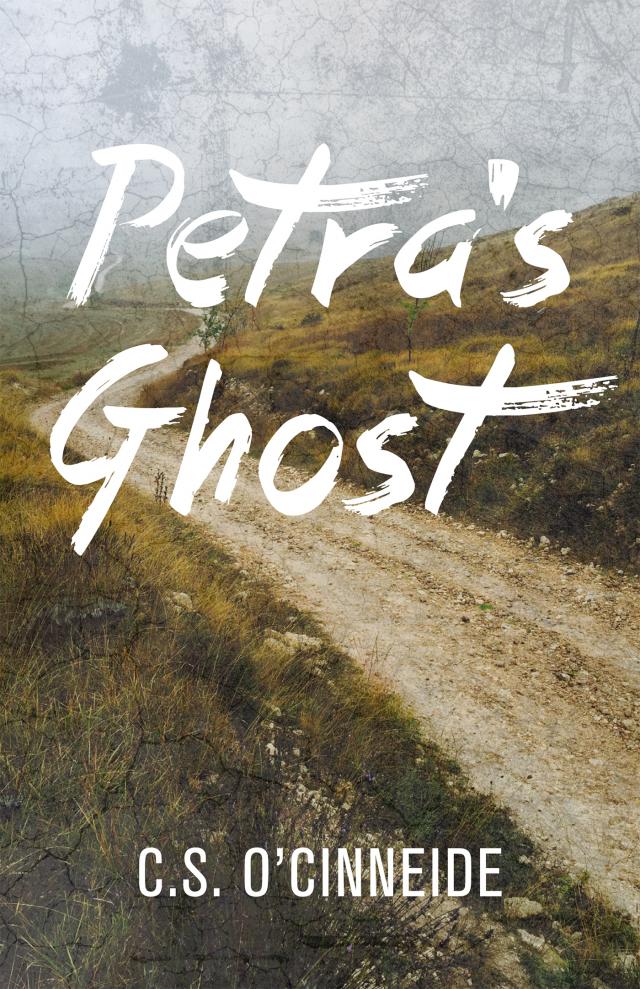
C.S. O'Cinneide, Petra's Ghost






