Ringman, p.1
Ringman, page 1


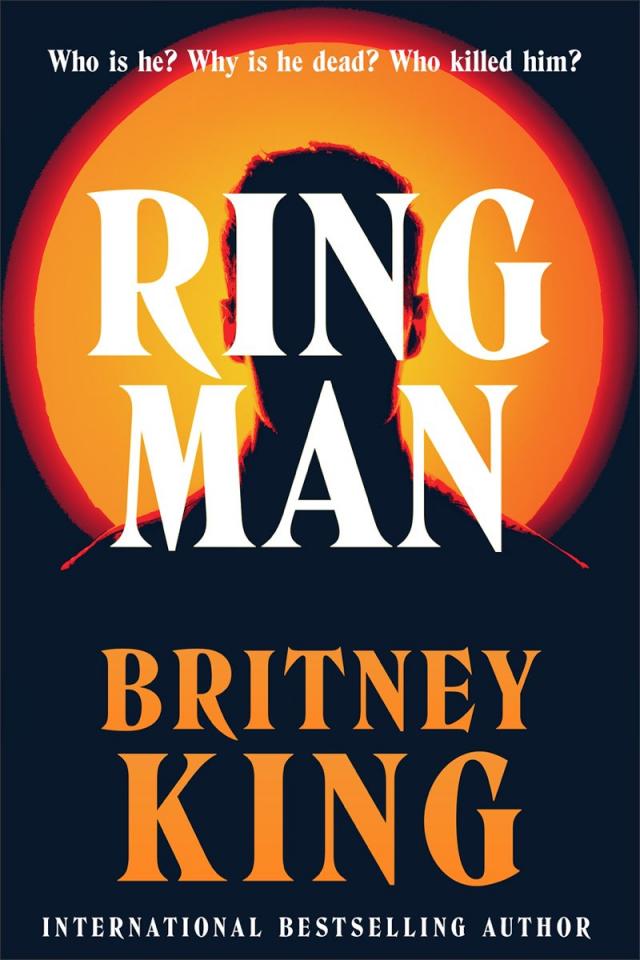
RINGMAN: A PSYCHOLOGICAL THRILLER
BRITNEY KING
CONTENTS
Prologue
Chapter 1
Chapter 2
Chapter 3
Chapter 4
Chapter 5
Chapter 6
Chapter 7
Chapter 8
Chapter 9
Chapter 10
Chapter 11
Chapter 12
Chapter 13
Chapter 14
Chapter 15
Chapter 16
Chapter 17
Chapter 18
Chapter 19
Chapter 20
Chapter 21
Chapter 22
Chapter 23
Chapter 24
Chapter 25
Chapter 26
Chapter 27
Chapter 28
Chapter 29
Chapter 30
Chapter 31
Chapter 32
Chapter 33
Chapter 34
Chapter 35
Chapter 36
Chapter 37
Chapter 38
Chapter 39
Chapter 40
Chapter 41
Chapter 42
Chapter 43
Chapter 44
Chapter 45
Chapter 46
Chapter 47
Chapter 48
Chapter 49
Chapter 50
Chapter 51
Chapter 52
Chapter 53
A note from Britney
Also by Britney King
Sneak Peek: The Social Affair
The Social Affair
Prologue
COPYRIGHT
RINGMAN is a work of fiction. Names, characters, places, images, and incidents are products of the author's imagination or are used fictitiously and are not to be construed as real. Any resemblance to actual events, locales, organizations, persons, living or dead, is entirely coincidental and not intended by the author. The scanning, uploading, and distribution of this book without permission is a theft of the author's intellectual property. No part of this publication may be used, shared or reproduced in any manner whatsoever without written permission except in the case of brief quotations embodied in critical articles and reviews. If you would like permission to use material from the book (other than for review purposes), please contact http://britneyking.com/contact/
Thank you for your support of the author's rights.
Hot Banana Press
Cover Design by Britney King LLC
Cover Image by Joe Shields
Copy Editing by Librum Artis
Proofread by Proofreading by the Page
Copyright © 2023 by Britney King LLC. All Rights Reserved.
First Edition: 2023
ISBN 13: 9798215029237
ISBN 10: 9798215029
britneyking.com
“Learn how to see. Realize that everything connects to everything else.”
― Leonardo da Vinci
PROLOGUE
He senses it before he sees it. Something’s wrong. Matthew Hannah has fifteen minutes until the end of his shift and two hours of work still to do. But he can't think about that now. He needs to check the kennels for blankets and empty the trash bins. Tonight will require at least two trips—the shelter is over capacity.
In the office, another employee is leaving for the day. His coworker heads out the door and down the stairs just as Matthew finishes cleaning the last litter box. He locks the door and jogs to the back of the shelter to grab the trash. Outside, a damp trace of rain is building in the air. It speaks of an imminent storm.
Matthew hurries to load the bags onto a cart. He pushes it through the kennels to the side door, ignoring vicious barks from the shelter dogs. He rolls the cart out into the parking lot, sprinting toward the dumpsters. A chill runs up his spine, and his hair stands on end. Then he looks up—the sky is black, and the orange moon has been snuffed out. Something feels off, and not just the weather. He pricks his ears. Something or someone else is here. Matthew takes a deep breath, reminding himself not to panic—the shelter has always been a little creepy at night.
Stillness blankets the city. Streets are deserted because of the weather. An ice storm is coming, but the temperature has already nosedived. He didn't plan to be on the road, but here he is. Something about the best laid plans, he muses, as his cart slams into the dumpster, halting abruptly. Bags of trash spill onto the pavement. One by one, he retrieves them, hoisting the bags over the side of the bin. He doesn't mean to look, but he does. That's when he sees it. The possibility seems so distant. He's sure he's wrong.
There’s a foot. A human foot.
Surely, it’s not real. Matthew is almost certain his coworkers are messing with him. He tosses the rest of the bags in the bin and hauls the cart inside, half-expecting Chris or Ian, and possibly even Sarah, to be standing inside the door waiting to see the look on his face. But they’re not. Everyone else has gone home for the day.
Matthew knows what he needs to do, even though he doesn't want to. He can still be wrong. He strides back to the front of the shelter and flips on the floodlights, bathing the entire building in light. It gives him a momentary respite from the panic.
The rest of the trash can wait. Matthew fills food bowls, dishes out medication, and checks that the dogs haven't dragged their blankets into their water bowls. He keeps busy, trying to stay calm. He hopes he's just imagining that foot. But if he's not, he'll have to call the police and risk being stuck at the shelter overnight due to ice. Worse, his record is not exactly squeaky clean, and jail is not an option.
He has to get home. His father is bedridden, and his mother is down with the flu. He hasn’t seen her eat in days. She needs a doctor, but Matthew needs his job. He kicks himself for not calling in sick today.
Matthew grabs the remaining trash bags and loads them onto the cart, then takes a flashlight from the office and stuffs it into his jacket. He has to hurry—he's needed at work, but he’s needed more at home.
Outside, a low fog has crept its way across the abandoned train tracks. He can't see the lights on the highway anymore; there’s just a black void.
He’s never liked this part of the city. Lived here his whole life, but the area around the abandoned train tracks has always made him feel uneasy.
The neighborhood is in the midst of being gentrified, but it is still run down. The local churches tried to help the few homeless people who refuse to leave, but some people still feel like they have a home here.
The train tracks are a relic of the local industrial past, long since abandoned. Now it’s just a pathway for vagrants and the homeless who refuse to go into the shelters at night. But tonight is different. Tonight they’d freeze to death, and it occurs to him the foot he saw in the dumpster is simply a man seeking shelter. If Matthew leaves him, the elements will kill him, if something else hasn’t already.
He calls out and shines his flashlight over the dumpster, pausing where he saw a foot. Something isn't right. He senses danger but can't move.
Then he feels movement behind him and freezes. He doesn't want to turn and see what's there, but he doesn't want to die either.
He whirls around.
There’s nothing there.
Shivering, he turns back to the dumpster. He looks down at the pile, shining his light into the depths, and at first he sees nothing.
Then he sees them: two eyes peering from the top of the mound, like two lifeless marbles in a forgotten toy box.
His stomach drops as he stares at the glassy, soulless eyes. Matthew realizes that whatever has happened to this man, he’s too late to do anything about it.
What he could not see, nor have predicted, was just how much this discovery was going to irrevocably and inconceivably change the course of his life.
1
Oliver
Truly, this is most unexpected. My chest constricts tightly, like a fist around my heart, making it difficult to breathe. Scattered thoughts assault me from all sides, preventing me from mentally organizing what I need to do.
I feel shaky, as though a high-pitched tone is forcing its way into my skull, causing a vibration that reverberates through my whole body. I must work hard to keep the erratic thoughts at bay so I can focus on putting one foot in front of the other.
This is not the time to lose my grip. I will not let my condition win. I remind myself what I came here to do. I have a plan. Nevertheless, sweat beads at my temples, and it’s the dead of winter.
I should have known this was a terrible idea. For one, there are too many people, and I’ve always detested crowds. They stare at me, averting their gazes whenever I look their way. I’m worried they can read my mind. What else could explain it? Some of them whisper about me. Their voices buzz in my ear like an errant mosquito.
Mother would say I’m overthinking this. She has a habit of saying not to judge a book by its cover, and I guess this is what she means. If only she held a similar sentiment with me. Life is short, Oliver. Make something of yourself, Oliver. Where did I go wrong, Oliver? Dallas will be more suitable for you, Oliver.
I should probably start by saying this was all her idea. It’s how I’ve found myself fresh out of college and pretty much homeless. Well, perhaps not that fresh. Graduation was six months ago, and this is another thing my mother likes to say: Time flies, Oliver.
Time does fly. But not as fast as one hopes when you’re sitting on the curb outside the arrivals at Dallas/Fort Worth Interna tional, waiting for a ride that’s a half-hour late.
I text Cousin Camile again. That’s what Mother calls her. To me, she’s just Camile. She may be family, but I have only a vague recollection of her. She could be anyone, a family member or a complete stranger. I'm not even sure if I would recognize her if I ran into her on the street. For all I know, she could have been the person sitting next to me on the shuttle. Or she could be the woman who was two rows behind me on the airplane. I've seen a photo of her online, but those can't be trusted. Ask me how I know. Better yet, don’t.
It’s not a very pleasant story.
When my text goes unanswered, I consider taking an Uber, but that would require an address, and I didn’t get a response about that, either. Or when I inquired about the make and the model of the car, which leads me to two logical conclusions: Cousin Camile is rude, or she's not so keen about me coming to stay. Mother swears it's neither, but she's also the one going around saying not to judge a book by its cover.
I find it all infuriating. How else are you supposed to decide?
A girl walks toward me, and my breath catches, erasing everything that had been in my mind. Just like that, it goes blank. This girl looks exactly like her. Not Camile. The other woman who no longer responds to my texts or calls. The girl is wearing the same clothes Mindy wore the last time I saw her, and she has the same backpack flung across her shoulder. She flashes a sideways smile. It’s crooked the same way, too. Like her face is frozen, only it’s not. It’s just a quirk you once found amusing and now wish you could erase from your memory. So your mother insists you come to Dallas. It’ll help you forget, she swears. The only problem is what you think you’re running from ends up staring you right in your face.
I walk toward her, but as I get closer, I realize I’m mistaken. It’s not Mindy. I’m not that lucky. I tell myself I’m just seeing things because I'm so tired. But then she turns and looks at me, and I see the same eyes that have haunted my dreams since that awful night. I start to run toward her, the same as I always have.
My phone dings and I look down, and when I look up again, the girl is gone. She has folded into the crowd. I hear Mother’s voice: it’s for the best.
I reread the text, considering how to respond. I’m angry thinking about everything, but at the same time, I feel relieved to finally get a response from Camile. Shit! So sorry! I forgot! Be there in twenty!
It’s strange that she’d forget, considering I emailed her my itinerary. I wish I knew whether to be surprised, but as I said, I hardly know anything about her. Mother says Camile used to babysit me when I was little. Mother insists she was the fun one, but, gun to my head, I couldn’t produce any details. I only know that this somehow meant that she was a suitable candidate for me to stay with while I figure out my next steps in life.
On the bright side, she’s already proving I’ll have plenty of time to do it. Before I left Vermont, I told myself: if Camile is anything like me, if she's nothing like me, if things go well with her or don't go well with her—whatever happens, maybe Mother is right. Maybe it’s for the best. At least it'll be a version of me not dying the way my father did. That’s the other reason Mother sent me here, the one we don’t talk about. Camile won't replace him, exactly, but at least it'll be a window into the universe where he didn't die drunk on an empty highway in front of an eighteen-wheeler. So thirty-five minutes later— thirty-five minutes! —when a white sedan pulls up to the curb and the passenger door swings open and I'm face-to-face with a woman who's falling out of her top, I don't know what to think.
"Sorry," she says, following my gaze. "I came straight from the gym."
Those cannot be real. Can they? “Camile?”
She lowers her sunglasses and glares at me. "Who else would I be?"
I shrug.
A horn sounds. She raises her glasses. “Get in.”
And so I do. But not fast enough, because she yells at me to hurry up! People stare, and I tell her I don’t like raised voices, but I don’t think she hears me.
Camile Brennan cruises down the streets of Dallas, Texas, talking as fast as she drives. Her car is a mess! The leather seats in her Mercedes are filthy, which is a shame as the seats themselves are not uncomfortable. Camile has a lot to say, but I don’t find much of it to be of any substance—until she tells me we have to make a quick pit stop before she drops me at the house. Then I do find what she says interesting. Detective Mark Davidson, captain of the Dallas Police Department, has summoned her to his office. She suspects a case.
In her mind, she is already planning her “detective” outfit. She is such a pro at the dress-up part of the job. She even has a special part of her closet for shoes, hats, disguises, and helpful accessories. I get the sense that her whole life is a show. Mother says Camile is an actress, a “professional belle” who is always preened to perfection. I learn that my mother was right, all in a matter of minutes.
I also learn she didn’t mean actress in the literal sense, something Camile finds amusing when I suggest it. She must want to get the facts straight because she tells me her life story without so much as a breath between act one and act two.
She says being a criminologist pays the bills and gives her a good living. Unlike some of her colleagues, Camile does not struggle to make ends meet. The reason for that is twofold—she is very good at her job, and she does not account for much overhead. At forty-four, Camile is still believed to be in her thirties. Her clothes are never out of fashion, and neither is she. That part Mother had already told me. She said I could learn a thing or two, but I’m not sure why she thinks I have any interest in women’s fashion.
“Please forgive my roots,” Camile tells me. “I’m going through a tough time.”
I don’t realize she’s talking about her hair until she points it out. “It looks terrible,” she says. “But my color is the least of my concerns, Oliver. My life is over.”
Her hair might not be in its most perfect of states, but her face is nice and her figure is flattering. Her nails are manicured, and her attire, although somewhat untasteful, draws attention. I point this out and she says, “No one wants to be boring.”
And this is how I know she doesn’t know me yet.
“I’m pretty boring,” I confess. “Mother says so, anyway.”
“Well, I happen to find you very interesting, Oliver.”
I smile. Things are only going to get better from here. That’s how it feels now, at least. But a lot can change in a week.
2
Oliver
The car zooms along the highway. Camile smiles, focused intently as she drives. “I’ve been very lucky in life, Oliver,” she tells me. “But everyone’s luck runs out, eventually.”
I assume she’s speaking about her parents, which is nice, because I worry Camile knows why I’m really here and also I wasn’t sure how to broach the subject. At nineteen, Camile lost her parents. They died in a helicopter crash. I knew this, of course. They were on their way to the Grand Canyon. Camile was supposed to be on the flight with her family, but at the last moment, a misunderstanding ensued.
Camile’s parents wouldn’t allow her male companion to accompany her on the trip, so Camile refused to show up the morning of departure. Mother said the payout from the settlement was substantial, but I don’t see how you could put a dollar amount on human lives.