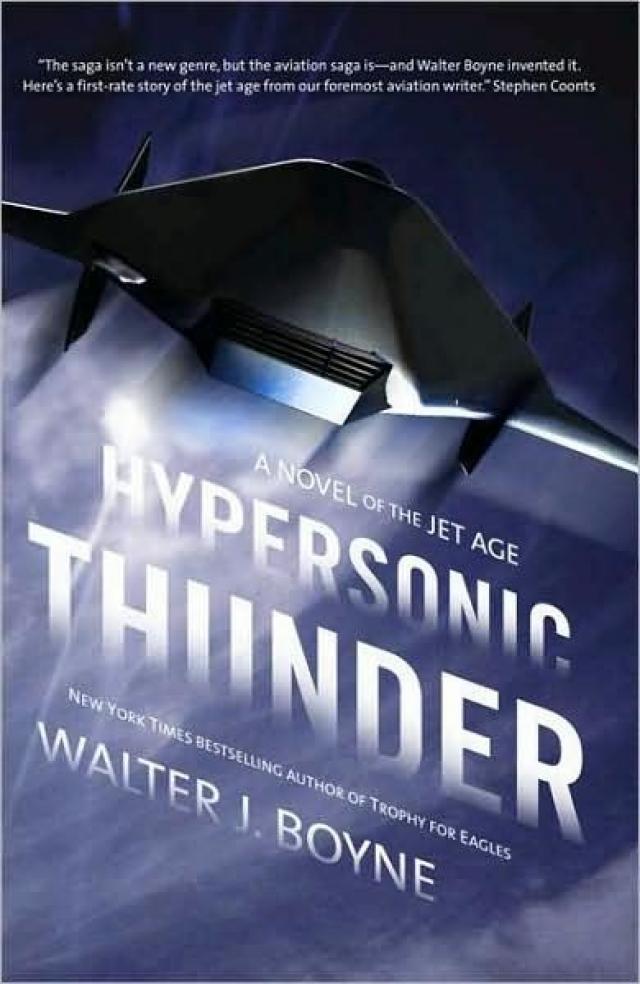
Hypersonic Thunder: A Novel of the Jet Age

Hypersonic Thunder: A Novel of the Jet Age

Boyne, Walter J.

Boyne, Walter J.

The jet age began in 1939 with the brief hop of a secret German airplane. Seventy years later, the entire world depends upon the jet engine in every sphere - political, military, economic, and social. In Hypersonic Thunder, Walter Boyne weaves an intricate story of how the jet engine changed aeronautics and astronautics, pushing the frontiers of flight forward and permitting humankind to enter the space age. Drawing on his knowledge of the period, Boyne paints a gripping picture of jet aviation from the brilliant supersonic Concorde to the coming challenges of hypersonic flight. Using the fictional Shannons as a vehicle, the author ranges the world of aviation, combining the triumphs and tragedies of great aviation companies with the familiar conflicts of family life. All of the great names of aeronautics and astronautics appear here as they did on the historic scene, including such luminaries as Howard Hughes, Kelly Johnson, Burt Rutan, and Steve Fossett. The book thunders with the clash of combat, ranging from the courageous fights of the Israeli Air Force down through the raid on Libya, Operations Desert Storm and Iraqi Freedom, and, most important the ongoing war on terror. And space is not neglected, as Boyne covers everything from Skylab and the Space Shuttle, with its great achievements and terrible tragedies, to the International Space Station. From Publishers WeeklyBoyne, former director of the Smithsonian's National Air and Space Museum, delivers the final installment in his historical aerospace trilogy, after Roaring Thunder and Supersonic Thunder. Spanning from 1973 to 2007, the novel follows three generations of the fictional Shannon family, powerful players in the aerospace industry. Patriarch Vance, a WWI fighter pilot, established Aerospace Consultants, later run by his twin sons, Tom and Harry. Bob Rodriguez, ace pilot from the Korean War and "electronics genius," runs the research and development arm. Conflicts quickly arise in the Shannons' personal and professional lives: Tom's wife, Nancy, takes the company's reins during his six years as a Hanoi POW; Harry is distracted from the business in caring for his alcoholic wife, Anna; and Bob faces divorce when his wife, Mae, grows tired of his workaholic habits. An even more colorful drama plays out in the background, with astonishing technological advances like GPS and space shuttles, and the machinations of real-life titans like Howard Hughes and Steve Fossett. Boyne's well-paced saga, with its technical slant, will surely appeal to aviation buffs. (Apr.) Copyright © Reed Business Information, a division of Reed Elsevier Inc. All rights reserved. From BooklistBoyne wraps up his three-part history of the jet age and of the fictional Shannon family with a novel that spans three decades and chronicles the development of the F-16, Skylab, the space shuttle, and the International Space Station. Like James Michener’s somewhat similar Space, the Thunder novels (the first two were Roaring Thunder and Supersonic Thunder, both 2006) are a mixture of technology and character, blending real and fictional people into a fact-based landscape. Boyne explores not just the aircraft and spacecraft themselves but also their impacts on the world, military and civilian. The writing is workmanlike—Boyne will never be accused of being a stylist—but the characters are meaty, and the events of the story are fascinating and often spectacular. Boyne also nicely captures the excitement and frequent tragedy of cutting-edge aeronautical innovation. The novel should appeal to a wide spectrum of readers, from technophiles to aviation-industry insiders to those who like to wander out to the airport just so they can watch planes take off and land. --David Pitt
Read online
  • 72
Trophy for Eagles

Trophy for Eagles

Boyne, Walter J.

Boyne, Walter J.

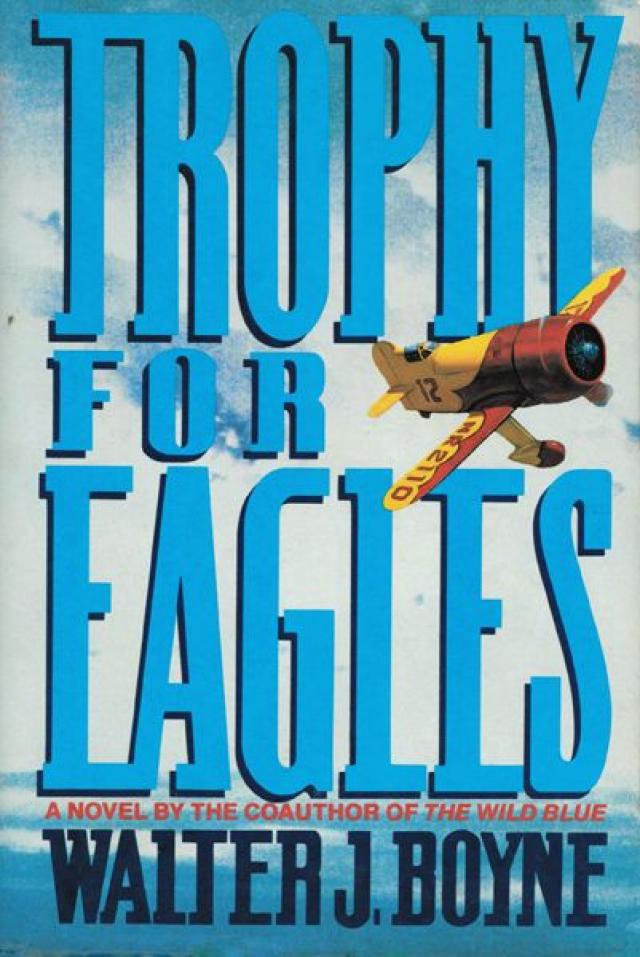
TROPHY FOR EAGLES Walter J. Boyne Colonel Walter J. Boyne, coauthor of The Wild Blue, here explores the golden age of aviation: the years from 1927 to 1937, when flying airplanes developed from an art to a craft and building them evolved from a craft to an industry. While peopled with historical characters such as Lindbergh, Howard Hughes and Ernst Udet, the relationship between two pilots, American Frank Bandfield and expatriate German Bruno Hafner, is at the novel's heart; their rivalry is the thread on which Boyne strings his vignettes. High-risk air racing in Depression America, innovations in design and production, the creation of Hitler's Luftwaffe , the bombing of Guernica during the Spanish Civil War—all find their place in this complex, compelling narrative. A former director of the National Air and Space Museum, Boyne impressively details flight techniques and aircraft construction. He even writes convincingly of the shortcomings that keep imaginary aircraft from entering production in his fictional universe. Technical material is so well integrated into the narrative, and human relationships are so dominated by flying, that it seems only natural when lovers talk of airplanes at intimate moments. From Publishers WeeklyBoyne, coauthor of The Wild Blue , here explores the golden age of aviation: the years from 1927 to 1937, when flying airplanes developed from an art to a craft and building them evolved from a craft to an industry. While peopled with historical characters such as Lindbergh, Howard Hughes and Ernst Udet, the relationship between two pilots, American Frank Bandfield and expatriate German Bruno Hafner, is at the novel's heart; their rivalry is the thread on which Boyne strings his vignettes. High-risk air racing in Depression America, innovations in design and production, the creation of Hitler's Luftwaffe , the bombing of Guernica during the Spanish Civil War--all find their place in this complex, compelling narrative. A former director of the National Air and Space Museum, Boyne impressively details flight techniques and aircraft construction. He even writes convincingly of the shortcomings that keep imaginary aircraft from entering production in his fictional universe. Technical material is so well integrated into the narrative, and human relationships are so dominated by flying, that it seems only natural when lovers talk of airplanes at intimate moments. 100,000 first printing; $85,000 ad/promo; paperback rights to Ivy Books; Literary Guild alternate; author tour. Copyright 1989 Reed Business Information, Inc.
Read online
  • 46
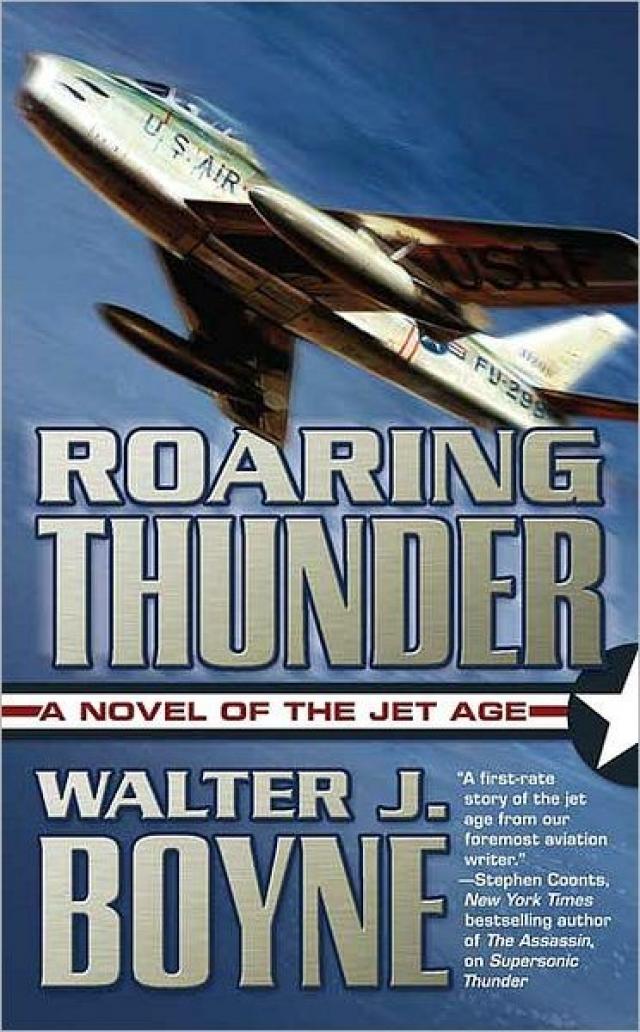
Roaring Thunder: A Novel of the Jet Age

Roaring Thunder: A Novel of the Jet Age

Boyne, Walter J.

Boyne, Walter J.

The story of the jet age of aviation revolves around remarkable geniuses--including Sir Frank Whittle, the British inventor of the jet engine; Hans von Ohain, a German jet engine designer who comes to work for the U.S.; famed aeronautical engineer Kelly Johnson; the daring test pilot Tex Johnston, and many more--brilliant men who conceived these early extraordinary airplanes and had the courage to fly them to new horizons. ** Roaring Thunder blends real life adventures of the industry giants with the fictional Vance Shannon and his aviation family. Shannon, a prototypical American test pilot, sees and guides the birth of American jet aviation, while his sons, Tom and Harry fly the new jets in combat. Their aviation careers are blessed by their skill and courage, and they help usher in the greatest advance in aviation history with the birth of the jet transport. The Shannons serve as counterparts to the real-life heroes, creating continuity and explaining the intricacies, successes, and setbacks of a brand new industry.The dramatic, totally accurate story of the beginning of the jet age is presented against a background of personalities, real and fictional who bring the story to life, and represent the first stage in the first ever fiction trilogy about the history of the aerospace industry.From Publishers WeeklyBest known for his numerous first-class nonfiction aviation histories, Boyne has also produced aviation sagas (such as Roaring Thunder), and here inaugurates a trilogy with mixed success. Vance Shannon and his twin sons, Tom and Harry, are big shots in the American aircraft world: all three men do stints as flying aces and as brilliant engineers, working with the likes of Boeing and Lockheed to develop new jet technology. From 1955 to 1973, Vance and his sons participate in the development of the U-2 and SR-71 spy planes, supersonic transports and Learjets, as well as missile and satellite technology. Events like the Sputnik launching, the Cuban missile crisis, the invention of the Polaroid Land Camera and the Volkswagen car craze all play in, as do figures like a former Nazi thug, a mistress who spies for French intelligence and POWs in Vietnam. The aviation history and tech talk are sparkling, but the plot is an anemic mix of family saga, corporate politics and various forms of espionage. (Jan.) Copyright © Reed Business Information, a division of Reed Elsevier Inc. All rights reserved. From BooklistThe first volume of a trilogy chronicling the history of the aircraft industry begins in Germany in 1939 with the first jet-engine tests. Like James Michener's Space (a novelized history of the space program), the novel has a very large cast of characters. Many of them are real people, such as Frank Whipple (who invented the British jet engine) and test pilot Tex Johnston. Others, like Vance Shannon and his family, around whom the story is built, are fictional. A former air-force pilot and an experienced aviation writer, Boyne packs the novel with historically accurate detail. As a novelist, he's on shakier ground. The two Shannon boys, Tom and Harry, for example, feel like pastiches of the Hardy Boys, or perhaps Tom Swift Jr and his good pal Bud Barclay. But the wealth of information and the author's epic-minded approach to the material more than make up for the sometimes-clunky prose. Aviation fans will gulp this one down in one long, satisfied swallow; more literary-minded readers may choke a bit but will still appreciate the author's grasp of his subject. David PittCopyright © American Library Association. All rights reserved
Read online
  • 23

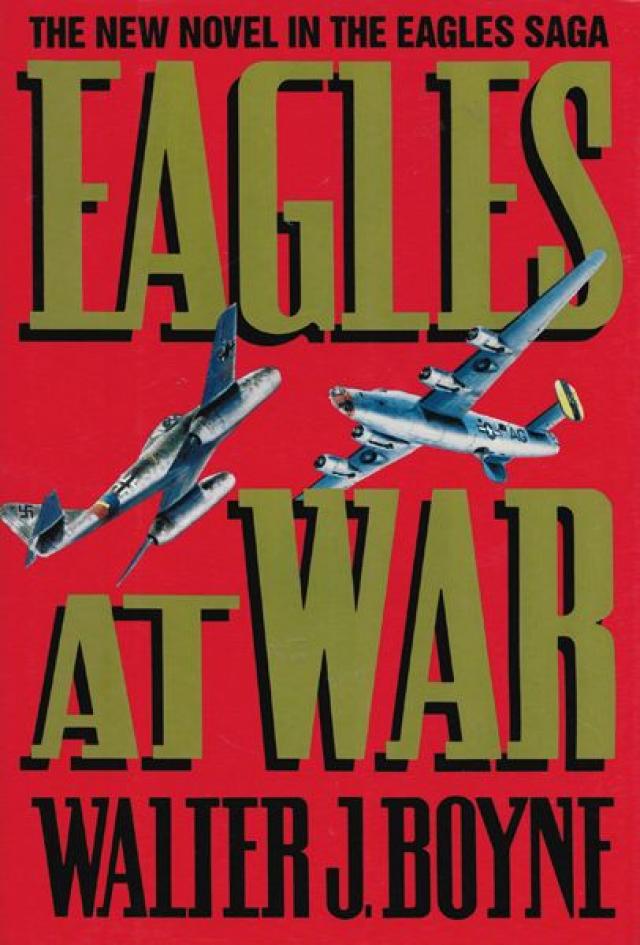
Eagles at War

Eagles at War

Boyne, Walter J.

Boyne, Walter J.

EAGLES AT WARWalter J. Boyne Eagles at War is the most compelling fictional account yet of World War II in the air. Covering every theater of the war, it combines some of the most realistic combat actionever written with the dramatic story of the war’s impact on industry and society. Colonel Walter Boyne continues the saga, started in Trophy for Eagles, of America’s rise to aviation supremacy. In the secret research laboratories of the Luftwaffe and in the skies over Europe and the Pacific, in the boardrooms where the modern military-industrial complex was forged and at clandestine meetings where a defeated Germany’s top-secret-weapons expert negotiates safe passage to the United States, Eagles at War tells the story of aviation’s role in the emergence of the Unites States as a superpower. As the coming global war becomes inevitable, American aviation pioneers Frank Banfieldand Hadley Roget put down their peacetime tools and become key architects of Allied victory in the air. Their nemesis, Bruno Hafner, is Hitler’s man in charge of developing thefirst jet fighter and other wonder weapons, using slave labor toiling in ghastly underground factories. Leading America’s aviation buildup is General Henry Caldwell, whose merciless prodding of the American aviation industry ultimately results in victory, even though he is the vulnerable target of sexual blackmail. Eagles at War coveys the unprecedented scope and ferocity of the air war through the eyes of key players and various airmen from all sides of the conflict. In bringing to life pilots and planes, generals and aviation giants, heroes and villains, Boyne makes superb use of his talents as a military pilot, historian, and novelist. Colonel Walter J. Boyne, an Aviation Hall of Fame honoree, lives near Washington D.C. He is the coauthor of The Wild Blue and the author of the Smithsonian Book of Flight. From Publishers WeeklyBoyle recycles the major characters from Trophy for Eagles to tell the story of aviation's development as a decisive weapon in WW II. Frank Caldwell, now a hard-hitting Air Force general, and still-hot pilot Frank Bandfield match wits and skills with Nazi Germany's production genius Bruno Haffner and Luftwaffe ace Harold Josten in this episodic work, in which the principal plot lines involve America's search for a long-range escort fighter and Germany's efforts to introduce jet and rocket weapons. Although more constrained than its predecessor by the need to adhere to historical events, this novel nevertheless skillfully integrates fact and fiction. While the work is not technically a roman a clef, knowledgeable readers will have no difficulty identifying the Bell Airacobra as the model for Boyne's misbegotten "McNaughton Sidewinder." And if Eagles at times exaggerates the personality factor in U.S. aircraft design and procurement policies, the novel is correspondingly successful in conveying the byzantine realities of a Third Reich that spectacularly failed to fight its war with its scientific and technical expertise. Copyright 1991 Reed Business Information, Inc. From School Library JournalYA-- The story of the buildup and growth of the airplane industry and the Air Force is well told in this fictional account of World War II. Fight scenes between aircraft are taut and dramatic, many real people make an appearance, and lots of descriptive data about the types of airplanes being built and their problems is included. While the focus is on the growth of the American industry, problems of the German expansion of their aircraft manufacturing are well covered also. Unfortunately, the dialogue between the men and women is somewhat trite, and the fictional characters are stereotyped. The men are very manly, and the good women stay home and cheer their men on. Those women who work are portrayed as cold and calculating. Even so, Boyne has captured the mood of the times, and there's a lot of technological information sure to please aviation buffs and students interested in the attitudes and events of this period. --Pat Royal, Crossland High School, Camp Springs, MDCopyright 1991 Reed Business Information, Inc.
Read online
  • 10
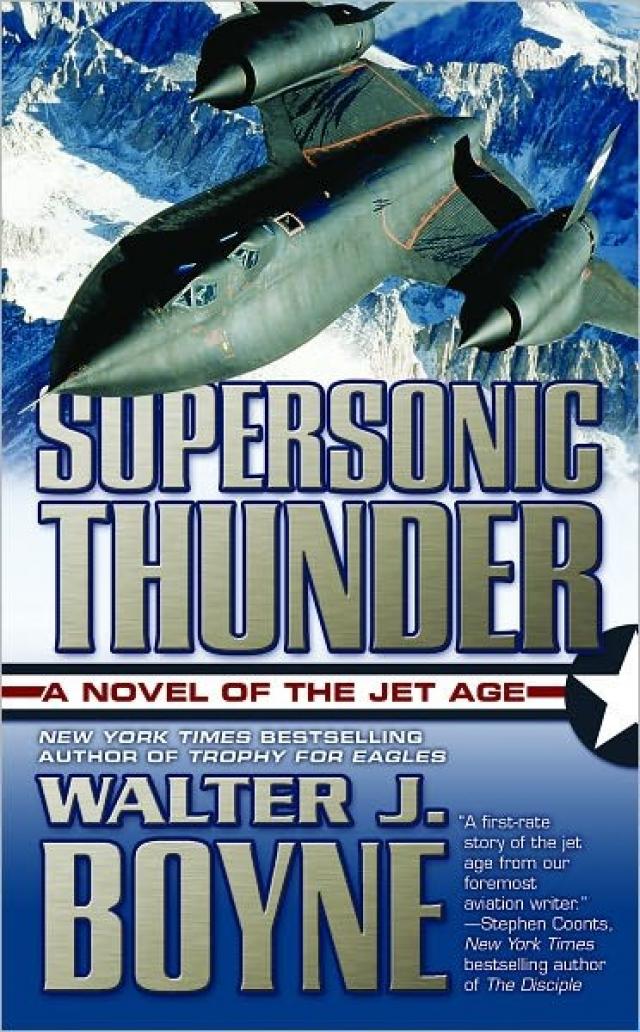
Supersonic Thunder: A Novel of the Jet Age

Supersonic Thunder: A Novel of the Jet Age

Boyne, Walter J.

Boyne, Walter J.

From the first flight of the U-2 to the flashing speed of the famous SR-71 Blackbird, Supersonic Thunder is a portrait of the jet as it comes of age.  Aviation genius is personified in famous engineers such as Kelly Johnson and Ben Rich and in test pilots like Tony LeVier and Tex Johnson in this fast moving story of military and commercial jet aviation.Under the guidance of test pilot and engineer, Vance Shannon, the reader is present at every major event in jet aviation in the 1960s and 1970s. As the ever-changing industry begins to speed up beyond Vance's grasp, he turns to his two sons, Tom and Harry, to keep the family business on the cutting edge. Though they've followed in their fathers' footsteps for many years, the stress from trying to stay ahead of the curve is destroying their families--as well as fueling a long hidden rivalry between the two brothers.   As the Shannon family struggles with their personal and professional lives, Supersonic Thunder reveals the great leaps of the aviation industry during this astonishing era, from Gary Powers' U-2 shoot down to the first flight of the Russian Supersonic Transport.  With historic and dramatic detail, we are taken behind the scenes, revealing the motivations of top Russian, English, and American designers as they push the limits of engines and airframes and confront the difficulties of the pursuit of Mach 2.0 speeds. From the luxury of the 747 to the abject despair of a cell in the Hanoi Hilton, Supersonic Thunder tells the real story of this amazing chapter of jet aviation in terms of the men and women who lived and died to make it a part of our everyday life. At the publisher's request, this title is being sold without Digital Rights Management software (DRM) applied.Review"The saga isn't a new genre, but the aviation saga is--and Walter Boyne invented it. Here's a first-rate story of the jet age from our foremost aviation writer."--Stephen Coonts on Supersonic ThunderAbout the AuthorWALTER J. BOYNE is the former director of the National Air and Space Museum of the Smithsonian Institution, he retired in 1986 to pursue a career as a novelist and consultant. He is one of a select few authors whose books have made both the fiction and the nonfiction bestseller lists of The New York Times. His recent books include Dawn Over Kitty Hawk and Roaring Thunder, which begins the story of the ascent to the modern Jet Age. Walter J. Boyne lives in Ashburn, Virginia.
Read online
  • 7
183