

Mobile 9, p.1
Mobile 9, page 1
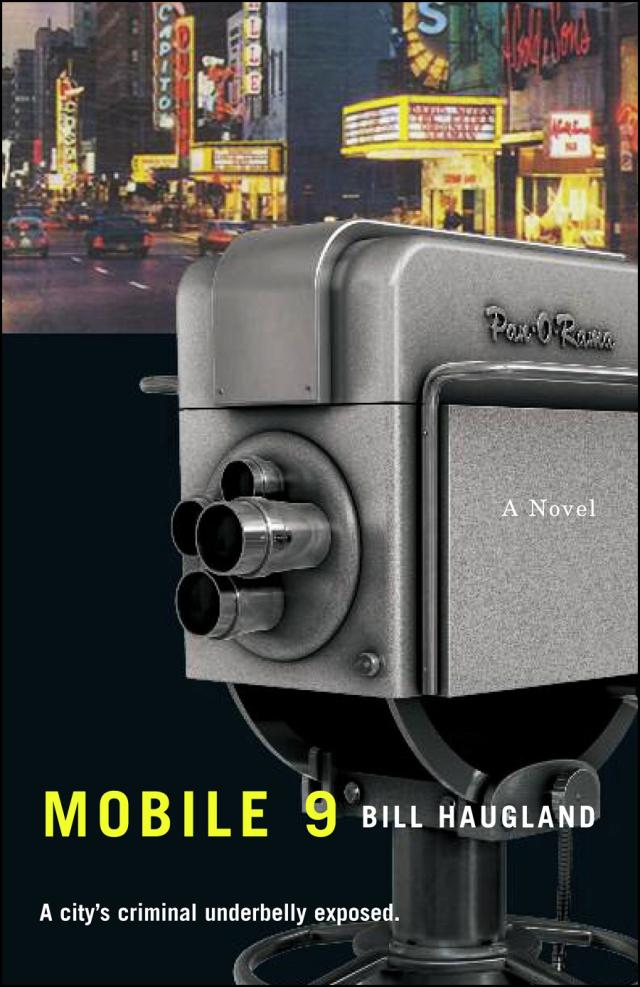


MOBILE 9
MOBILE 9
A Novel
BILL HAUGLAND
Published with the generous assistance of The Canada Council for
the Arts, the Book Publishing Industry Development Program of the
Department of Canadian Heritage and the Société de développement des
entreprises culturelles du Québec (SODEC).
Cover design: David Drummond
Set in Adobe Minion and Helvetica Condensed by Simon Garamond
Printed by Marquis Book Printing Inc.
Copyright © Bill Haugland 2009
Dépôt légal, Bibliothèque nationale du Québec and
the National Library of Canada, secpnd trimester 2009
All rights reserved.
LIBRARY AND ARCHIVES CANADA CATALOGUING IN PUBLICATION
Haugland, Bill
Mobile 9 / Bill Haugland.
ISBN 978-1-55065-255-0
I. Title. ii. Title: Mobile nine.
PS8615.A785M63 2009 C813'.6 C2009-900677-4
Mobile 9 is strictly a work of fiction. Plot line and characters are a product
of my imagination and are in no way intended to reflect on individuals,
living or deceased. Certain events that actually occurred
in 1969 are woven into the story for effect. I’ve taken license with
the time frame of certain others, particularly in reference to
organized crime in Montreal. Personalities, places and events in this
regard are of my own invention and are merely a vehicle I’ve
employed to move the narrative along.
Published by Véhicule Press, Montréal, Québec, Canada
www.vehiculepress.com
Distribution in Canada by LitDistCo
www.litdistco.ca
Distribution in U.S. by Independent Publishers Group
www.ipgbook.com
Printed in Canada on 100% post-consumer recycled paper.
To my wife Linda and my former colleagues and good friends
Bill Draper, Tom Sharina and the late Bert Cannings.
Fond memories of youthful days in the “news-biz.”
CHAPTER ONE
TV cameraman Greg Peterson was exhausted. He’d put in a long shift, covering an overnight series of drug raids. He couldn’t remember how many cups of coffee he’d swallowed. Yet he had a gut feeling the action was just beginning. Greg was usually right about gut feelings.
His perfectionism added to the pressure. The film had to be processed at the lab in downtown Montreal. Editing and scripting would come later in the day. Reporter Ty Davis would be under pressure to tell the story in fewer than a hundred seconds and neither he nor Ty would get any feedback on content before it went to air. The rule for reporters and cameramen was sink or swim. Get the story and succeed. Miss the shots or the point of the story, and live with the reputation.
So far, 1969 had been a year of escalating political turmoil in Quebec. Members of the Quebec Liberation Front, the FLQ, roamed the streets of Montreal. Bombs exploded. Manifestos espousing the need for Quebec to separate from the rest of Canada were delivered to media outlets. Greg enjoyed the challenge, but long hours and sleepless nights were sapping his energy and dulling his senses. He yawned, stretched his arms overhead and winced as a sharp pain traced its way across his right shoulder and down his spine.
The police sweep, dubbed Opération Cantons de l’Est, Operation Eastern Townships, began at 2 a.m. Five drug raids in the Townships resulted in twelve arrests. Greg had been tipped off at midnight by assignment editor Jason Moore.
“It’s big!” Jason promised. “Cops say biggest bust in years.” He sounded excited.
As he stepped out of the car back in Montreal, Greg squinted into the early morning sunshine. His head ached, and the August day wasn’t helping. The humidity was high. It was already much too hot.
Montreal’s Flash News won its viewer loyalty and ratings dominance by being first with breaking stories. Moore, nicknamed “Scoop,” was on a first-name basis with most key players in the Montreal Police Department, the Quebec Provincial Police and the RCMP. They often gave him a heads-up on any major operation, so he could scramble his reporters and camera personnel.
Greg had shot plenty of sound-film in the Townships. He’d forgotten to load the Bell and Howell hand-held silent camera into his news mobile the day before, contrary to normal routine. Cameramen assigned a company vehicle were obliged to pack all the equipment that they might need for the next assignment. By the time Greg reached the Townships, the raid was in full swing. He’d gone with sound and the cumbersome shoulder-mount.
“Get that footage to the lab,” Moore told him. “Cops called a press conference for later this morning. Drugs’ll be on display for the media, so shoot sound if Davis shows up a little late. He’ll meet you and bring the Bell and Howell. You got five hours. Go home. Get some sleep. RCMP headquarters at eleven, 10-4?”
Greg stared at the mobile radio for a few moments before responding.
“Yeah. Okay. 10-4.”
He never could figure out why Moore insisted on the military code being used in all radio transmissions. “10-9” for “location.” “10-6” for “repeat.” “10-10” for “arrived at destination.” “10-4” to end a sentence. Some reporters believed it stemmed from a secret desire to be a police officer. Moore, they said, hadn’t met the height requirement, and played at being a police dispatcher.
Ty Davis knew better. He’d been in plenty of situations where static interference made radio contact with the station difficult, if not impossible. The code was most likely to be heard clearly. The emergency “10-5”, for example, signalled the newsroom there was trouble. It was brief and avoided lengthy explanation. Moore knew where you were. As soon as he heard “10-5,” he could call out the troops.
Ty lit a cigarette and stared at his typewriter. The overnight footage on the police raids had been processed and returned from the lab. There was plenty of wild sound as the cops kicked down doors, cuffed suspects and seized the drugs.
He glanced at the news director’s office. The door was ajar. A faint blue cloud of cigar smoke wafted into the news department, momentarily clinging to the teletype machines. Clyde Bertram was in. Ty checked his watch. Nine-forty-five. Plenty of time to dig up some background on the police operation before the press conference. He pushed away from the typewriter, stood up and walked into Bertram’s office.
The news director was on the phone, tipped back in his chair with his feet on his desk. The office reeked of cigar. Ty waited in the doorway until Bertram waved at him to sit down. He was a huge man with thinning red hair and a wisp of a mustache, carefully trimmed to turn up at the ends, a Salvador Dali wannabe. His midsection was so bulky, no belt would fit. Baggy trousers were held up by suspenders.
“Call you back, Don,” he said. “Gotta go.” He hung up the phone and laboriously moved his feet to the floor. Ty sat on one of the chairs in front of Clyde’s desk.
“Waddya got, Ty?” He stuck the cigar into the corner of his mouth.
“Greg’s been out most of the night. Bunch of police raids in the Townships. Drugs. Arrests. The whole nine yards.”
Bertram puffed out a mouthful of smoke. “Heard about it from Moore. Got a price tag on the drugs?”
Ty shifted his weight in the chair. “We’ll know about that from the cops in about an hour.”
Bertram nodded and picked up his phone again.
“Okay, kid. Stick with it. Wrap the piece for the six o’clock.”
Ty went back to his typewriter.
He resented being referred to as “the kid.” He was in his late twenties. He’d been on the payroll for seven years and was married with two children. He paid his bills, worked hard at his job, and felt the “kid” reference was an insult. Ty considered himself a product of the times. Richard Nixon was in his second year as U.S. President. War raged in Vietnam and Americans were sharply divided on the need to spill blood in the name of democracy. Ty sometimes found it difficult not to inject anti-war sentiment into the on-air work. He and Greg saw eye-to-eye on matters of war and peace.
Sometimes he hated the job. Ty wished somebody would have the cojones to tell Bertram to shove his cigars where the sun don’t shine. The news director constantly berated him for what he called his “hippie haircut.” He invariably advised Moore to assign any story involving Vietnam to Ty and Greg. Then he’d call them both into his office, grin from ear to ear, blow fetid smoke into their faces and criticize their leftist politics. If Ty and Greg felt they’d lent a justifiable slant to the story, Bertram would argue they had no business editorializing. Then he’d rant on about the domino theory, a scenario that foresaw a Communist takeover of all of Southeast Asia. “Somebody’s gotta stop ’em. Might as well be the U.S. of A.”
Bertram made Ty edit out references to the plight of draft-dodgers who’d taken up residence in Montreal. His efforts to tackle issues involving the homeless and disenfranchised, including Americans who didn’t believe in the war, would always be met with another round of bickering in Bertram’s office. Draft-dodgers were the lowest of the low in the news director’s opinion.
“Cut that pinko shit out.”
Ty had his orders. No one could ever argue that the CKCF news department was a democracy. He leaned back in his chair and lit another cigarette. His typewriter stared up at him.
Greg couldn’t sleep, stimulated by the black coffee and the highspeed trip down the Ten and back. The Eastern Townships Autoroute connec ted metropolitan Montreal with farmlands to the east of the city, meandering through a patchwork of communities on the South Shore of the St. Lawrence River.
The region was dotted by old seigneurial lands that bore the history of both English- and French-speaking Quebeckers. Numerous landmarks were named after Abenaki Indians, who had fought against the British in the French-Indian War. United Empire Loyalists who rejected the concept of a country called the United States had settled there at the end of the American Revolution.
Greg lay in bed, wondering if his footage had turned out okay. He lived with his mother in an upper three-bedroom duplex in Montreal’s blue-collar Park Extension district. She was retired from her personnel job at Bell telephone and spent most of her time trying to get Greg to eat more.
“You’re too damn skinny,” she scolded. “Eat. Eat.”
Greg sat on the edge of his bed. His reflection in a full-length wall mirror next to his closet reminded him that his mother was probably right. He looked exhausted. His ribs protruded. Dark circles underlined his eyes.
“Ma,” he shouted. He could hear her rattling dishes in the kitchen. “Ma!”
She came down the hall toward his bedroom.
“What godawful time did you get in?” she asked, leaning into the doorway. “I didn’t even hear you.”
Greg rubbed his eyes and smiled. “It’s the job, Ma. Just the job. What’re you gonna do?”
“Well, if you can’t sleep”—she looked concerned—“I’ll fix you some eggs.”
Greg stood up. “Make that sunny side up,” he grinned.
The news department is the core of a major-market television outlet. It generates more air time than any other local production, and the on-air personnel of CKCF were known throughout the city. Jason Moore often felt under-appreciated. After all, he was the reason guys like Ty Davis had something to report. He was the heart of the news-op, overseeing the wire services, dispatching the reporter-camera units, monitoring the police radio, establishing valuable contacts. Moore believed the assignment editor’s job definition was to run the entire ship and then take most of the shit from Clyde Bertram when a story was missed or a reporter wasn’t spoon-fed some vital detail. He was always in the eye of the storm.
Moore had a hunch about the Townships raids. He settled back in his chair and concentrated on blocking out the constant noise of the teletypes and the police and mobile radios. At least the phones weren’t ringing.
Initial wire copy on Opération Cantons de l’Est indicated some sort of regional drug ring. The usual suspects. Local thugs operating out of farm houses and trailer parks. One of the police targets, however, was different. It was a strip joint outside Knowlton, one of the biggest towns in the region. Months before, a contact in the Quebec Provincial Police had told him that the Club Coquettes was more than it appeared to be. It was being watched for prostitution and drugs and, more importantly, as a possible money laundering center for the Montreal mob.
Moore’s glassed-in work station provided a clear view of the entire news department. He spotted Ty Davis, back at his typewriter. He tapped on the glass to get the reporter’s attention. “Ty, gotta sec?” Ty gestured with his hand. “Yeah, Jason. Be right there.”
Ty had learned from one of his own contacts that the Mounties were putting a street value of more than three million dollars on the seized drugs. He closed his note pad and walked into Moore’s cubicle.
“Cops’re calling it one of the biggest coke busts in history,” he said.
“Right. There’s more to this than a home-grown drug ring.”
The Wood Avenue headquarters of the Royal Canadian Mounted Police sat in the center of one of the most affluent residential neighborhoods in North America. The city of Westmount nestles against Mount Royal, the once volcanic heart of the island of Montreal. Westmount’s personality is dictated by its British origins.
Ty walked up the stairs of the RCMP building. He had a heavy wooden tripod slung over his shoulder. In his left hand, he carried the silent camera Greg had forgotten the night before. “Press?” someone asked, after he awkwardly maneuvered the tripod through two sets of glass doors. Ty thought, “Bucking for sergeant,” as he sized up the spit-and-polish appearance of the constable who greeted him.
“Right. Flash News for the eleven o’clock news conference.”
The constable straightened his shoulders. Ty was sure the man was about to salute. He forced a straight face, as the Mountie turned and pointed to the left. “In there. Ask for Corporal Armand Gadbois.” Ty nodded. “Thanks. Are the drugs laid out, by the way?”
The constable wheeled around to face him. “Drugs, cash and weapons.” He spoke in a quieter tone, as though revealing a great secret. “Quite a haul.”
“Alright then,” Ty said. “Lights, camera, action!” The constable didn’t appear amused. Ty swung the tripod back over his shoulder, smiled and walked towards an ante-room off the main lobby.
Members of the press were assembling in front of a podium that resembled a tree-stump on a bad-hair day—a tangle of cables led from wall-sockets and portable battery-packs to a riot of microphones that protruded from the podium like Medusa’s serpentine locks. Radio and TV reporters who’d arrived early had set their mics in the center. Sound clips, picked up by the others, might prove tinny and hollow. Newspaper reporters had it easy. They carried only their steno-pads and a perennial attitude of superiority. Radio and television, they maintained, were the new kids on the block. Shallow, at best, in their efforts at responsible journalism.
“Ty,” someone shouted. “Over here!” It was a tired-looking Greg Peterson. He had taken a cab to RCMP headquarters and had already staked out a section of floor-space to the left of the podium.
Ty pushed his way through the crowd, being careful not to clobber anyone with the heavy tripod. He set it down beside the cameraman.
“You look like shit,” Greg said. He tossed back a mane of dark hair and stuck out his lower lip.
“Well,” Ty replied with an effeminate air, “I just didn’t have time to put on my makeup.”
“But, as usual, you look so-o-o-o cute.”Greg frequently teased the on-air personnel about their studio makeup.
Ty grinned at his friend. “G’morning to you too.”
Corporal Armand Gadbois looked like a walking oil-drum as he entered from an adjoining office and walked to the podium. He strutted on legs that appeared too long and too spindly to support his upper body. He had a barrel-chest, no neck to speak of, and a meaty face that seemed directly attached to his shoulders. His arms were huge. He surveyed the room.
“At approximately zero-two-hundred hours this morning,” he began, in a high-pitched nasal voice.
Ty winced and whispered into Greg’s ear. “Great, he sounds like Peter Lorre doing a Donald Duck impression.”
Greg chuckled. “Do you want any o’ this?”
Ty shook his head. “He’s not saying anything we don’t already know. Let’s wait for the Q & A.”
* * *
It was something about the name. Jason Moore ran his hand over the top of his head. He was prematurely bald, a process that had begun in his mid-twenties. At thirty-three, he suffered from what some people referred to as “a wide part.”
Jason spent the better part of the morning talking with his police contacts about the drug raids. One of them provided him with a list of the eight men and four women who were arrested. Nine were to be arraigned on trafficking charges before the end of the day. Lesser charges were being leveled at the other three. One of the names triggered a memory. Gino Viscuso. Where had he heard that name before? He decided to run it by Clyde Bertram.
The news-director was hovering over a teletype machine. He’d smoked his cigar down to a butt, which still occupied one corner of his mouth. Jason grabbed his notes on the police raids and walked out to the newsroom.
“Clyde,” he said.
Bertram was reading some Canadian Press copy. “Yeah, Jason.”
“Clyde, one of the guys arrested this morning near Knowlton,” Moore glanced at his notes, “his name seems familiar, but I can’t put a finger on it. Have you ever heard of Gino Viscuso?”
Bertram raised an eyebrow. “A soldier in the Salvatore Positano crime family. One of the radio operators knows about him, if it’s the same Viscuso.”






