

Edgar rice burroughs, p.1
Edgar Rice Burroughs, page 1
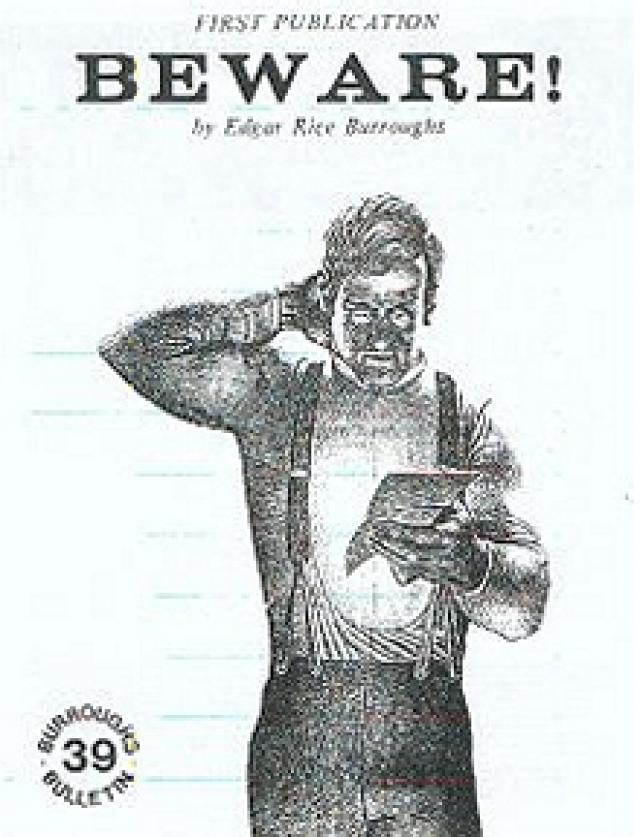


Introduction
Seems that back in the early 1920s, Burroughs wanted to know what Stephen King wondered about much later: Did his name on the title page alone sell the book, or would one of his yarns sell if it went out to editors under a pseudonym? Between Aug. 9-31, 1922, he wrote the novelette BEWARE! and sent it out into the world as written by “John Tyler McCulloch.” It was a flop.
Eventually, it sold to Ray Palmer at AMAZING STORIES. With Burroughs’ permission — he was a pretty easygoing fellow — this contemporary mystery/spy thriller was rewritten as science fiction, re-titled THE SCIENTIST’S REVOLT, and finally published in the pulp FANTASTIC ADVENTURES in July 1939. The Burroughs original stayed tucked away for another 35 years, not seeing publication until the July 1974, issue of THE BURROUGHS BULLETIN.
Prologue
A small pane in the leaded glass of the window tinkled to the study floor, as the bullet embedded itself in the ebony paneling behind the Emperor.
It was the first of May preceding that historic second which wiped an ancient dynasty from the throne of Assuria. For a month the imperial family had virtually been prisoners in the summer palace upon the outskirts of the capital, but they had been unmolested, and their personal safety had seemed reasonably assured until this morning.
For years the voice of the agitator and the malcontent had been heard with increasing emphasis throughout the length and breadth of the empire. "Whatever is is wrong" had been the text from which they preached. During the early weeks of April the capital had been a hotbed of revolution which had rapidly merged into the chaos of anarchy. The people had grievances, but no leader—they had only agitators, who could arouse but not control.
And then had come this first of May, when the rabble from the low quarters of the city, drunk with liquor and with blood lust, had derided the weaklings at the head of the revolution and, screaming for blood and loot, had marched upon the palace with the avowed intention of assassinating the imperial family.
All that day they had howled and hooted about the palace, held in check only by a single military unit which had remained loyal to the Emperor—the Foreign Corps, recruited among foreigners and, with few exceptions, similarly officered.
A shot, the tinkling of glass upon the study floor behind the Emperor; bits of the inlaid ivory design fell as the bullet crashed into the paneling. A fusillade of shots from the palace grounds. The steady roar of the rabble, pierced by shrieks and screams of pain and rage. The Emperor turned and surveyed the panel ruefully. "My great-grandsire brought that from Persia over a hundred years ago, Semepovski. 'So fleet the works of men, back to their earth again, ancient and holy things fade like a dream'."
As the Emperor spoke his companion had crossed the room quickly. "Come, sire!" he cried, "we must leave this apartment. That shot was intended for you."
The Emperor shook his head sadly. "But for Her Majesty, I could have wished the fellow had been a better marksman," he said.
"And the Crown Prince Alexander," Semepovski reminded him.
"It might make it easier for him," replied the Emperor. "It is I they hate. My people hate me, Semepovski—my people whom I love and to whom I have tried to be a father. But them I cannot blame. They have been deceived by lies. It is toward those who knew the truth, who lived closest to me, and for whom I did the most that I feel any bitterness. Every day they are deserting me, Semepovski—the rats and the sinking ship. I am sure of only a few of you—I could count my friends tonight upon the fingers of one hand."
Prince Michael Semepovski, Minister of War, bowed his head, for the Emperor had spoken the truth and there was no denial to be made. After a moment's silence, the Emperor spoke again.
"What do you suppose started them today?" he asked. "What brought this mob to the palace?"
"They heard last night of the birth of the Crown Prince Alexander to Her Majesty," replied Semepovski. "They pretended to see in that fact a menace to what they are pleased to call The Republic—that is why they are here, sire."
"You think they want the lives of the Empress and the Crown Prince, as well as my life?" demanded the Emperor.
Semepovski bowed. "I am sure of it, sire," he replied.
"That must be prevented at all cost," said the Emperor.
"I had thought of removing them from the palace," replied Semepovski, "but that would be difficult, even were it possible to move Her Majesty, which the physicians assure me is impossible at this time, but there is just a faint possibility that we may be able to remove the Crown Prince Alexander. I have given the matter a great deal of thought, sire, for I have apprehended just such a contingency as that which has arisen. I have a plan. It entails risk, but on the other hand, to permit the Crown Prince to remain in the palace another twelve hours would, I am confident, prove fatal."
"Your plan, Semepovski, what is it?" demanded the Emperor.
"For the past month the officers of the Foreign Corps have been quartered within the palace. Several of them are married men, and their wives are here with them. One of these women, the wife of a Lieut. Donovan, gave birth to a son two days since. She is a strong and healthy young woman and could be moved without materially endangering her health. For all the rabble know, she may have had twins."
The Emperor elevated his brows. "I see," he said, "but how could she pass out with the infants? We are all virtually prisoners here. No one may escape."
"But they do daily, sire," replied Semepovski. "The palace is filled with traitors. Not a day passes but that several desert to the enemy. We are close pressed. Only a miracle can save The Foreign Corps from absolute extermination. It would not seem strange, then, to the revolutionists, should Lieut. Donovan desert to them, for the sake of the safety of his wife and children."
For several minutes the Emperor stood with bowed head, buried in thought. The yells of the rabble rose and fell without, but at a greater distance than before, since the fusillade of shots that the soldiers had poured into the ranks of the mob in reply to the shot that had shattered the window in the Emperor's study. The irregularity of the firing now suggested the activity of snipers, rather than a concerted attack by any considerable body of men. But both the Emperor and Semepovski guessed that the mob had but withdrawn temporarily, and that when they renewed the assault it would be with increased numbers and redoubled ferocity. Sooner or later the loyal guardsmen must fall, and if aught was to be done to save the Crown Prince it must be done at once.
"Call Drovoff," said the Emperor, "and we will send for this Lieut. Donovan."
"Perhaps I had better go myself," said Semepovski. "The fewer who know of what we intend, the safer will be the secret of Prince Alexander."
"I have implicit confidence in Drovoff," replied the Emperor. "He has served me faithfully for many years."
"Pardon, sire," said Semepovski, "but the occasion is one of such tremendous moment to the dynasty that I would be untrue to the trust you repose in me, were I to remain silent—sire, I fear Drovoff; I mistrust him, I have no confidence in him."
"Why?" demanded the Emperor.
"I could substantiate no charge against him," replied Semepovski, "or I should have preferred charges long ago, yet in my heart of hearts I believe him disloyal."
"Poof!" exclaimed the Emperor. "Drovoff would die for me. Summon him, please."
Semepovski moved toward the bell cord, but with his hand upon it he turned again toward the Emperor.
"I beg of you, sire, to let me go instead."
The elder man replied with an imperious gesture toward the bell cord, and Semepovski, bowing, pulled it. A few moments later, Paul Drovoff, the Emperor's valet, entered the chamber, bowing obsequiously. He was a slender, dark man, apparently in his early thirties. His eyes were large and dreamy and set rather too far apart, while, in marked contrast to them, were his thin, aquiline nose and his straight and bloodless lips. He awaited in silence the will of his master, who stood scrutinizing him closely, as though for the first time he had seen the face of the man before him. Presently, however, the Emperor spoke.
"Drovoff," he said, "you have served me faithfully for many years. I have implicit confidence in your loyalty, and because of that I am going to place within your hands tonight the future of Assuria and the safety of the dynasty."
The man bowed low. "My life is yours to command, Your Majesty," he replied.
"Good. The mob seeks our life and that of Her Majesty, the Empress, and of the Crown Prince Alexander. Even if I could leave the palace I should not do so. Her Majesty, on account of her condition, cannot, but Prince Michael believes that we can smuggle the Crown Prince away where he may remain in safety and seclusion until my poor deluded people have recovered from the madness which grips them now."
Prince Michael Semepovski, watching intently the face of the valet, saw reflected there no emotion which might arouse the slightest suspicion, as the emperor outlined the plan which might cheat the revolutionists of the fruit of their endeavor.
Twenty minutes later Drovoff returned with Lieutenant Terrance Donovan, a young Irish soldier of fortune who had been a Lieutenant in the Foreign Corps for better than a year.
At the emperor's command, Prince Michael explained the plan to the officer.
"The most difficult part," he concluded, "will be in obtaining safe escort for your wife and the two infants through the drunken rabble that surrounds the palace, but that is a chance that we must take, for in their present mood the mob will spare no one once it has gained access to the palace, which now can be but a matte
Donovan inclined his head in assent.
"We are placing in your hands the fate of Assuria," said the Emperor; "God grant that you may be true to the trust imposed upon you."
I shall not fail you, Majesty," replied the Irishman.
Twenty-four hours later the rabble overcame the remaining guards and forced its way into the palace. The fate of the emperor and his empress is not known—their bodies were never found. The rage of the revolutionists when they discovered that the infant prince had been spirited away was unbounded. But all that is history. If you are interested in it I recommend to you The Last Days of the Dynasty, by Prince Michael Semepovski, large 12mo. illus., 529 pgs., G. Strake, Ltd., London.
* * * *
It was the sixteenth of May, two weeks after the fall of the Empire, that a tiny, muffled figure, with a weight at its feet, slipped over the side of the liner Collosic bound for New York. Upon the deck, with bowed head, stood a young Irishman, and at his side, sobbing softly, his wife clutched tightly to her breast a little baby.
* * *
Twenty-two Years Later
Chapter I
Your Ma is a very sick woman, Mackie." The older man, sitting at his desk, did not raise his eyes to his son as he spoke, and the other knew that it was because he feared to reveal the emotion that lay behind them, and thus give the boy greater cause for apprehension.
"I guessed as much when I got your message, Dad," and as he spoke, Macklin Donovan arose, and walking to his father's side laid his hand affectionately and sympathetically upon the broad shoulder of the police lieutenant. "May I see her?" he asked.
"That is all, Mackie—just see her," replied his father. "She will not know you. We must be very quiet. The doctor has ordered absolute quiet."
The younger man nodded, and together they tip-toed their way upstairs to a room on the second floor.
When they returned to the den again there was a hint of moisture on the lashes of both men.
"How did you find me," asked the younger man, "through the department?"
"Yes. I telephoned Washington. You chief told me where you were."
"I am still on the Thorn case. It has got us guessing. No one in the department believes Mr. Thorn to be more than a visionary philanthropist with conservative socialistic leanings. He wants to do good with his money, but doesn't know how. At first we thought the Reds had gotten hold of him, but the more we investigate the less sure we are about it. We haven't been able to identify a single avowed radical with him, yet we are sure that there is a bunch of Assurians with whom he has frequent dealings, often secretly. His son is as much mystified as we, and almighty worried, too. You know it was he who reported the matter to the department. He thinks they are after the old man's money, and fears that they may influence him to finance some movement that will lay him liable to Federal prosecution.
"But there's another angle to the whole case—something we haven't sensed yet, even faintly; but I'm going to get it. I think I'm closer to it now than I have been at any time during the past month that I've been on the case. We came down from their summer place yesterday on Mr. Thorn's yacht and things seem to have tightened up some way from the moment we got into his town house—there's a sort of tenseness and air of mystery that wasn't manifest at 'Three Gables.' About the only new element that seems to have been infused into the affair is Thorn's butler, a fellow named Goertz, who was not at Three Gables. None of the rest of the town servants seems to count much that I can see, but this fellow Goertz I don't like. He's always pussy-footing. I can scarcely turn around without finding him behind me. I think he suspects me and is watching me accordingly. The other guests, beside myself, are Mrs. Glassock and her daughter—the Peabody Glassocks of Philadelphia, you know—and Count Saranov and his daughter. As far as the Glassocks are concerned they are out of my reckoning entirely—might as well connect young Roosevelt or Joe Cannon with Red activities as a Glassock of Philadelphia—but the Saranovs are different. They're from Assuria. He's supposed to be a political exile. I haven't a thing on him, but I've filed him in the same folder with Goertz. The girl, his daughter, is all right—very much all right, plus."
Lieutenant Terrance Donovan looked up quickly at his son and smiled. The latter grinned back at the older man, and flushed a little.
"Don't be too sure about anybody, Mackie," counseled the father. "The best friend I had when I was walkin' beat tried to stab me in the back one night when we were raidin' a joint in the old Tenderloin. And, anent that, are you sure about young Thorn?"
"He was the best friend I had in Harvard," replied the son. "He asked to have me assigned to this case because he and I could work together better than strangers. He has done everything to aid me. Not a soul in the house knows who I really am. Thorn was afraid to even let 'em know that my father is a police lieutenant, for fear it might arouse suspicion as to my motives for being there. They think you're a retired sugar king from San Francisco and that we're lousy with money. Say, if Mrs. Peabody Glassock of Philadelphia knew the truth she'd throw a conniption."
The older man's face sobered, reflectively. "I'll say she would," he said, "-if she knew the truth."
"Well, Dad," said the boy, rising, "I've got to go—that's the hell of a job like mine, and yours, too; our personal interests mustn't count. Kipling's Tommy has nothing on us:
"'You 'aven't got no families when servin' of the Queen— "'You 'aven't got no brothers, fathers, sisters, wives, or sons—
"'If you want to win your battles, take an' work your bloomin' guns!'"
He threw an arm about his father's shoulders affectionately. "Buck up, Dad," he said. "I'm sure Mother'll pull through all right. Keep me posted, and if I can see her when she's conscious, why—well, to Hell with the Queen. I'll come."
As he walked down the street he nodded pleasantly to the policeman at the corner who was guarding one end of the block that had been roped off against traffic to insure quiet for the sick woman lying unconscious on the second floor of the Donovan home. The cross street was covered with a layer of tan bark and as he felt it soft beneath his silent tread a realization of the reason for its being there brought a lump to his throat. "Mother!" he murmured, and then, shaking himself, stepped briskly to a waiting taxi at the opposite curb and was driven rapidly south toward an older part of the city.
The cab stopped, at last, in front of a tall, brown-stone house—one of several identical houses in a hideous, frowning block of them. Once upon a time each of them had housed a family of fashion and wealth, and even now some of the old timers remained in a few of them—men who, like Mason B. Thorn, had been born there. As Macklin Donovan mounted the steps the door was opened by a footman, just beyond whom Donovan saw Goertz, who bowed low—much too low the Secret Service man thought -- as he stepped forward to take the guest's hat.
"Mr. Thorn and the others are in the library, sir," said Goertz.
"Thank you," responded Donovan, curtly. At the library doorway he turned quickly to see Goertz's eyes upon him. Instantly the butler turned away. There was a frown on the young man's face as he entered the room.
"My!" exclaimed a tall, blonde girl; "whatever in the world is peeving our little Mackie?"






