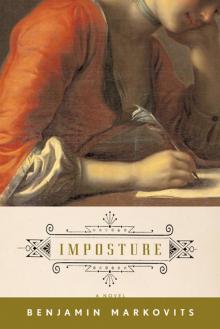
Imposture, p.17
Imposture, page 17


Mr Esmond and Eliza both despaired of this tone, acknowledged the power of the common-sense behind it, hated it, resisted it whenever they could, and gave in to it in the end. ‘What do you mean, poor Liza?’ he said, and continued, trying to sit up on the settee and give his posture more dignity: ‘He was perfectly charming, and not the monster of misanthropy they make him out to be. He brought us a bag of fresh plums, from Brazil. We walked around the gardens together. He admired them exceedingly.’
‘You mean Lord Byron?’
‘I do. I mean Lord Byron.’
‘You mean, that he spent the afternoon with you, in Bagnigge Wells. That he took tea in your cottage. That he has an honourable interest in Liza. In you.’
‘I do. That’s just what I mean. But as for tea in my cottage, he was called away, and left us at the door. Liza herself saw him out. I believe they have formed what they call in novels an attachment.’
She turned back to her reflection in the mirror and looked at her face – just as prettily sober now as before it had been prettily amused – as if to read in it how serious the situation had become. ‘Poor Liza,’ she said again.
‘What do you mean, poor Liza?’
‘She has taken you in again. He, whoever he is, has taken you both in. This is just like her: to fall for a hopeless impostor. In fact, they are perfectly suited. I’ve no doubt she’s mostly to blame herself. Is it any wonder, the way she wastes herself on books, that she imagines one day Lord Byron himself has come to woo her?’
‘I don’t see why you should take this line. You are worse than your mother, giving yourself airs. Just because you get about in society. I tell you frankly, I dislike this manner; you should correct it. Why shouldn’t she catch his eye?’ And then he added, to show he was a realist himself, that he saw things squarely, ‘which, as for that, is hardly rumoured to be the most discriminating. She says, you danced with him yourself.’
‘I did, three years ago. Before he left for France, for Italy, God knows where. Never to return.’
‘Just so. He particularly wishes her, she tells me, to keep his presence a secret. A trust I have now broken.’ But the false hurt honour of his tone effected its own persuasion. The whole thing looked so shabby and plain through his daughter’s eyes. So obvious: he couldn’t quite shake off her view of it. What a pair they were, Liza and he; their shameful willingness to be flattered, to be taken in, struck him for the first time. And he said, in a very different voice, with his chin in one hand, ‘What shall we do now?’
‘How far has it gone?’ Her father said nothing, helplessly; he didn’t know. ‘If he’s touched her,’ she said, ‘I’ll see he’s hanged for it.’
CHAPTER FIFTEEN
ELIZA HAD SO OFTEN DREAMED of being in love, dreamed practically, as it were, in great detail, about particular men – how they looked at her and the promises they made – that when she awoke happy with a pale sunrise on her lap, for an instant she felt the little coming-down that always followed these dreams. The gradual return of her illusionless life. How much sweeter, then, the second surge of reflection, which reminded her that Lord Byron had met her father and been approved of, had charmingly accompanied them on their Sunday promenade. That she had kissed him at last, to his pleased surprise – had risen on tiptoe and taken his face in her hands, outside her father’s cottage. She lay in bed warming those hands in the sunshine and delaying, minute after minute, the start of her ordinary day.
In a moment, she would rise and dress the children and bring them downstairs to be fed. She would present them to their grandmother at breakfast. It was then she could snatch an instant’s solitude, to eat whatever the cook had saved for her meal. After that, the lessons would begin, leaving no respite in sight but tea till the end of her day. Still, as she pushed off the covers at last and sat up in bed, with all the common pains of waking, she was conscious that her life had been altered, irretrievably; conscious too that it might end in heartbreak, and that, at least as she saw the affair in her present uplifted mood, she wouldn’t regret it if it did. She couldn’t, in any case, go on as she had been going.
By noon a shadow had fallen over the happiness in which she’d awoken. Not so much as a morning’s pleasant recollection of the previous day had been granted to her. Lady Walmsley, when Eliza presented the children, said that Mrs Simons had sent a note to say that she would be calling at eleven, and wished to see her sister in private. Lady Walmsley sat up comfortably in her own bed. Eliza, at her nod, stooped to the side-table to present her with the dish of tea, which her querulous hand uncertainly accepted. At another nod, Eliza retrieved it and returned it. A heap of papers lay on that half of the bed which had in the past been intermittently occupied by her husband. Lady Walmsley, who was fond of repeating amiable sentiments, expressed how delightful it must be for Miss Esmond to have so attentive a sister; what a blessing it was. And Eliza, who understood the purpose of these repetitions, their gentle insistence on her continuous state of gratitude, bowed her head. Lady Walmsley said that she didn’t mind if they ‘had the library to themselves’, and that Miss Esmond mustn’t forget to tell Cook to prepare something ‘suitably refreshing’ for Mrs Simons – who, poor dear, was only just recovered from her cold.
For the rest of the morning Eliza worried over what Bea was going to say. She suspected at once that Bea was coming to ‘spoil everything’, though why it lay in her sister’s interest or power to do so, Eliza couldn’t guess. Hopewell and Caroline sensed their governess’s distraction. And it was among the things that frightened Eliza, about her own state of mind, that they had picked up something of her tremulous susceptibility, to the surges and retreats of happiness, and behaved themselves with a respectful decorum that was always on the verge of lapsing into tears. By the time Beatrice arrived, ‘with the wind behind her’, as their mother used to say, in the rush of her own importance, Eliza had already got her hackles up; and not the least of her sources of irritation was the freedom Beatrice assumed in her use of Lady Walmsley’s house. She sent the cook down twice, first to steam her cup of hot milk again, and then to add another spoon of honey to it. Beatrice had decided to adopt, for the purpose of persuasion, the role of the put-upon sister dragged out of her sick-bed to set things right.
The interview got off on the wrong foot. The library was really more of a storehouse for whatever Lady Walmsley disliked among the objects her husband had left behind on his death. Their marriage was not an intimate one, and, as the weaker party in it, Lord Walmsley had taken to travel to relieve the monotony of home-life. His collection of weapons, ornamental and practical, which he had picked up in the Levant, was part of his sly revenge on a wife who greeted his homecomings with the chill of immaculate propriety. Most of them were considerably rusted now; but they served to prop up the heavy-bound volumes of parliamentary and Roman history that Walmsley had bought, as a single lot, from the remnants of the sale of the Alfred Club, of which he had been a founding member – another guerrilla sally in their matrimonial warfare. It was a gloomy, dusty, odorous room, that smelt of unwashed men and damp leather. Two tall windows looked over the gardens at the back, but these were partly obscured by the drapery of curtains (which were drawn neither at night nor in the morning, and had begun to sag) and the trunk of a tall beech tree, which rose with dark magnificence between them. A walnut card table, ruined by water-marks, had been pushed against the pane of one of them, with a chair on each side; and there the sisters sat. Eliza, after a while, took some comfort from the velvet thickness of the curtains, against which she pressed her cheek and ear, hoping to drown out half of what Beatrice was saying.
But she began more sharply. Eliza complained that Bea mustn’t boss the servants around, as she often depended on their kindness and was in no position to give herself airs. Bea waited for her cup of hot milk to arrive, thanked the girl who brought it with cruel exaggeration, and then, after a sip, shot out, ‘Now tell me at once, I must know, how far it has gone.’
Eliza pretended not to understand her.
Bea continued regardless, ‘I meant to come earlier, but I wanted to speak with a lawyer. I supposed even you couldn’t make any trouble before eleven o’clock in the morning. And I wanted to know if we had a criminal case – if it comes to that. Mr Wilmot assures me that we may, but this depends a good deal on just what was said and done. On what he called the nice particulars. Or rather, the not so nice.’
Eliza felt already the awful closing in of everybody else and their opinions – a sensation not unlike the pressure on the brain in high weather, before a storm. She yawned, out of nerves; but had the cheek to stretch it out luxuriously. ‘I suppose,’ she said, ‘it’s simply a matter of jealousy. He’s very handsome, of course; but there’s something irresistibly charming in the idea of playing one’s part, you know, in his inspirations. You can’t bear to see me preferred, especially when you missed your chance at him yourself.’
Her sister leaned forward and took Eliza’s hand. ‘I haven’t come to be silly.’ She paused a moment – Eliza could feel that she didn’t mean to let go of her. And then began again, ‘But I want to hear you say whom you mean, out loud. So that you hear what it sounds like; so that we both do.’
Eliza stubbornly bit her bottom lip. ‘I won’t give in to you this time,’ she said.
‘Will you say it?’
‘No.’ But even she felt the weakness of her position; either course involved a kind of concession, but she had chosen the worse. Not to admit his name seemed childish – a child clutching a lie to her heart by keeping silent. Better to brazen it out; and yet Eliza knew that once she said his name whatever had happened, whoever he was, would be exposed to the full force of her sister’s common-sense. Bea looked at herself in the window. She confessed to herself that she performed these sisterly duties not without pleasure; but she took consolation in the thought, that it was only the pleasure of doing good which moved her. Her fine colouring had returned, and in the grey light – it was a messy, windy morning outside, not entirely sunless – her pink cheeks had a particular vividness, which pleased her.
Eliza, looking at her, could not help but admire her sister. She knew that men mistook Bea’s loveliness – the small-headed tilt to her long neck, her large eyes and childish features, still soft, it seemed, with being formed – for sympathy, for invitation. But her beauty was only the efficient instrument of her hard will. Only her brown teeth, which she hid as well as she could beneath reddened lips, gave away her age and something humble in her birth.
Bea, warming her hands on the cup, had turned to look out the window. In a different tone, she said, ‘I remember how much kindness, a sort of clever, careful kindness, was required, simply to dance with him. He was terribly embarrassed of his foot. As we waltzed, I had to press my hip against his; we swung our legs around together. But you couldn’t on any account reveal that you knew what you were doing. He would have walked off, or rather limped off, at once. One felt – mothering towards him, I remember that well. It surprised me. I had expected to feel something much more thrilling. I was practically a girl at the time, just barely a mother myself; but the first thing I wanted from him, was to look after him. Not that we didn’t tease each other. His manner was quite perfect, gentlemanly and engaging. But what made it still sweeter was, that one guessed the pains it cost him, to please. He had his mind on other things. He inquired, very attentively, of little Louisa. He had a daughter, too, he said. There was nothing he liked better, he said, than the weight of a daughter, in one’s arms.’
Eliza, softening, said, ‘There is something like a woman in him, but without that air of show, that women put on.’
Bea gave her a look, and continued, ‘He told me that he was having his tailor make up a cushion to the exact heft of his little girl, filled with eiderdown, rosemary buds and grain, and that he planned to take it with him on his travels, and lift it in his arms whenever he missed her. The tailor, he said, had offered to make up a dummy of his wife as well, stuffed with virtues and potatoes and thistles, he supposed. An offer, which, on reflection, he had decided to decline. I remember flirting with him shamefully. If only you had married me, my lord, I told him, I shouldn’t have minded who you brought to our bed. He replied, I might have married almost anyone but her I did. Not that it mattered any more, he added. England had had enough of him. He had had enough of England.’ And then, leaning forward, she took Eliza’s hand in both of hers. Eliza felt how warm and moist they were still from her cup of hot milk; how cold her own had become. She was almost bloodless. ‘How long have you known this . . . impostor?’ Bea asked, and repeated, ‘How far has it gone?’
Eliza wriggled free of her sister. ‘He said, he did not remember you.’ Eliza was lying now, and this fact upset her as much as anything else. ‘I described you in great detail. I said, a very cold-hearted woman, with a mean face and a common-looking husband.’ Eliza had always had terrible tempers, a foul tongue. She turned horribly spiteful when denied; her face seemed made for spite, too, narrow and sharp, with that stubborn sulking and fat bottom lip. It was a part of the tenderness with which she was treated, by her father and sister, that these tantrums were dismissed as more of her childishness, quite harmless. ‘She was once a lovely girl, but lost her looks with motherhood. Still, she can’t bear to be outshone, and clutches, in every ball, at the nearest single gentleman, begging him to flirt with her. Lord Byron,’ it was the first time she had confessed his name, and the sound of it gave her a blushing courage, ‘admitted, that he was used to the attention of unhappy mothers. It seemed to him only charitable, to make a little love to them.’
Beatrice was accustomed to her sister’s tirades, which in fact left Eliza more miserable afterwards than anyone else. Bea stood up, and briefly checked her appearance in the window. Behind her face, she saw a boy hold down a rose-bush in the wind; the gardener clipped it. The wind repeatedly tugged at the thorny branches and let go. A cherry-tree had blossomed and shed a few petals on the paving. She was thankful, after all, with age, to spare more attention for the world, to spend less on herself. It is true, she was happier than Eliza, she must show pity. ‘I can’t help you,’ she said, ‘if you won’t confide in me. I shall have a word with Lady Walmsley, tell her to keep a sharp watch – on you.’ And then, taking Eliza’s head in her hands and holding fast, ‘I know what ideas you get. I know how you suffer, living as you do. I feel it – here,’ and she let go, and pressed her hand against her breast. ‘How nothing compares to the life you lead in your books. You’re as bad as Father. You want everything to turn out as you imagine it. You must learn to make do.’ And then she gave in to the need to explain herself, to defend her principles, for her mother’s remembered sake, for their part in the old family argument. Eliza had touched her nearer the quick than she let on. ‘What you don’t see is that practical-minded people find as much to love in each other as any hot-headed dreamers. The captain and I . . .’ but she thought that Eliza was weeping, and added more gently, ‘I promise to take you in hand. I’ll find you a suitable young man.’
But Eliza had only bent her head in rage; she was angry at her own silence, as much as anything else. ‘I should like a soldier, perhaps; I’ve never cared for the navy.’
Bea lost patience at last. ‘Even if Lord Byron himself fell head over heels in love with you, what good could come of it? You haven’t any position in society; you daren’t risk the scandal. You don’t, for God’s sake, think he’d marry you?’
‘What does it matter, what good comes of anything, really?’ Eliza asked, looking up. Bea’s assurance had a way of hushing her, but she was glad, for once, of having said just what she meant. How much she disliked her sister’s efficiency: the intimate collusion of her ends and means.
‘Oh, it matters, it matters.’ She rang the bell and waited for someone to come. They stood awkwardly for a minute in silence, until the door opened, and the maid put her head round it. ‘Ask Lady Walmsley if I might have a word with her,’ Bea said. And then added, ‘thank you, my dear.’ Remembering to be kind, for her sister’s sake, to the servants.
That night, Eliza turned again to her books. She picked up the third volume of Childe Harold’s Pilgrimage and ran her finger over the publisher’s mark: John Murray, Albemarle-Street, 1816. The leather of the binding had the smell of a man’s hand; the pages, faintly discoloured, shifted under her breath.
Is thy face like thy mother’s, my fair child!
Ada! Sole daughter of my house and heart?
When last I saw thy young blue eyes they smiled,
And then we parted, – not as now we part,
But with a hope.
Strange, that he hadn’t mentioned his daughter. It worried her a little, what Lord Byron had confessed to Bea about the ‘weighted cushion’: it had the ring of truth, of his voice, a tenderness whose overtone was irony. It suggested an intimacy she had not yet surprised him into. And she realized that what had upset her most about her sister’s insistent question (how far had things gone?) is that they hadn’t yet gone far enough. Nothing had been done that could not be undone again. If only she had some great irreparable sin to lay claim to, to silence their fussing, to put herself beyond the pale. To bind him to her.