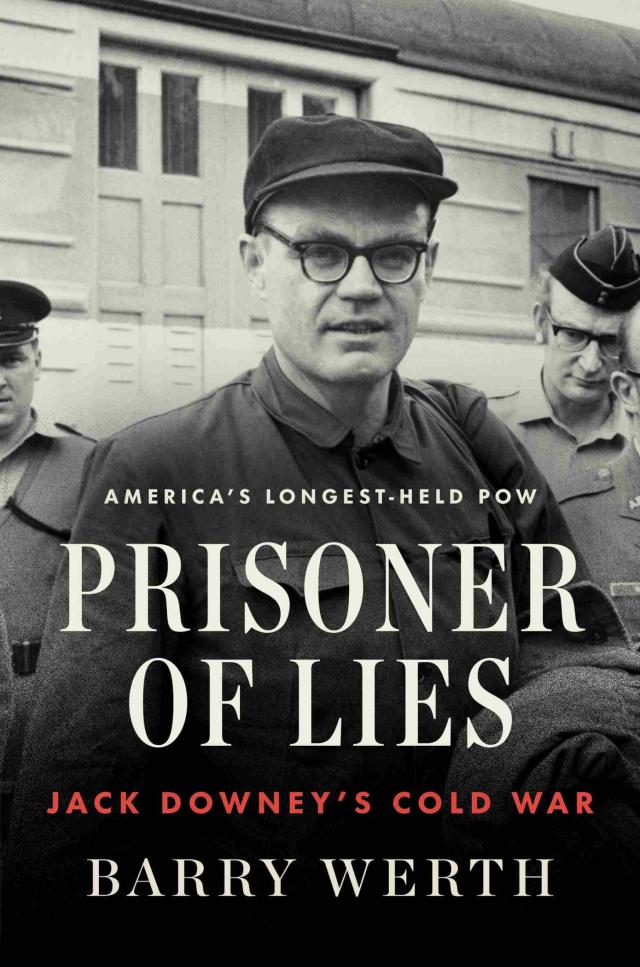
Prisoner of lies, p.1
Prisoner of Lies, page 1


Thank you for downloading this Simon & Schuster ebook.
Get a FREE ebook when you join our mailing list. Plus, get updates on new releases, deals, recommended reads, and more from Simon & Schuster. Click below to sign up and see terms and conditions.
CLICK HERE TO SIGN UP
Already a subscriber? Provide your email again so we can register this ebook and send you more of what you like to read. You will continue to receive exclusive offers in your inbox.
In memory of Alice Mayhew
Downey is a different case, as you know. Downey involves a CIA agent.
—President Richard Nixon, White House Press Conference, January 31, 1973
AUTHOR’S NOTE
Readers of a book that presumes to take them inside the life of an imprisoned American spy in China are entitled to know how the writer came upon his information. Fortunately, Jack Downey, a gifted writer, wrote a prison memoir that was published (Lost in the Cold War, Columbia University Press) eight years after he died. The problem, at least for someone attempting to re-create his experience while staying true to actual events, is that he wrote it more than a decade after his return to the United States, without the benefit of notes. Thus, very little can be verified.
Just about all I know about the intimate day-to-day details of Downey’s training, mission, capture, confession, trial, sentencing, and imprisonment I’ve absorbed from the elegant pages he wrote from memory more than forty years ago, then locked away until after his death in 2014 at age eighty-four. In China, he never put on paper anything that reflected his truest thoughts or deepest longings because he knew it could be confiscated.
Where possible, I have tested Downey’s version against other sources, but for the great majority of scenes portraying that vanished period of his life, I have confidently relied on his candor, commitment to facts, exceptional recall, fine prose, and warm, funny, self-knowing voice. I’m indebted to his family for permitting me to draw extensively from this memoir so that readers can more fully appreciate his exceptional character, dramatic life-story, and instructive place in the history of his times.
* * *
The transliteration system used by the West was revised during the timeframe of the book, which explains why some quotations will contain spellings of Chinese names and places that are no longer used (Chou En-Lai, Mao Tse Tung, Peking/Peiping, etc.). In narrative text, I use the versions currently in use.
PROLOGUE
In the shadow of World War II, a rugged, literary, Yale-bound scholarship student named John Thomas “Jack” Downey capped off a lofty boarding school career (class president, captain of the wrestling team, cum laude grades) just as President Harry Truman and special envoy General George C. Marshall “lost” China to the Communists, sending shock waves through both countries that reverberate to this day. Impressionable schoolboys of what Jack called his “little narrow postwar generation” shared the inherited guilt of being too young to fight in the war. Their elders considered them lucky. Time labeled this cohort the “Silent Generation,” aloof, muted, wary of ideologies. Among themselves, they burned to defend their country and families and freedoms against totalitarian Communism, and to test themselves against an implacable enemy, and each other. By the time he finished college, Downey—along with up to one hundred of his classmates—seized a prized opportunity, joining the Central Intelligence Agency during the Korean War.
The CIA, five years old, modeled itself on the British Secret Intelligence Service—MI6. Veterans of the Office of Strategic Services (OSS), the daring, legendary American World War II spy organization, imbued the fledgling Agency with an unearned swagger; it could strut sitting down. It was Jack Downey’s special misfortune to undertake his first mission as a twenty-two-year-old covert officer—a perilous, botched, and blown air-snatch attempt inside Manchuria—on the same day in 1952 that General Dwight Eisenhower, as president-elect, flew in secret to Korea to try to end an increasingly unpopular war mired in a bloody stalemate. With vice president–elect Richard Nixon and Senator Joseph McCarthy hunting Reds in government on Capitol Hill, and the sanctimonious, long out of power, crusading Christian-nationalist brothers John Foster Dulles and Allen Dulles preparing to take over at the State Department and CIA, Ike reversed the “treadmill policies” of Truman and Marshall, whom Truman promoted to secretary of state, then secretary of defense, after Marshall failed despite thirteen months of intense personal diplomacy to unify China’s warring factions in a pro-West coalition. Under the Republicans, Communism was instead to be “rolled back” through brinksmanship, espionage, and deception.
In Peking (Beijing), Chairman Mao Zedong and Premier Zhou Enlai bided their time. They kept Downey’s capture secret for two years until—as they braced to confront Washington over its support for Generalissimo Chiang Kai-shek’s breakaway regime on Formosa (Taiwan) by shelling two small islands in the contested waters between Taiwan and China—they released the news of his confession, trial, conviction, and life imprisonment to the world. Aimed as a propaganda blow, the disclosure cued a rash of indignant denials. The Dulles brothers protested that Downey was one of two civilian employees whose plane disappeared over the Sea of Japan. Both were believed to be dead. “How they came into the hands of the Chinese Communists is unknown to the US,” Foster Dulles said. Ike told a press conference the situation was “cloudy” and he couldn’t discuss it. Senate Republicans demanded that Beijing release Downey and other American prisoners or risk a war that threatened to go nuclear.
Isolated, disavowed by his country, unaware of the seismic politics at work, Downey staggered through the first years of his punishment. He despaired over “time present” and “time future.” The bright destiny he left behind—he had imagined prospering, like his father, as an attorney, then pursuing their shared passion: public office—slipped away from him as he read his missal and ate his gruel and exercised furiously, trying to get through another day and night without losing hope. More and more on edge, he desperately gamed out diplomatic scenarios that might free him. When UN Secretary General Dag Hammarskjold journeyed to China in early 1955 to seek the release of three groups of imprisoned American fliers amid the spiraling war fever in Washington and Beijing over the Taiwan Strait, Jack’s fate and the fate of US-China relations fused. History took Downey hostage and made him an emblem of his anxious times in both capitals without his knowing it.
Zhou told Hammarskjold that China would discuss releasing Downey and other prisoners in return for an admission of truth, but the Dulleses and Ike refused. Deniability was the essential condition of US intelligence. Foster Dulles, pious, pompous—“a bull,” Winston Churchill reportedly remarked, “who carries his own china shop around with him”—heaped insult on injury. Doubling down on his claim that Downey was being detained unlawfully, he accused the People’s Republic of diabolically bartering innocent American lives to blackmail Washington. Mao and Zhao scorned the inversion of truth and deceit, right and wrong; America’s duplicity, unreason, chauvinism, truculence, and bluster flaring in the face of unimpeachable reality. Jack had no clue war was averted, or how close he came to being freed.
He pulled himself together at age twenty-six, when he understood he simply couldn’t know his fate. Long before his privileged classmates, Jack discovered the hard way that life was more than positioning yourself to reach and rise and then collecting the fruits. Whether he would ever go home, and when, was out of his hands. He trusted his government to do what needed doing to get him released, and he no longer feared being brainwashed, giving him hope that he could endure imprisonment without “losing myself.” With acceptance came strength. Downey shrank his focus to the minute tasks at hand, filling his time with endless reading, running ten miles a day in place or in tight circles, calisthenics, hygiene, rigorous cell cleaning, and other self-maintenance. He made himself “the busiest man in Peking.” When Dulles finally permitted Jack’s mother and brother to visit him the following year, they found him fit and optimistic.
For the next decade, China’s internal upheavals—the mass starvation of the Great Leap Forward and the frenzied purges of the Cultural Revolution—shaped and obscured Downey’s imprisonment. He refused to learn Chinese so his communication with his guards was abstract and monosyllabic. His case faded into the tumult and noise of the 1960s.
Another Cold War flashpoint illuminated the cruel facts of his abandonment. The 1960 Soviet shoot-down of U-2 pilot Francis Gary Powers again delivered the Communists not just another airborne American spy caught in the act like Jack Downey, but also a proven strategy for baiting Washington into a disastrous error, allowing it to roll out a cover story before puncturing America’s credibility, moral standing, and legal arguments by producing the live flier and indisputable proof of his guilt. Unlike six years earlier, Ike and Allen Dulles couldn’t deny Powers’s mission: the Kremlin possessed, and displayed to the world, his high-tech cameras and data-gathering devices. Eisenhower’s hopes for a “crack in the wall” of the Cold War were smashed. Senator John F. Kennedy defeated Vice President Nixon, Ike’s loyal, ruthless heir apparent.
When Kennedy secretly sent a Brooklyn insurance lawyer to negotiate Powers’s release in 1962, Downey and his family were dealt a fateful disappointment: Washington would barter only for acknowledged spies. As long as it maintained that he was an innocent civilian who inexplicably ended up in Red hands—in other words, wrongfully detained—he was out of luck, his hopes of early release futile. Alone in his cell, Jack paid a harrowing price for the distortions and self- deceptions of the era, becoming America’s longest-held captive of war. He had become a prisoner of lies, and all he could do was hope for the truth to free him.
PART ONE
ONE THE RECRUIT
He was a Wallingford boy, a local. At Choate, the all-male Connecticut boarding school ensconced on the town’s rolling northeast ledge—if not the finest prep school in America, surely the fiercest about molding future leaders—sixteen-year-old Jack Downey stood out for what his wrestling coach Hugh Packard called his “Hibernian good humor” and “zest for work and play.” Among the seniors who’d left home for its stern, protected world within a world just as their older brothers and cousins shipped out for combat overseas, Downey often downplayed himself as a “thick Mick” but that was neither accurate nor fair. He excelled in every category.
At six feet and two hundred pounds, Jack was solid—square-jawed, broad-shouldered, with dark, wavy hair. He played tackle on the football team. Nearsighted, he wore thick glasses that magnified his most expressive feature, his eyebrows, which in an instant would arch hilariously, or else bear down with headstrong ferocity, sometimes both at once. His teammates nicknamed him “Squinto.” His best friend Putney “Put” Westerfield, another tall, outstanding scholarship boy, rivaled him for top honors. From their earliest glances at each other in chapel as the Reverend Dr. George St. John, the school’s headmaster, recited the names of Choaties killed in war, they shared a sense of solemn duty, conjuring manly adventures far beyond the lecture hall, the seminar room, the publication office, or the library, where even after the longest days in the gym and on the field and in class, Downey pushed a cart until 11:00 p.m., collecting books in dimly lit stacks, organizing them by call numbers, and returning them to the shelves.
Downey’s indenture—and the high expectations set for him and that he set himself—never seemed to weigh on him. Nothing did. He was unbothered by social, religious, and class divisions. Being a Downey in Wallingford, while not quite like being a Fitzgerald or Kennedy in Boston, meant Jack radiated the vitality of a boisterous, fun-loving, Democratic, upwardly mobile Irish Catholic clan with local roots going back a century. “Not shanty, not lace-curtain,” his uncle Tom explained: “More like pigs in the parlor.” Jack started Choate with a “townie’s chip on my shoulder,” but soon sloughed it off. His ability to lead, a combination of ease, grace, daring, grit, and kindness, derived chiefly from a strong character but also from growing up in the penumbra of his uncle Morton Downey, the celebrated singer and prototypical radio host whose fifteen-minute, five-day-a-week hit broadcast during the war was the first national series launched by Coca-Cola.
Wallingford was a 40-square-mile city of fewer than 20,000 inhabitants, a sprawling plateau of factories, farms, wetlands, and woods cleaved by a snaking, long-polluted river, the Quinnipiac. Downtown girdled a 100-acre millpond built by a clean-living, abstinent nineteenth-century religious cult devoted to radical communalism and “free love”—property should be shared, never owned, all men and women were free to sleep with each other, parents raised all children, not just their own. It was the second stop north on the railroad from New Haven. The first Downeys to arrive were farmers who settled from Ireland before the Civil War, Jack’s great-grandparents John and Elizabeth, who raised eight children in town and who were known as hardworking, independent, sociable, and lively.
By the 1930s, the bustling corner of South Cherry and Quinnipiac Streets, a block from the train station on the poor side of the tracks, “amounted to a Downey enclave,” Jack wrote fifty years later. His grandfather John F. Downey owned a tavern and was politically powerful, serving in the state legislature and running local party patronage. Around the corner Uncle Tommy and his wife, Alice, operated a grocery store, Downey Bros., which opened Sundays before First Mass at Holy Trinity Church so that shoppers could buy last-minute items for family suppers with guests numbering in the dozens. Across the street stood the firehouse where his Uncle Jimmy, Mort’s father, served a record-breaking fifty-two years, the last dozen as chief.
In summers, the whole clan picnicked at a family-owned cabin on the brow of a knobby hill, Mount Tom, with a field for games and a panoramic view of the smokestacks, coal silos, water towers, and steeples flanking Community Lake. A cousin from Meriden, Tomie dePaola, whose mother brought him over every Saturday to work in the grocery store while she did the books, recalls the family gatherings as “magical… The Downeys were all upbeat, they were all full of fun, they all had laugh lines.” (DePaola would become a celebrated writer and illustrator of books for children.) It was said in town that the Irish immigrants in the flats had built Holy Trinity’s spire to tower nearer to God than the Episcopal steeple up the hill. From this angle the Downeys could believe it.
John E. Downey, Jack’s father, shouldered the clan’s political ambitions. His older brother Tommy died at fifteen, leaving him the baby in the family and the only son. After excelling at Catholic University and Yale Law School, he returned to Wallingford to practice and by age thirty-two was elected probate judge; a popular, personable New Dealer, he had two offices in town, one private, one at the courthouse. He and Mary, née O’Connell, a laborer’s daughter from New Hampshire who’d moved to nearby New Britain to teach school, soon had three children, two boys and a girl. As their ambitions grew, they moved up the hill for a few years to a rental, then into their own house across from the Wallingford Country Club, a pristine semi-colonial with seven rooms, a circular staircase, a garage, and a rolling hilltop view. Sensing his father’s forcefulness as they drove up the hill, the big tires of the family’s wood-paneled Ford station wagon thrumming on the bricks, Jack thought of it as his castle.
Morton Downey, hailed by promoters as the “Irish Nightingale” or the “Irish Thrush” (he was born John M. but took his middle name to avoid being confused with all the other Jacks in the family) parlayed an early career singing in club cars and church socials into being featured throughout Europe fronting Paul Whiteman’s big band. After a brief acting career in Hollywood where he married starlet Barbara Bennett, one of the famous Bennett sisters, he switched to broadcasting. By 1933, millions of American women, stationed at their sinks and ironing boards as the kids returned from school at lunchtime, voted him radio personality of the year. He outearned Frank Sinatra by $1,000 in his first week at the Waldorf Astoria. “Sinatra makes you want to sprawl out and listen,” a critic wrote, “while Downey makes you want to sit up and listen.”
With millions of dollars in Coke stock, a board seat, and ownership of its lucrative local bottling franchise, Mort bought and operated posh Manhattan restaurants. He swanned around the city in a chauffeur-driven Rolls–Royce and purchased a house in Hyannis Port on Cape Cod next door to Joseph P. Kennedy’s that Kennedy’s son Jack—who’d struggled through Choate, a sickly, “sloppy” youth eclipsed by his charismatic big brother Joe—one day would borrow to use as his summer White House.
Unlike John F. Kennedy (Class of’35), first elected to Congress in 1946, a fresh-faced, celebrated “Greatest Generation” war hero and author propelled by his father’s money and connections, being John T. Downey (’47) at Choate signified far more to its cooks, groundskeepers, and housemaids than to his peers and masters. But to his classmates, the friendly, funny, killer-competitor playfully menacing them with a crooked grin and a water gun loomed larger than the others. Bundled in his father’s old undergraduate coat, good-naturedly sweating and starving himself weekly to compete in the 185-pound class in wrestling, he exuded maturity and confidence.
Heading into his last semester, Jack doubled down. Choate considered itself a training ground, a “way of life” for becoming successful in America. For forty years, Dr. St. John had preached that it was the exemplary boys who ran the school, enforcing its values and showing the way. “It’s not what Choate can do for you,” he admonished, “it’s what you can do for Choate.” The Old Head ruled with unchallenged authority and a mighty hand. Boys weren’t flogged, but they were lectured severely, reminded daily in chapel of their moral duties. Masturbation, though seldom brought up, was on every mind: in a chapel talk, St. John recounted the chilling story of a young student of faith who carved a deep scar across his palm as a permanent reminder never to pleasure himself.