The godmother, p.1
The Godmother, page 1


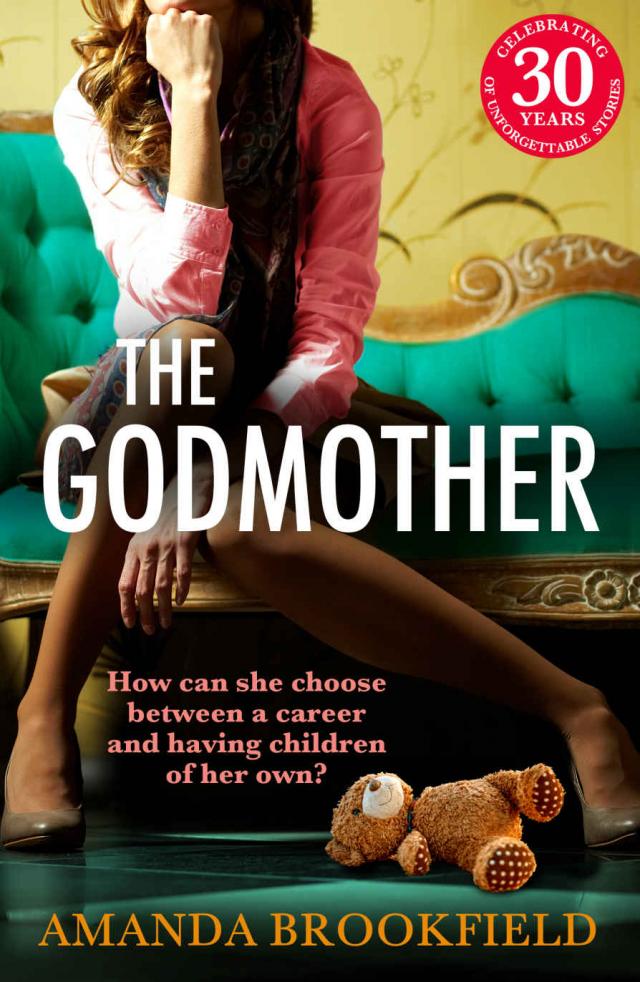
THE GODMOTHER
AMANDA BROOKFIELD
For Edward
CONTENTS
Foreword
Chapter 1
Chapter 2
Chapter 3
Chapter 4
Chapter 5
Chapter 6
Chapter 7
Chapter 8
Chapter 9
Chapter 10
Chapter 11
Chapter 12
Chapter 13
Chapter 14
Chapter 15
Chapter 16
Chapter 17
Chapter 18
Chapter 19
Chapter 20
Chapter 21
Chapter 22
Chapter 23
Chapter 24
Chapter 25
Chapter 26
Chapter 27
Chapter 28
Chapter 29
Chapter 30
Chapter 31
Chapter 32
Chapter 33
Chapter 34
Chapter 35
Acknowledgments
More from Amanda Brookfield
About the Author
About Boldwood Books
FOREWORD
I wrote The Godmother over twenty-five years ago, back in distant pre-digital days when people used fax machines instead of sending emails, and ‘mobile’ phones were cumbersome office gadgets used by the rare few. It was my fifth novel and I was in my mid-thirties, raising two very young children between finding time to write.
I picked advertising as the career for my heroine, Rachel, because it was the industry I had gone into after leaving university and therefore a world with which I was familiar. I had found it a fun and well-paid career, but also hugely stressful, mostly from being – like all workspaces then – a male dominated world. I loved being able to create my single, feisty, capable heroine, Rachel Elliot, and plant her in the middle of it, ready to take on all challenges, giving as good as she got – or at least doing her best to. ‘What Rachel Elliot wants, Rachel Elliot gets’, as an envious friend remarks at one point, which is what Rachel believes of herself, until life – reality – starts to get the better of her.
It is a curious business re-reading something you wrote a quarter of a century ago – a bit like meeting a person you once knew, of whom you feel inordinately fond, while seeing all their flaws! What struck me most on returning to The Godmother, however, was the fact that all the difficulties – some of them deeply disturbing – that Rachel has to grapple with, at work, in relationships and in society at large, have not really changed. That pressure on women not to cause a fuss, not to assert themselves, while still being multi-tasking domestic/work goddesses – sadly, it’s a battle still being fought. Indeed, Rachel Elliot, in many ways, was ahead of her time. She takes some dire wrong turns, but she is fearless and true to herself – which is what we are all aiming for in the end.
Amanda Brookfield, 2023
1
‘Give him to Rachel,’ said Joy, pointing with the christening candle across the room.
‘Yes, give him to Rachel,’ echoed Tony, her husband, emerging from the kitchen with a fresh pitcher of wine. ‘Let the godmother have a go.’
The wriggling bundle of yellowing silk, trimmed with cob-webbed lace, was passed from hand to hand along the line of guests, like a parcel at a children’s party, thought Rachel, regarding its approach with all the wariness of a native being invited to speak a foreign language.
‘He’s bound to cry,’ she declared, smiling through her fear, feeling all eyes upon her as she laid her white, suede handbag on the arm of the sofa and rubbed her hands together in a show of eagerness for the challenge ahead.
But Leo, who was six months old and who had been placed in the woefully haphazard care of his eleven-year-old sister, Isobel, for the last twenty minutes, did not cry upon being delivered to his godmother. He frowned at her instead, twisting his fist into his mouth and kicking out at the restrictions of the long christening robe, now entwined round his stocky legs like clingfilm.
‘I’m not sure he approves of his costume very much,’ Rachel ventured, cradling the baby in stiff arms, wary of projectile milk-dribble staining the front of her white, linen jacket, or, worse still, her chest being mistakenly identified as a source of nutrition. A frisson of repulsion and curiosity had zigzagged through her the day before upon finding Joy with her T-shirt hoicked up unceremoniously over one ripe and veiny bosom, so that Leo could feed while she guided Sam, her dyslexic nine-year-old, through a French reading book about farms.
‘But they all wore that gown,’ remarked a brisk, mousy-haired woman with Tony’s nose, ‘it’s family tradition.’
‘Oh, I see.’ Her arms were aching now. The woman turned away, giving Rachel the chance to step out of the social throng, none of whom she knew anyway, and sit down beside her handbag. Gingerly, she propped the baby up on her lap, straightening the copious folds of the gown as tidily as she could and doing her best to contain the wriggling limbs. For a moment, she thought wistfully of her other three godchildren, all of whom had long since acquired mouthfuls of teeth and a taste for beautifully undemanding, post-able activities like video games and Barbie dolls. ‘Bad luck, Leo,’ she whispered, giving the voluminous family heirloom another tug, ‘I should hate it too.’ The baby offered a feisty kick by way of concurrence and then promptly put his head in the crook of her arm and closed his eyes. Hardly daring to move for fear of interrupting this astonishingly rapid – and most welcome – submission to the pull of sleep, Rachel lifted her eyes for a few moments in order to study the room.
It was still only a few months since Joy and Tony had made their daring exit from the London rat race, transplanting the family from a four-bedroomed semi in Wimbledon to a charming but dilapidated farmhouse a few miles outside Turon, a medieval town that nestled in the upper regions of the Loire valley. A daring move indeed. Something to be admired as an attempt to make a dream come true, one of those about which most mortals ended up doing nothing more than talking. Upon studying the undisguisable chaos of the Daltons’ new sitting room, however, the peeling wallpaper, bunches of wires sticking out everywhere, like skeletal fingers, the scores of boxes stacked along every spare inch of wall, Rachel could not resist a shiver of relief that the experience was being endured by Joy and not herself. Leo hadn’t been part of their plan either, she remembered, casting a wary eye at her lap, her godson’s conception apparently having occurred quite by accident during the chaotic and unforeseeably long business of trying to sell the house and settle all their affairs in England. Joy, while professing to be appalled at the discovery of this unscheduled pregnancy, had seemed to revel in it too, perhaps, thought Rachel wickedly, because she was secretly thrilled to have proved that a fifteen-year marriage could still muster enough passion to overlook the use of sexual prophylactics.
‘Well, if it is such a disaster, why not consider your options?’ Rachel had asked, trying to be blunt but kind, when Joy first broke the news, weeping into a glass of wine which she said she really shouldn’t have, but from which she nevertheless gulped with unabashed need.
‘Christ, Rachel,’ she had gasped, hugging the small hump still easily disguised by a generous sweatshirt, ‘there’s a child in there. At twelve weeks, it’s got all its bits. I know it may be hard for you to understand, not having children and so on, but to have its life terminated, even now, would be tantamount to murder.’
‘Okay, okay – sorry I spoke.’ Rachel held both hands up. ‘Though I do remember,’ she couldn’t resist muttering, ‘there was a time when you waved a banner for abortion rights.’
‘That was years ago, for God’s sake. It’s different when you’ve had children, believe me. The very thought that… Oh, it’s impossible to explain.’
Rachel had nodded in a show of empathy, hating the familiar, unspoken criticism that she herself had not borne any children, that she had committed the unmentionable sin of choosing to remain single and nurture a career instead of a family. Once, friends like Joy had challenged her openly about such things, expressing either pity or fascination with her single status, teasing her with suggestions for life partners and having late babies. Now they no longer did so. An omission which Rachel suspected was connected directly to the fact that, at thirty-nine, she was moving ever closer to an age at which acquaintances had stopped expecting – or even wanting – her to change her ways.
Leo yawned, absently pushed a thumb into his eye socket, scowled at the unexpected pain, and then settled back to sleep, the dimpled fingers of one hand closing round the third button of Rachel’s suit jacket.
The trouble was, thought Rachel, watching the button being tugged by its cotton roots and not minding, something did feel different these days. Some new, unclassifiable emotion was pushing its way into the perfect bubble of her world, something which she did her best to ignore, but which felt disturbingly like a growing sense of pointlessness behind all that she had created, all that she had achieved. The ebb and flow of such thoughts, apart from being unpredictable and distressing, was also highly inconvenient. As board director of an international advertising agency, earning in excess of a hundred thousand pounds a year, with a luxurious flat in Chelsea, a soft-topped Audi and her own named parking slot in the underground cubby hole of a directors’ car park, Rachel Elliot was not in the habit of entertaining doubts of any kind. As well as being a formidable businesswoman with a string of happy clients and successful campaigns to her credit, she had lover s, she had hobbies, she had friends, she had good health. Dissatisfaction – or whatever it was – had no business creeping up on her like that. How dare it? she thought now, looping her little finger into the cup of Leo’s free hand and being surprised at the hungry clench offered in response.
‘Rachel, you are sweet. Thank you so much. I know babies aren’t exactly your thing.’ Joy held out her arms for her son. ‘Both Tony and I are absolutely thrilled that you agreed to be his godmother – and of course, that you could come all this way. Really, it means a lot to us… friends like you…’ She sucked in her lower lip and then blew out hard. ‘Well, we go back a long way you and I, don’t we?’
As Joy took the child, Rachel felt the pull on the button increase until, with a yank, the little fingers were forced to let go. ‘We certainly do.’ She studied Joy’s face for a moment, trying to judge whether the veins standing out round her eyes and the straggly limp hair spoke of something more than the exhaustion of moving countries and taking care of children. Though their friendship dated back to the shared horror of an old-fashioned boarding school, testimony to the mutual problem of having fathers in the armed forces, Rachel no longer felt that she really knew Joy very well. In recent years, their meetings had slumped to one or two a year, over the occasional dinner-party table, or a snatched evening at the theatre. Wimbledon was a long way from Chelsea and, as Rachel found with nearly all her girlfriends, marriages to men whom she barely knew and whom she struggled to find obviously endearing, inevitably took their toll on the degree of intimacy which she was able to maintain. ‘No second thoughts, I hope?’
‘Second thoughts?’ Joy rocked Leo gently in her arms, her hips swaying with a practised, unselfconscious ease that made Rachel almost ashamed of her aching arms, and of her timidity over something so small and peaceful.
‘About France. About living here.’
Joy’s expression tightened into a concentration of brightness. ‘But how could I? This is what we’ve always wanted, what we’ve both worked towards for years. Tony had absolutely had it with the whole architectural scene in London. Here he’s his own boss – converting barns and all that kind of thing. He loves it. And after holidaying round here for so long, he’s built up scores of useful connections. He’s already got more work than he knows what to do with. And oh, Rachel, you should see Tony’s plans for this house. It’s going to be positively dreamy. We’ll have to force relatives and friends like you to join the queue to come and stay. And the school is fine,’ she swept on, ‘even though the classes are bigger than the children are used to. Isobel is already jabbering like a local, though poor Sammy is obviously going to take a little longer to find his feet. And as for this one…’ she nuzzled Leo’s yellow fuzz of hair, ‘he could be on Mars for all he cares, so long as he’s got a steady supply of food and a dry bottom.’
‘Oh, good,’ murmured Rachel, wondering if Joy was aware that she had accounted for everyone’s state of happiness but her own.
2
The best thing about being alone was the freedom, mused Rachel, as she glibly fibbed about having an airplane to catch and levered herself out of the squash of the Daltons’ cement-floored sitting room in order to escape back to her hotel. Although a light rain was still falling, it felt warmer outside, more welcoming. She shivered again at the recollection of the stone walls of the house, the plastic flapping in place of window panes, the way the loo door had refused to close, forcing her to sit awkwardly with one leg outstretched in case any other unsuspecting guest had chosen that moment to barge in. Apart from Joy and Tony, she had known no one at all, only close family having been able to make the journey and none of their new, local friends being familiar to her.
With a satisfying click, the doors of her hired Mercedes obediently unlocked themselves. As she slipped into the driver’s seat, Rachel threw a wistful glance at the peachy straw hat in the back. Joy should have warned her. Smart outfits but not a hat in sight. And it had suited her, too, especially with its wide brim pulled ever so slightly down over one temple, so that she could peer out imperiously from underneath, feeling grand and pretty all at the same time. She didn’t often get a chance to wear hats these days, weddings and christenings being somewhat a thing of the past.
Although September had barely begun, the imprint of autumn had already touched the landscape bordering the narrow tarmac road on which Rachel sped away; armies of drooping sunflowers smothered the fields to her right and left, their blackened heads nodding in the damp breeze like old men despairing at the ways of the world. Sensing that her good mood was in danger of slipping away, Rachel turned on the radio, tuning into a light, fizzy pop tune that sounded vaguely familiar. She tapped her fingers on the steering wheel and hummed quietly, squinting at the signposts because she had left her spectacles in the hotel. Some ten minutes into her journey, an avalanche of grey clouds scudded past like shifting scenery, allowing a new assemblage of fluffy, white tufts and a beaming sun to take their place. The sunflowers were replaced by acres of harvested corn, rolled into golden cylinders, their wet surfaces glistening on this new and brilliant stage like giant, polished tins.
Turning away from the fields, towards the less dramatic pastures that lined the sides of the Loire itself, Rachel braced herself for the first glimpse of the chateau in the environs of which she was fortunate enough to be staying. It perched on a piece of high ground beside the river like a fairytale castle, complete with Rapunzel-style pointed turrets and vertical slits in its towering walls. The hotel itself was in a converted side-section, where French lords were said to have once stabled their horses. Set further into the extensive grounds, carefully masked behind several rows of tall trees, lay a kidney-shaped swimming pool; flecks of its shimmering azure could just be glimpsed from the four windows of Rachel’s second-floor room.
A team of maids had come to close the shutters and turn down the sheets on her bed the evening before, bustling in when she was only just out of the bath, smiling approvingly at the vast, white towelling dressing gown in which she emerged, their eyes saying they had seen it all before and much more besides, that such states of undress were entirely expected of such patrons at such times of day.
When she arrived back after the christening, the shutters were still open, allowing the rain-washed air to drift in and lighten the oppressively regal atmosphere of the room, of which the four-poster bed formed the centrepiece, its sides decked with sweeping brocaded curtains of the kind that Rachel associated with honeymooning couples in old films.
Settling herself against the wall of embroidered cushions arranged along the tapestried headboard, she took a desultory nibble of the mint chocolate which had been left on her pillow, willing herself to sink into the stupor of self-indulgence which her surroundings demanded. She reached for the telephone beside her bed to dial room service, but changed her mind. There was nothing she wanted. Nothing at all.
Beside her lay most of the contents of her small suitcase, rummaged through earlier that day in her hurry not to be late for the church. In her absence, invisible hands had folded and arranged every item into tidy shapes across the bed, the line between assistance and intervention clearly dictating that the repacking of the suitcase itself was not permitted. Rachel picked up a neatly folded pair of white, silk stockings and threw them in the direction of the open suitcase. They flew badly, too light to reach their destination, fluttering down instead, like tired wings, on a black leather book near the far edge of the bed. On noticing the book, Rachel rolled over and picked it up. Still lying on her stomach, she extracted a gold ball point pen from its broad spine and began to write, her hand sweeping fluently across and down the lined page.