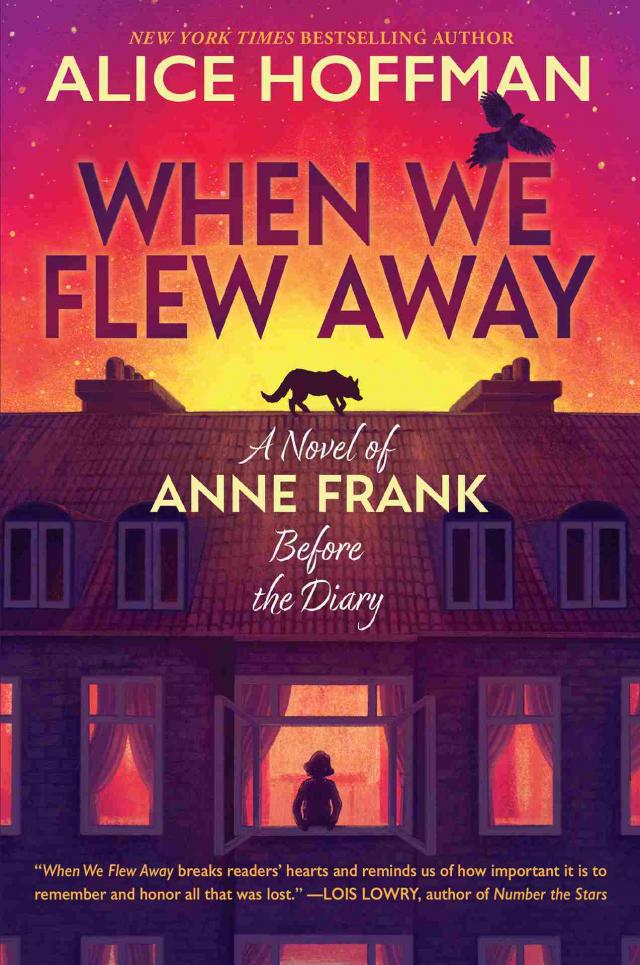
When we flew away, p.1
When We Flew Away, page 1


Contents
Title Page
Epigraph
Part One
Chapter One
Chapter Two
Chapter Three
What We Lost
Part Two
Chapter Four
What We Lost
Part Three
Chapter Five
Chapter Six
What We Lost
Part Four
Chapter Seven
Chapter Eight
Chapter Nine
What We Lost
Part Five
Chapter Ten
Chapter Eleven
Chapter Twelve
Chapter Thirteen
What We Will Remember
Afterword
Acknowledgments
Further Reading
About the Author
About the Anne Frank House
Also by Alice Hoffman
Copyright
How wonderful it is
that no one has to wait even a minute
to start gradually changing the world…
—Anne Frank
There is a day you never forget, the day the whole world changes.
When you close your eyes, light becomes dark, night never ends, beasts walk freely down the street, stars fall from the sky. You were young one second, and then you were far too old. You lived years in minutes and decades in weeks.
You wanted to travel, you wanted to grow up, you wanted to be beautiful, you wanted to fall in love. You wanted so much that your heart broke in half, but half a heart is better than none, and your heart is stronger than anyone would guess.
You remember everything.
You see the leaves turning green on the elm trees along the canals after the spring snow. Songbirds are rising up from the branches, and the bells over the bookstore doors are still ringing. There is a heron sitting on a balcony, a bird that is a sign of good luck. You are wearing two sweaters and a coat though the day is warm. When you see black moths rising from deep underground, you can barely breathe. In this moment, you suddenly realize you may not always be with the ones you love. Something is happening all around you.
This is when you understand that the story can change.
Once, there were two sisters. One was beautiful and well-behaved, and one saw the future and stepped inside it. One planted a rosebush, but the other one noticed that every white flower was turning red. One did as she was told, but the other one wrote down everything she had seen.
When you write it down, they cannot pretend it never happened.
They were walking home through the River Quarter in Amsterdam on the day before everything changed. The sisters were three years apart, and at fourteen and nearly eleven they were opposites in practically every way. Margot, the older girl, was beautiful, although she didn’t seem to know it. The younger girl, Anne, had always been envious of her sister, for Anne might be considered ordinary, if you didn’t know her. She had light brown eyes and dark hair, and she was always curious, making people laugh and talking nonstop as she entertained her friends in class, even during lessons. All the same, some people found her willful and headstrong. Most people didn’t have any idea of who she was deep inside.
The sisters sometimes met after their classes to go home together. Margot would make a detour to pick up her sister, then walk her bicycle. It was only ten minutes’ time if they were quick about it, which they rarely were, for the weather was glorious, and today they lingered longer than usual. The world seemed perfect on this day, with bright sunlight falling through the branches of the trees. Why should they rush home to the chores that awaited them? They were young girls, in love with life and with all the possibilities of a wonderful future. It was May, their favorite time of the year, the season when the birds returned to nest in the trees along the river and the canals. Only the magpies stayed all year round and managed to survive the ice-cold winters, but now the skies were filled with migrating birds returning from Spain and Morocco.
“Let’s go to Oase,” Anne suggested. It was their favorite ice cream shop, and if they could, they would have stopped there every day.
“You know we can’t,” Margot answered, always the voice of reason.
“Can’t or won’t?” Anne grinned. Let’s break the rules, she often urged her older sister. Let’s take a chance. “We’re already going to be late,” Anne said cheerfully. “We might as well stop.”
They had to pass the ice cream shop on their way from the school anyway. Going home meant starting their homework and setting the table and listening to their mother’s questions and judgments about how they’d spent their day. Anne loved walking along the streets of their busy neighborhood to the Merwedeplein, the square where they lived, not far from the Amstel River. The neighborhood was filled with bicycles and cars, and the sisters always looked for the flower man, whose cart was pulled by a huge dog.
“Let’s bring him home,” Anne said when they spied the enormous white dog, who steadfastly towed the cart loaded down with tulips from the flower fields out in the countryside.
Margot laughed. “He’d take up our whole house.”
“Good,” Anne responded. “He’d make things interesting.”
“And what do you think our mother’s reaction would be? If he sat on a chair, he’d be tossed out the door.”
The girls laughed at the idea of the gigantic dog being bossed around by their mother. Edith Frank insisted their house be kept neat and clean at all times, and dog hair and muddy pawprints would never be allowed. Their apartment was in a new building in a comfortable neighborhood with many Jewish residents who had fled from the Nazi regime in Germany. There were dozens of new apartment buildings in the neighborhood, including the tallest residential building in Amsterdam, called the Skyscraper, one with so many stories that little children living nearby said the top floor led into heaven. People claimed it was possible to see every star up above if you lived in the highest apartments. In the evenings, when the Frank sisters sat on the steps outside their apartment, they could see lights flickering in rooms that seemed to float above the tallest trees.
“If we stop at Oase, maybe someone will treat us,” Anne suggested, for although she had no money of her own, there were often boys who were willing to buy girls ice cream. Anne was young, too young for boys some might say, but she liked to flirt, and what was the harm in doing so?
“We shouldn’t take gifts from strangers,” Margot instructed her little sister. She didn’t know where Anne got her nerve, and there were times when she wished that she, herself, were a bit braver. She couldn’t remember ever breaking a rule.
“Ice cream is not a gift,” Anne insisted. “It’s a necessity. And there’s nothing wrong with friendship.”
“Anne.” Even Margot, easygoing as she was, could get annoyed by her sister’s badgering. “Not today.”
“Fine,” Anne said, walking on ahead of Margot. They weren’t friends, only relations, and Anne was certain she would have never chosen Margot as a friend; they had so very little in common.
“Don’t bother trying to catch me,” Anne called over her shoulder as she took off running. “Someday you’ll wish you’d listened to me and had more fun.”
Margot did her best to watch over her sister, but Anne had a mind of her own. She was perceptive and already interested in topics she wasn’t supposed to know about at her age. The more she knew, the more puzzled she was by the workings of the world around her. Why were men allowed more freedom than women? Why did people fall in love? How did it happen, and when would it happen to her? Why had their family left their home in Germany? Why was there so much hatred in the world?
Margot was an excellent student, diligent and kindhearted and athletic, and a valued member of the rowing team. She was enrolled in a high school that included students of all religions, with only five Jewish girls registered in a class of thirty or more. Anne, whose full name was Annelies Marie Frank, went to a Montessori school on Niersstraat, a wonderful place where students were allowed to write and paint as they saw fit, with classes based on a method that encouraged children to express themselves. The girls’ parents knew their younger daughter needed the freedom to be herself; she couldn’t sit still for very long and only paid attention to the subjects she liked, and she likely wouldn’t have done well in the classes Margot attended. Anne’s school felt like an enchanted place for those who had wild imaginations. There was a huge chestnut tree in the courtyard, and some people believed if you touched the bark of the tree your wish would be granted, but only if you closed your eyes, and only if you really believed. Anne was a believer, one who loved fairy tales and myths. She was certain girls could forge paths for themselves, no matter how dark and deep the forests might be.
I wish to be whoever I want to be, Anne whispered when she held the palm of her hand against the tree in the courtyard. I wish to be myself.
The sisters had lived in Amsterdam ever since Anne was four, when the family had fled Germany. The Netherlands still allowed Jews to enter when other countries, including the United States, had instituted quotas that kept out refugees, even though the conditions for Jews in Germany were worsening as the Nazi persecution grew more ruthless all the time. The Netherlands had been a refuge for Jews fleeing the Inquisitions in Spain and Portugal in the 15th and 16th centuries. It was a place rooted in equality, where much of the Jewish population was given full civil rights in 1796, allowed to live freely in a city that was both mysterious and practical, a world made of ice in the winter and of tulips in the spring. Back then, the city would flood with the rising tide; it had been built in the marshes, and people wore wooden shoes so they could walk through the mud as they tended their fields. Now Amsterdam was ringed by 165 canals, with countless bridges built across the waterways, for the swampland had been drained hundreds of years ago by wealthy merchants who had then built tall, elegant canal houses with fairy-tale gables. For those passing by, it was possible to imagine they had walked into a story, one in which good people were rewarded and those who were evil were locked up in the towers, the keys thrown away, tossed into the dark waters of the canals.
Anne liked to stop and gaze into the canals. She sometimes thought she could see what other people could not. There, in the still water, she imagined she saw pieces of the city’s past. Bricks from houses that had fallen down, a necklace lost by a noblewoman, a silver fish that had been swimming in the canals for a hundred years.
“You’re a dreamer,” Margot always told her sister, for all Margot saw when she gazed at the canals was the dirty water and ducks paddling by. She saw boats making their deliveries and an occasional elegant white swan, too proud and vain to look back at her.
When Margot made such comments, Anne knew that even if you were sisters you could see the world in completely different ways. The here and now and the what could be. How dull to have no imagination, to see only what was right there in front of you. She thought of the fairy tale “Snow-White and Rose-Red,” a story in which two sisters were different in every way, just as she and Margot were different. Anne sometimes thought her favorite words were Once upon a time, even though her mother always told her to wake up and pay more attention to her schoolwork and her chores and not always be reading one of her books. But the girls’ father, Otto Frank, whom they called Pim, was a great reader, and what was so wrong with that? He was the one who understood Anne, even when her mother didn’t.
Dreams are the beginning, he always told Anne. They’re the stories we tell ourselves.
At the Montessori school, Anne’s best friend was Hannah Goslar, called Hanneli or sometimes Hanne. Both girls had spent their earliest years in Germany, and they often whispered to each other in a language not many in their class understood. The two friends spent huge amounts of time together, for Hanneli also lived nearby in the River Quarter. Soon, they included another girl in their friendship, Susanne, who was called Sanne. Anne and Hanne and Sanne. They thought it was fate that they would be best friends with rhyming names, and they would never stop being friends—they had already decided that. They talked for hours about the future that awaited them and all they would do.
“We’ll go to America,” Anne said, for that was her dream, a story she told herself every night. Once upon a time, we lived in Amsterdam, until we left and went across the sea.
“And we’ll live in the same house,” Hanneli added.
“But who will pay for it?” Sanne was a realist who always wanted to know details.
“Whoever is in love with us,” Hanneli suggested.
“No.” Anne shook her head. “I’ll pay for it,” she told them. “I’ll be famous by then.”
They all grinned, for if Anne believed it, so did they. She always took charge, and her closest friends understood why. Anne had always thought she would be someone special. But whenever her friends left for their own homes, the truth was Anne felt far too alone. She felt as if anything could happen. Maybe she wasn’t special, maybe she would find herself alone in the darkness without anyone who understood her. Margot was who she appeared to be, sunny and bright and well-mannered, but Anne kept her truest self hidden, even from her closest friends. She was the cheerful girl who was always such fun, but she was smarter than anyone imagined, which was something she kept to herself. Let people think she was nothing beyond the person she showed on the outside, the dramatic girl who liked to act in plays, the chatterbox who often found herself in trouble at school. She was always reading and thinking, but she gazed out the window at the clouds when she should have been listening to her teachers and her parents. Anne’s mother was often disapproving when Anne talked too much or acted as if she knew the answers to most questions, even though Edith was a big talker as well. But the girls’ beloved grandmother Rosa Holländer, whom they called Oma, understood Anne.
If you want to know who she is, Oma had told Anne’s mother, look more deeply. Look inside.
The girls’ grandmother spent nights sleeping in what had been the dining room but had been set up with a bed for Oma, a necessity now that the extra bedroom on the top floor was occupied by a boarder who helped pay the rent. Oma had been frail ever since she’d arrived from Germany a little over a year ago. She had lost everything, her home, her belongings, even the roses that grew in her garden; all of it had been taken by the government. In 1933, Adolf Hitler and his Nazi Party rose to power in the wake of Germany’s loss in World War I, often called the Great War. Otto and Edith had sensed that conditions for Jews would grow worse under Hitler’s regime. Soon, there were race laws in Germany, and Jews were no longer considered citizens, even if they had lived there all their lives, even if they had fought in the Great War to protect their country, even if they were doctors or teachers or famous writers. By 1940, German Jews were no longer allowed into parks or public schools or markets. Hate had become legal; it was everywhere.
First, Otto Frank came to the Netherlands in 1933, then Edith and Margot and Anne followed in 1934. The family had left long before the mayhem of November 9 and 10 in 1938, later known as Kristallnacht, the Night of Broken Glass, because the streets in Germany and Austria were littered with shards of broken glass after the Nazis’ most violent public attack on the Jews. Bands of storm troopers and Hitler Youth ran wild, out for blood, beating and murdering Jews. Thousands of Jewish-owned shops and houses were destroyed, fourteen hundred synagogues were burned to the ground, and Jews were dragged from their homes simply because they were Jewish; murdered men were left on the street, women and children wept, and their cries echoed far into the countryside.
More than thirty thousand Jewish men were rounded up on Kristallnacht, then arrested and taken to concentration camps; even Anne’s uncle Walter was arrested, though later released. People fled as if they were birds, for soon more concentration camps were built, and any Jew who didn’t flee would be trapped in a cage for which there was no key. They were called labor camps, and it was said that those brought there to work would return home when their work was completed, but in time, the Jews in Germany came to realize those who were taken would never come back.
Anyone who didn’t fly away soon discovered it was too late. The sky was wide, but the world they inhabited was small, and before you knew it there was nowhere to escape to, and even the sky was crisscrossed by nets. Countries closed their borders, refusing to let Jewish refugees enter; boatloads of people were turned away from the shores of free countries and many had no chance to survive. Anne’s family was thankful to have come to the Netherlands, a neutral country that had avoided taking sides in international issues. They would be safe here, the girls’ father was sure of it, which was why Edith Frank’s mother, Oma, had come to live with them in March 1939 as well.
They were settled in Amsterdam, and yet Oma dreamed of broken glass; she heard it shattering in her sleep, and sometimes she spent the night in a chair by the window so that she might keep watch, even though they were no longer in Germany. Oma heard something breaking apart. She heard the future that might await them.
One night Anne spied her grandmother peering out the window in the middle of the night, and she came to sit at Oma’s feet.
“I thought I heard a riot outside,” Oma said in a quiet voice.
Anne had heard about Kristallnacht, and she dreamed about it sometimes. In her dreams she saw people running down a dark street. There were men who were dragged underground, and women who turned into birds in order to fly away. Families who had been sitting in their own homes had been pulled into the street. People who had huddled in courtyards and office buildings were arrested and thrown onto a ground of glass. Oma had warned her that the worst things happened when you least expected them, they came the way a hard rain fell, when you had your eyes closed, when you were too busy thinking about other things. On an ordinary day, when the weather seemed fine, that’s when it happened, that’s when the whole world changed.