

What time the sextons sp.., p.1
What Time the Sexton's Spade Doth Rust, page 1


Reviewers love Alan Bradley’s New York Times bestselling Flavia de Luce series!
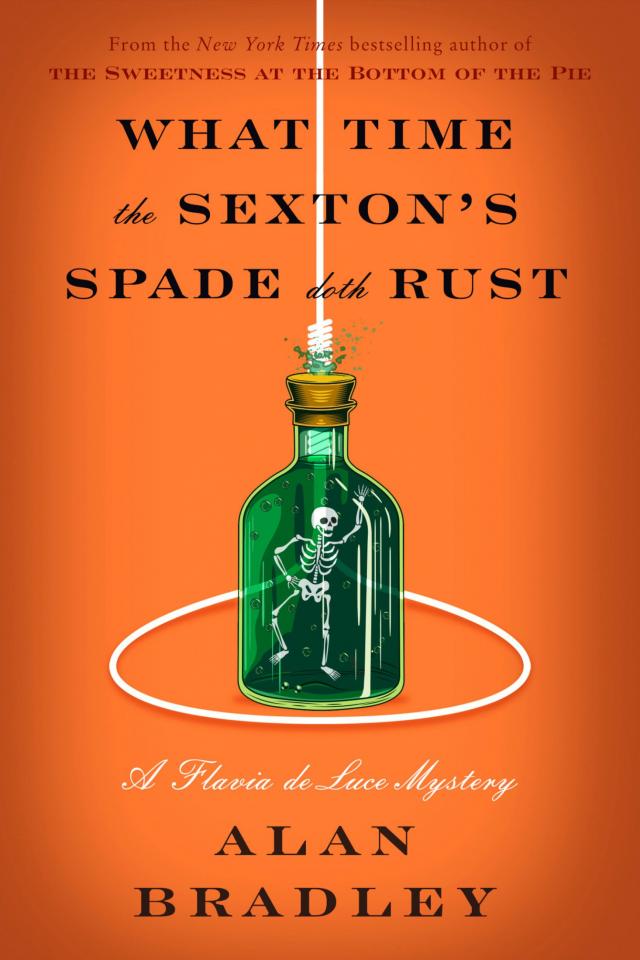
What Time the Sexton’s Spade doth Rust
“I love the Flavia de Luce novels! I identify, though I unfortunately didn’t have an Uncle Tarquin and was forced to make do with a Christmas chemistry set from the Sears catalog. Flavia is the best female detective I’ve ever read, full of realism, self-confidence, and emotion (in roughly equal parts), and her tales are hilarious, engaging, and occasionally heartbreaking.”
—Diana Gabaldon, #1 New York Times bestselling author of the Outlander series
“To say I am overjoyed by the return of the magnificent Flavia is a massive understatement. It is a great day when we have her back in our lives with a new, and riveting, crime to solve. Brava, Flavia. Bravo, Alan!”
—Louise Penny, #1 New York Times bestselling author of the Inspector Gamache series
“Cozy mystery fans will love this latest delightful installment featuring Flavia de Luce, Alan Bradley’s plucky and spirited protagonist.”
—Nita Prose, #1 New York Times bestselling author of The Maid
The Golden Tresses of the Dead
New York Times bestseller
USA Today bestseller
Publishers Weekly bestseller
Indie bestseller
“Delightful…The mysteries in Mr. Bradley’s books are engaging, but the real lure is Ms. de Luce, the irreverent youngster.”
—The Wall Street Journal
“A ghoulish question is at the heart of Bradley’s excellent tenth Flavia de Luce novel…. Bradley, who has few peers at combining fair-play clueing with humor and has fun mocking genre conventions, shows no sign of running out of ideas.”
—Publishers Weekly (starred review)
“Flavia’s over-the-top use of alliteration…and proudly precocious, sesquipedalian vocabulary…along with the thoroughly endearing cast of characters, make this series’ tenth installment a laugh-out-loud winner.”
—Booklist (starred review)
The Grave’s a Fine and Private Place
New York Times bestseller
Publishers Weekly bestseller
Indie bestseller
“Outstanding…As usual, Bradley makes his improbable series conceit work and relieves the plot’s inherent darkness with clever humor.”
—Publishers Weekly (starred review)
“As those of us with Flavia-mania know from previous books, the plucky adolescent is terrifically entertaining—the world’s foremost brainiac/chemist/sleuth/busybody/smarty-pants. Nobody can touch her in that category.”
—The Seattle Times
“[Bradley] lets Flavia be her hilarious, inimical best, and perfectly captures village life in 1950s Britain. Historical fiction and mystery readers alike are sure to rejoice at getting to spend another afternoon in Flavia’s agreeable world.”
—Shelf Awareness
Thrice the Brinded Cat Hath Mew’d
New York Times bestseller
USA Today bestseller
LibraryReads pick
“Bradley’s heroine is one of the most delightful, and one of the sharpest, sleuths to come along in a long, long time.”
—Alfred Hitchcock Mystery Magazine
“The preteen version of Miss Marple…In addition to the meticulous investigations, what makes these novels, including this eighth in the series, so enjoyable is the personality of the primary character who, while being a murder investigator savant, is also an emotionally vulnerable little girl. It is a very unusual combination…and it works.”
—Mystery Scene
As Chimney Sweepers Come to Dust
New York Times bestseller
Indie bestseller
Publishers Weekly bestseller
LibraryReads pick
“Eleven-year-old Flavia de Luce, perhaps contemporary crime fiction’s most original character—to say she is Pippi Longstocking with a Ph.D. in chemistry (speciality: poisons) barely begins to describe her—is finally coming home.”
—Maclean’s
“Even after all these years, Flavia de Luce is still the world’s greatest adolescent British chemist/busybody/sleuth.”
—The Seattle Times
The Dead in Their Vaulted Arches
#1 Library Journal pick
New York Times bestseller
Indie bestseller
“Bradley’s latest Flavia de Luce novel reaches a new level of perfection…. These are astounding, magical books not to be missed.”
—RT Book Reviews (Top Pick)
“Young chemist and aspiring detective Flavia de Luce [uses] her knowledge of poisons, and her indefatigable spirit, to solve a dastardly crime in the English countryside while learning new clues about her mother’s disappearance.”
—National Public Radio
Speaking from Among the Bones
“The precocious and irrepressible Flavia continues to delight. Portraying an eleven-year-old as a plausible sleuth and expert in poisons is no mean feat, but Bradley makes it look easy.”
—Publishers Weekly (starred review)
“Bradley’s Flavia cozies, set in the English countryside, have been a hit from the start, and this fifth in the series continues to charm and entertain.”
—Booklist
I Am Half-Sick of Shadows
“Every Flavia de Luce novel is a reason to celebrate, but Christmas with Flavia is a holiday wish come true for her fans.”
—USA Today (four stars)
“A delightful read through and through.”
—Library Journal (starred review)
A Red Herring without Mustard
“Think preteen Nancy Drew, only savvier and a lot richer, and you have Flavia de Luce.”
—Entertainment Weekly
“Delightful…The book’s forthright and eerily mature narrator is a treasure.”
—The Seattle Times
“Bradley’s characters, wonderful dialogue and plot twists are a most winning combination.”
—USA Today
The Weed that Strings the Hangman’s Bag
“Flavia is incisive, cutting and hilarious…one of the most remarkable creations in recent literature.”
—USA Today
“The real delight here is her droll voice and the eccentric cast…. Utterly beguiling.”
—People (four stars)
The Sweetness at the Bottom of the Pie
THE MOST AWARD-WINNING BOOK OF ANY YEAR!
WINNER:
Macavity Award for Best First Mystery Novel
Barry Award for Best First Novel
Agatha Award for Best First Novel
Dilys Award
Arthur Ellis Award for Best Novel
Spotted Owl Award for Best Novel
CWA Debut Dagger Award
“Impressive as a sleuth and enchanting as a mad scientist…Flavia is most endearing as a little girl who has learned how to amuse herself in a big lonely house.”
—Marilyn Stasio, The New York Times Book Review
“Sophisticated, series-launching…It’s a rare pleasure to follow Flavia as she investigates her limited but boundless-feeling world.”
—Entertainment Weekly (A-)
“A delightful new sleuth. A combination of Eloise and Sherlock Holmes…fearless, cheeky, wildly precocious.”
—The Boston Globe
By Alan Bradley
Flavia de Luce Novels
The Sweetness at the Bottom of the Pie
The Weed That Strings the Hangman’s Bag
A Red Herring Without Mustard
I Am Half-Sick of Shadows
Speaking from Among the Bones
The Dead in Their Vaulted Arches
As Chimney Sweepers Come to Dust
Thrice the Brinded Cat Hath Mew’d
The Grave’s a Fine and Private Place
The Golden Tresses of the Dead
What Time the Sexton’s Spade Doth Rust
Flavia de Luce Stories
The Curious Case of the Copper Corpse
What Time the Sexton’s Spade Doth Rust is a work of fiction. Names, characters, places, and incidents are the products of the author’s imagination or are used fictitiously. Any resemblance to actual events, locales, or persons, living or dead, is entirely coincidental.
Copyright © 2024 by Amadeus Enterprises, Ltd.
All rights reserved.
Published in the United States by Bantam Books, an imprint of Random House, a division of Penguin Random House LLC, New York.
Bantam & B colophon is a registered trademark of Penguin Random House LLC.
Library of Congress Cataloging-in-Publication Data
Names: Bradley, Alan, author.
Title: What time the Sexton’s spade doth rust / Alan Bradley.
Description: New York : Bantam Dell, 2024. | Series: A Flavia de Luce novel
Identifiers: LCCN 2024006568 (print) | LCCN 2024006569 (ebook) | ISBN 9780593724514 (Hardback) | ISBN 9780593724521 (Ebook)
Subjects: LCSH: De Luce, Flavia (Fictitious character)—Fiction. | Murder—Investigation—Ficti on. | LCGFT: Cozy mysteries. | Novels.
Classification: LCC PR9199.4.B7324 W47 2024 (print) | LCC PR9199.4.B7324 (ebook) | DDC 813/.6—dc23/eng/20240222
LC record available at https://lccn.loc.gov/2024006568
LC ebook record available at https://lccn.loc.gov/2024006569
Ebook ISBN 9780593724521
Cover art and design: Joe Montgomery
randomhousebooks.com
ep_prh_7.0a_148085660_c0_r0
Contents
Dedication
Epigraph
· One ·
· Two ·
· Three ·
· Four ·
· Five ·
· Six ·
· Seven ·
· Eight ·
· Nine ·
· Ten ·
· Eleven ·
· Twelve ·
· Thirteen ·
· Fourteen ·
Acknowledgments
About the Author
_148085660_
For Shirley
What time the sexton’s spade doth rust,
And he must drink his ale on trust.
—“At the End” by Andrew Dodds
· One ·
The greatest minds in the world are often cranky when they first awaken in the morning, and mine is no exception. If I am to ascend above the ordinary, I require solitude the way a balloon needs helium.
Which is why, barely a quarter of an hour after a hasty and solitary breakfast at Buckshaw, I am hunched under a black umbrella in the ancient churchyard of St. Tancred’s: the only place I can be certain of being left alone and in peace.
There is a particular kind of graveyard soil that bubbles when it rains. I have my own theory about the cause of this phenomenon but have come here for further study before committing my thoughts to paper.
In my experience, nothing is more deeply refreshing than to huddle under a bumbershoot in the rain and the raw fog of a country graveyard. Bare inches above your head, the downpour drums a military tattoo on the taut black silk as your nose greedily drinks in the invigorating pong of tombstones, wet grass, and ancient moss: a smell that opens doors in your mind you didn’t even know you had.
Churchyard moss is soft to sit on—but wet. Mrs. Mullet says I’ll get rheumatism and need to have my bones replaced.
It may sound cold and clammy, but there is a special warmth in knowing that you are utterly alone—except for the dead.
With the dead, there are no sudden rages; no fits of hissing savagery; no flung plates or cutlery; no petulant sulks or towering rages. Just beneath your feet the deceased are being devoured by fat black beetles, in a vast and grand banquet, while merry mushrooms digest the welcome leftovers of coffin wood. It is a world of harmony and dark contentment, a world of quiet grace and beauty. It is a happy dance of death.
I thought about the year I had sent up an armful of skyrockets from a remote corner of this same churchyard on All Souls’ Night, each labeled by hand with the name of one of the nearby but almost forgotten dead:
Blam!
That was Nettie Savage (1792–1810).
Kaboosh!
Samuel Pole (1715–1722).
Blassh! Arden Glassfield (1892–1914).
Boom! Poom! Poom! A triple salvo for Annie Starling, Spinster of this Parish (1744–1775).
Unfortunately, one of Annie’s fuses had come down in the gutters of the church, igniting a stupid cluster of accumulated moss and debris and thus setting on fire the House of God. The Bishop’s Lacey Fire Brigade had to be called to extinguish the small but fierce blaze. Father had expressed his displeasure by requiring me to make a monthly donation to the Fireman’s Fund, which, since it was ultimately his money, was no hardship at all. The tough thing was that I had to deliver each donation in person, which at first was excruciating and made me feel like a worm, but in the end I got to know a lot of firemen and learn the chemistry of quenching blazes.
Oh, those days of glory! And oh, to have them back again!
These days, my only friends are fungi.
* * *
—
Sometimes, when I can’t sleep, I pretend that I myself am a fungus, creeping silently and unobserved along some slimy moonlit surface, greedily feeding on unsuspecting bits of bark, smacking my fungus lips as only a fungus can smack them.
Smack! A nice bit of pine needle. Smack! A taste of bitter willow. Smack! An unexpected splinter of coffin lid, with its faint bouquet of formaldehyde. Encouraged, I move on, hoping for something more meaty.
And so on and so forth…until I fall into a gray and groggy sleep.
Which brings us back to St. Tancred’s churchyard in the rain.
I needed time alone.
“Flavia!”
Oh, jellied curses! It was Undine, my pestilent little cousin: the Bane of Buckshaw. How had she found me? I had tucked my trusty bicycle, Gladys, away in the church porch, both to keep her dry (Gladys loves running in the rain, but hates standing in it) and to keep her from unwelcome eyes.
I squatted even more deeply, scrunching my body slowly, as much as I was able, as if doing so would make me smaller, or maybe even invisible. Perhaps the pest would mistake my wet umbrella for part of a black marble tomb.
“Flavia!”
I held my breath and gritted my teeth. In her mackintosh and waterproof hat, she looked like an apprentice ghoul.
But she had spotted me.
“What is it, oh precious one?” I finally managed, brushing a raindrop from my eyelid.
She was looking at me, mouth agape, as if I had just climbed down from the sky on a golden rope.
“Why do you insist on following me everywhere?” I asked.
“ ’Cause I’m your crocodile,” she hissed, snapping her jaws and making a ghastly clicking noise with her throat. “Tick-tock. Tick-tock.”
“Kiss my crumpet,” I said.
“You’re nuts,” she said. “Do you know that? You’re nuts.”
My gorge, as they say, was rising. I bit my tongue.
“I want us—you and I—to take an oath, right here and now,” I told her, “on the sacred tomb of Saint Tancred, so to speak, to be kinder and more gentle with each other. We’re both orphans, remember, and orphans ought to stick together. Do you know what I mean?”
“Yowza!” she said enthusiastically.
“Don’t say ‘yowza,’ ” I said. “It makes you sound like a ventriloquist’s dummy. You’re spending too much time with Carl Pendracka.”
Carl was one of my sister Ophelia’s former suitors: an American serviceman from St. Louis, Missouri, by way of Cincinnati, Ohio. Carl’s childhood had been, in his own words “seasonally migratory.” Although Carl’s ardor had been dampened somewhat by Feely’s marrying one of his rivals, he nevertheless had taken to hanging round Buckshaw again after the wedding, perhaps, as my other sister, Daffy, suggested: “in search of smaller game.”
“Carl is a swell guy,” Undine said. “He’s teaching me to fart ‘Hail to the Chief.’ ”
“Undine! Don’t be coarse.”
“I wanted him to teach me ‘Rule Britannia’ but Carl said that’s a concert piece, and too risky for a beginner. You have to work up to it, like the Triple Splutterblast. So far, I’ve only mastered the Baby Duck. Carl says I need to learn to release the contralto and avoid squizzlers. So, I come here to practice sometimes. In case of an accident, you know. Say, Flavia, here’s a riddle for you: What’s white, has a handle, and flies?”






